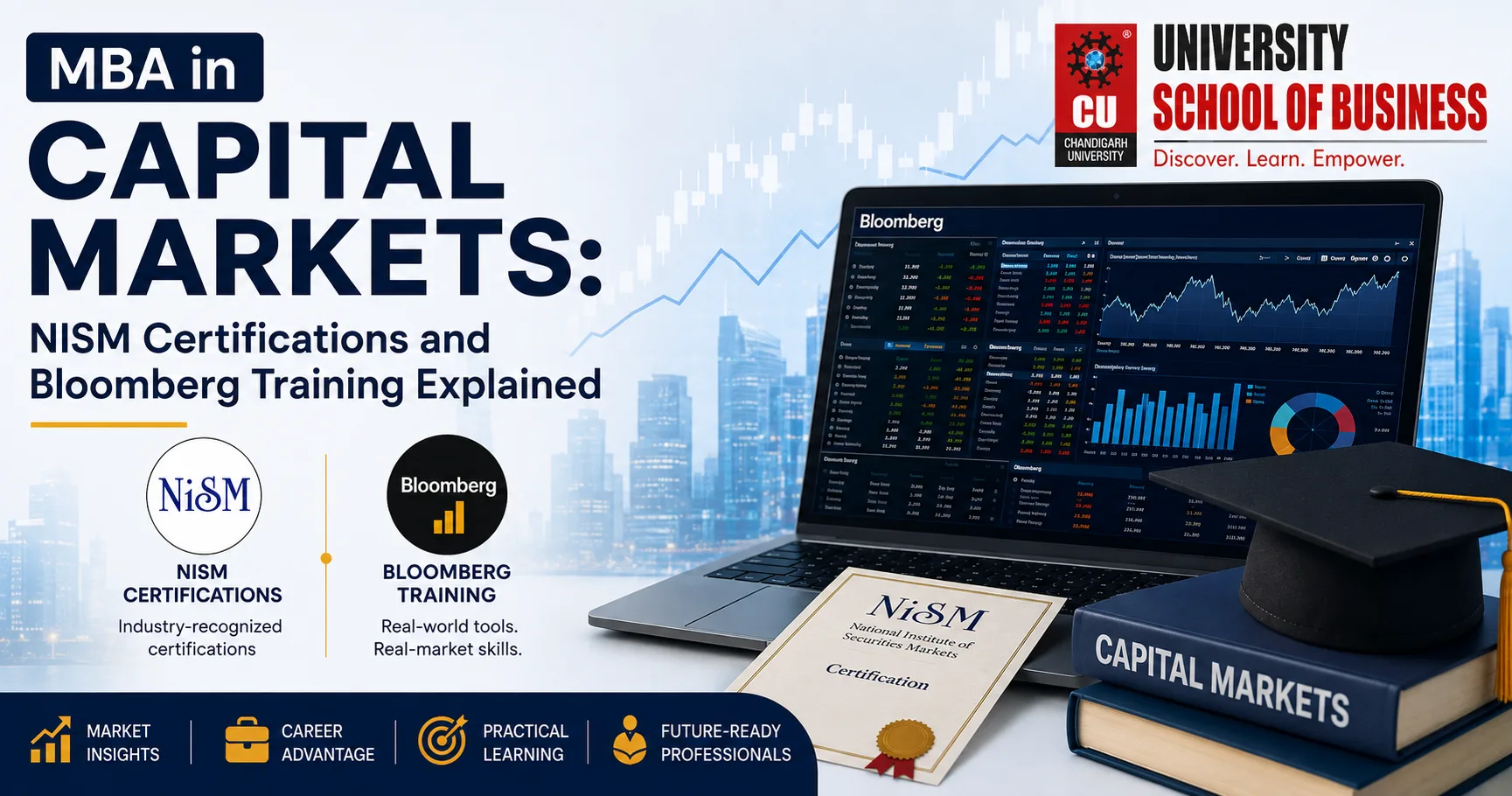
The finance industry is evolving rapidly. Today's employers look for professionals who not only understand financial concepts but can also apply them using industry-recognized certifications and advanced financial tools. This is why an MBA in Capital Markets stands out, compared to the more usual finance programs.
An MBA in Capital Markets mixes classroom learning with real-world exposure to stock market analysis, investment analysis, portfolio management, and financial technology. , and even financial technology. Among the most useful parts of this specialization, you’ll see NISM Certifications and Bloomberg Terminal Training. When these are taken together, they make it easier for students to build job-ready, practical skills, and also raise their employability in that tough, competitive financial space.
In this blog, we’ll break down how these certifications, and training tracks in general, add more value to an MBA in Capital Markets.
Understanding Capital Markets
Capital markets are financial markets where companies, governments, and other organizations raise capital through instruments such as stocks, bonds, and other securities. Capital markets play a vital role in economic development by connecting investors with organizations that require capital for growth and expansion.
If you look at the people working in capital markets, they might get involved in a few different things like, equity research and analysis… also investment banking and portfolio and wealth management. Then there’s trading and brokerage services, and of course risk management. Some professionals also do financial consulting and advisory services , financial advisory services.
So to succeed in these areas, students don’t only need theory, they also need hands-on industry exposure, and some real-world practice, even if it starts small.
What are NISM Certifications?
The National Institute of Securities Markets, or NISM, is an educational initiative that was brought in by the Securities and Exchange Board of India (SEBI). NISM certifications are widely recognized in the financial services space, and they validate a professional’s understanding across multiple market segments.
For students doing an MBA in Capital Markets, these NISM certifications provide a strong foundation in securities markets and they also help with better job opportunities.
Why NISM Certifications matter
In the BFSI sector, employers tend to gravitate toward candidates who already carry industry-recognized qualifications, not just degrees on paper.
There are several benefits of NISM certifications, such as
- Enhanced credibility with recruiters
- Better understanding of market regulations
- Practical industry knowledge
- Competitive advantage during placements
- Improved career opportunities in financial services
At the end of the day these certifications show that students have both the understanding and the kind of professional competence that employers actually look for.
What is Bloomberg Terminal training?
The Bloomberg Terminal is one of the world's most widely used financial information platforms worldwide. It provides real-time market data, updated news, details about companies , economic indicators, plus a comprehensive suite of analytical tools that people depend on daily.
Because of that, investment banks , asset management firms, research groups, and all kinds of financial institutions around the globe use Bloomberg when they need to make decisions.
And with Bloomberg training, MBA students get the chance to understand how finance professionals actually examine and make sense of market data, in more practical, real world scenarios.
Skills Students Develop Through Bloomberg Terminal Training
Bloomberg Terminal Training provides students with practical exposure to financial markets through hands-on learning and real-time market analysis.
Real-Time Market Analysis Students start by tracking stock prices while also monitoring market trends, and then they move on to analyzing economic signals, plus studying world financial markets too.
Financial Research ,Through the platform students can access company reports , compare sector performance , and conduct financial analysis. They also get to evaluate investment opportunities , and in the end they’re ready to make informed investment decisions based on financial data.
How NISM and Bloomberg Training mix in with an MBA in Capital Markets
An MBA gives you the big picture of finance, yet NISM certifications and Bloomberg training provide practical industry exposure, plus the real industry atmosphere.
With both, learners usually end up:
- Gain a deeper understanding of financial markets
- Develop analytical thinking
- Build technical competence
- Strengthen decision-making skills
- Improve professional confidence
Overall, it makes an easier bridge between what you learn in class and what the industry actually expects, so it doesn’t feel so theoretical all the time.
Portfolio Management In this part students learn how to create investment portfolios and measure performance. They’ll look at risk-return relationships, and then make informed investment decisions based on financial data and market trends.
Professional Data Interpretation Overall the Bloomberg training builds the ability to interpret complicated financial information quickly , and still keep it accurate. That kind of fast comprehension is highly valued by employers.
Why Industry Exposure actually matters
These days most employers expect you to be job-ready from day one, not just theoretically. So components that are Industry-focused learning experiences such as Bloomberg Terminal Training, NISM certifications, live projects, market simulations, industry visits, and internships significantly improve students' practical knowledge and employability.
They help students get practical understanding of how financial markets work in the real world, not only in slides. And that kind of exposure often makes graduates feel more self-assured, more employable, and better ready for those day-to-day challenges.
Why Choose MBA in Capital Markets at University School of Business, Chandigarh University?
Students benefit from:
- NISM certification preparation
- Bloomberg Terminal training
- Industry-oriented curriculum
- Practical learning through live market simulations
- Expert sessions by finance professionals
- Internship and placement support
- Hands-on exposure to financial markets
Conclusion
An MBA in Capital Markets is more than a usual management degree. Adding NISM certifications, plus Bloomberg Terminal training, enhances the program by providing industry-relevant skills and practical exposure. In a way, students get theoretical clarity and also practical grounding, at the same time.
Even when NISM certifications provide a solid grasp of securities markets and the whole regulatory landscape, the Bloomberg training gives you that direct, real-time exposure to financial numbers and market analysis. Put both together, and you end up with a strong mix that can seriously improve career readiness for investment banking, equity research, wealth management, and other fast-growing areas across finance.
For students who want to shape a strong career in finance, an MBA in Capital Markets with NISM certifications along with Bloomberg training can be a meaningful step toward reaching their professional objectives.
FAQ’s
Q1. What is the importance of NISM certifications in an MBA in Capital Markets?
NISM certifications kind of matter a lot, because they are recognized across the financial industry, and they help a student build practical know-how about securities markets, mutual funds, derivatives, and investment research. At the same time they add a bit more weight to employability, plus professional credibility, like employers tend to look for that.
Q2. What is Bloomberg Terminal training?
Bloomberg Terminal training helps students learn how to get to and interpret live financial data, shifting market trends, company details ,and investment research using one of the worlds leading financial platforms. It’s sort of hands-on in a way, where you practice what you actually would do during work, not just theory.
Q3. Do NISM certifications help in placements ?
Yes , in general they do. A lot of employers in the BFSI sector prefer candidates who have NISM certifications because it shows some industry specific understanding, and also a sort of familiarity with financial rules and how the market actually works day to day.
Q4. What sort of career opportunities show up after an MBA in Capital Markets?
After finishing an MBA program, graduates may move into roles like Equity Research Analyst , Investment Banking professional, Portfolio Manager, Wealth Advisor , Risk Analyst, as well as Financial Consultant at leading financial firms.
Q5. Is Bloomberg training useful for beginners in finance?
Yes. Bloomberg training can be pretty useful for people who are just starting out , especially if you are trying to develop a strong understanding of financial markets and the way research is done. It also covers investment analysis , so you can build a more grounded understanding early on, rather than jump into it blindly. Even if you are new, the whole setup feels helpful for building a successful career in finance.