
Introduction
If you have built more than one AI agent, you have felt this pain. Every tool integration is bespoke: a new function schema for Slack, a different one for Jira, another for the CRM. Swap the underlying model and half of it needs rewriting.
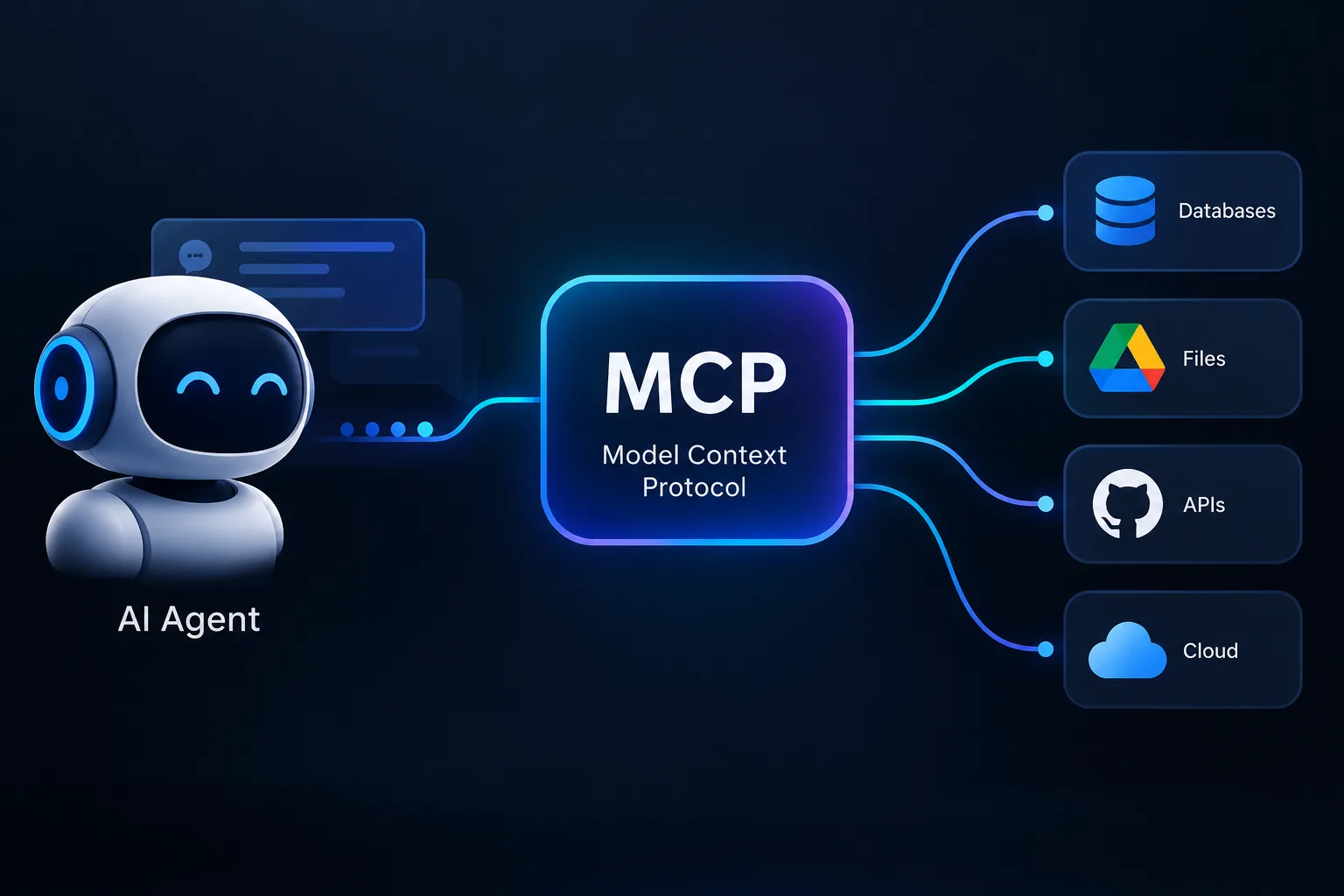
Model Context Protocol (MCP) is the standard that tries to fix this. Instead of custom glue for every model-to-tool combination, you write one MCP server per tool. Any MCP-compatible client (Claude, various IDEs, custom agents) can then use it.
This guide covers what MCP is, why it matters for custom AI agent development, how it fits into a production stack, and when to build your own servers versus adopt what already exists.
What Is Model Context Protocol
MCP is an open specification released by Anthropic in November 2024 and now supported by a growing set of vendors and open-source projects. It defines a JSON-RPC-based way for AI applications ("clients" or "hosts") to talk to external systems ("servers") that expose three things:
- Tools: functions the agent can call (send an email, create a ticket, run a query)
- Resources: read-only data the agent pulls in as context (files, documents, DB rows)
- Prompts: reusable prompt templates the server offers
The protocol handles discovery, invocation, streaming, and permissioning in one consistent shape. Servers run locally over stdio for dev use, or over HTTP with SSE for hosted deployments.
Before MCP, connecting M models to N tools meant M × N adapters. MCP flips that: M clients + N servers, each side implementing the protocol once. That is the whole business case.
Why MCP Matters for Custom AI Agent Development
Three reasons.
Portability. Move from one model provider to another without rewriting your tool layer. In a market where frontier models leapfrog each other every few months, that is a real hedge.
Reuse. A well-built MCP server (say, one that wraps an internal ticketing system) can be shared across every agent your team ships, and across teams. This changes the economics of AI Agent Development Services: one server pays back over many use cases.
Ecosystem. Public MCP servers already exist for GitHub, Slack, Google Drive, Postgres, and many niche tools. For non-sensitive workloads, you get integrations "for free." For sensitive systems, most teams that hire AI agent developers still write internal servers.
The MCP Architecture in Practice
An MCP host is the application the user interacts with (a chat UI, an IDE, a custom agent). Inside the host, an MCP client manages connections to one or more MCP servers. Servers expose the tools and resources described above.
Two transports matter today: stdio (server runs as a subprocess of the host, best for local dev and desktop apps) and HTTP with SSE (server runs as a hosted service, best for team and production deployments).
The protocol also supports session state, capability negotiation on connect, and a "sampling" feature that lets a server ask the client's LLM to generate text as part of a workflow. Underused today, and where interesting agent patterns will emerge next.
Real-World Use Cases
Internal knowledge agent. One MCP server wraps Notion, Google Drive, and Confluence. The agent can search and cite across all three. Add a new source? Extend the server. Add a new agent? Point it at the same server.
Developer workflow agent. MCP servers for GitHub, the local file system, and CI let a coding agent open PRs, run tests, and check build status. Teams that hire AI agent developers for internal tooling often start here because the ROI is easy to measure.
Vertical SaaS. A generative AI development company shipping an agent for real estate or healthcare can package domain-specific MCP servers (MLS data, EHR read-only access with audit logs) that customers plug into their preferred client.
How to Use MCP in Custom AI Agent Development
Step 1: Inventory Your Tool Surface
List every external system the agent needs to touch. For each: read or write, sensitivity, rate limits, existing SDK. Group them into "public server exists and is safe to use," "public server exists, but we need to fork or audit," and "must build internally."
Step 2: Start With One Server, One Client
Pick one high-value tool (say, your ticket system) and build an MCP server for it. Wire it into a single client and prove the loop end to end. Faster than designing the whole platform upfront.
Step 3: Add Guardrails Before Scale
Before rolling out beyond a few internal users, add authentication and per-user scoping, log every tool call with input/output/latency, add rate limits and cost tracking, and write an evaluation set of realistic tasks so you can tell when changes regress behavior.
Step 4: Ship Internal Servers as First-Class Products
Treat each internal MCP server like a shared library: owner, changelog, versioning, deprecation policy. Skip this and three teams end up maintaining three slightly different Slack servers.
Build In-House or Hire an AI Agent Development Company
Should you write MCP servers yourself or bring in outside help? It depends.
In-house makes sense when the tool is proprietary or sensitive, you have the engineers, and the integration is central to your product. Owning your MCP surface is like owning your API: strategic.
Outside help makes sense when you need to move fast, the tools are standard, or your team has no LLM experience. An AI agent consultant or an established AI Agent Development Company can stand up servers and clients in weeks rather than quarters. Firms with published case studies (LeewayHertz AI development is a commonly cited example) share reference architectures worth studying even if you do not hire them. Many teams also hire AI developers in India for the build phase and keep spec ownership internal, balancing cost and control.
Vet vendors on protocol experience specifically. MCP is new enough that generic "AI agent development" experience is not the same as "we have shipped MCP servers to production."
What to Watch For
MCP is evolving. The spec has changed meaningfully since launch, and clients differ in what they actually support. Pin your server to a spec version, test against the clients you care about, do not assume every client supports sampling or resource subscriptions, and audit any public server before putting it near production data.
Conclusion
MCP is not magic. It is the boring, correct answer to a real problem: too many custom integrations, too little reuse, too much rewrite risk when models change. Teams doing serious custom AI agent development are already treating MCP servers as permanent infrastructure, next to internal APIs and shared libraries.
Ready to start? Pick your highest-friction tool, spec an MCP server for it, and get it in front of one agent this week. If you need help, brief two or three AI Agent Development Solutions providers with real MCP work and compare reference architectures, not pitch decks.
Frequently Asked Questions
1. What is Model Context Protocol (MCP) in simple terms?
An open standard for how AI agents talk to external tools and data. Think USB for AI: one plug shape, many devices.
2. Who created MCP?
Anthropic released the initial specification in November 2024. It is open source, and adopters now extend beyond Anthropic.
3. Is MCP tied to Claude?
No. Claude was the first major client, but the spec is open, and adopters include IDE vendors, custom agent frameworks, and third-party hosts.
4. Do I need MCP if I only use one LLM?
Not strictly. But even in a single-model shop, MCP gives you a clean tool-reuse layer across agents and cuts rewrite risk when you eventually switch or add models.
5. How does MCP compare to OpenAI function calling?
Function calling is a model-specific API for invoking tools. MCP is a transport-level standard for how any client and any server discover and exchange tools, resources, and prompts. Complementary, not competing.
6. Can I use existing public MCP servers in production?
Sometimes. Audit for maintenance activity, auth model, and permission scope. For sensitive systems, most teams write their own or fork.
7. What language should I write an MCP server in?
Official SDKs exist for TypeScript, Python, and several others. Pick whichever your team already ships services in.
8. How does MCP change what an AI Agent Development Company delivers?
Deliverables split into servers, clients, and orchestration logic instead of a monolithic agent. Ask for each piece separately in the SOW.
9. Is MCP ready for production?
For internal tooling and controlled deployments, yes. For high-scale customer-facing systems, do your own load and security testing; the ecosystem is still maturing.
10. Build in-house or hire AI agent developers for MCP work?
Score each candidate tool on sensitivity, complexity, and reuse. High sensitivity or high reuse: build in-house. Low sensitivity and one-off: outside help is fine.