
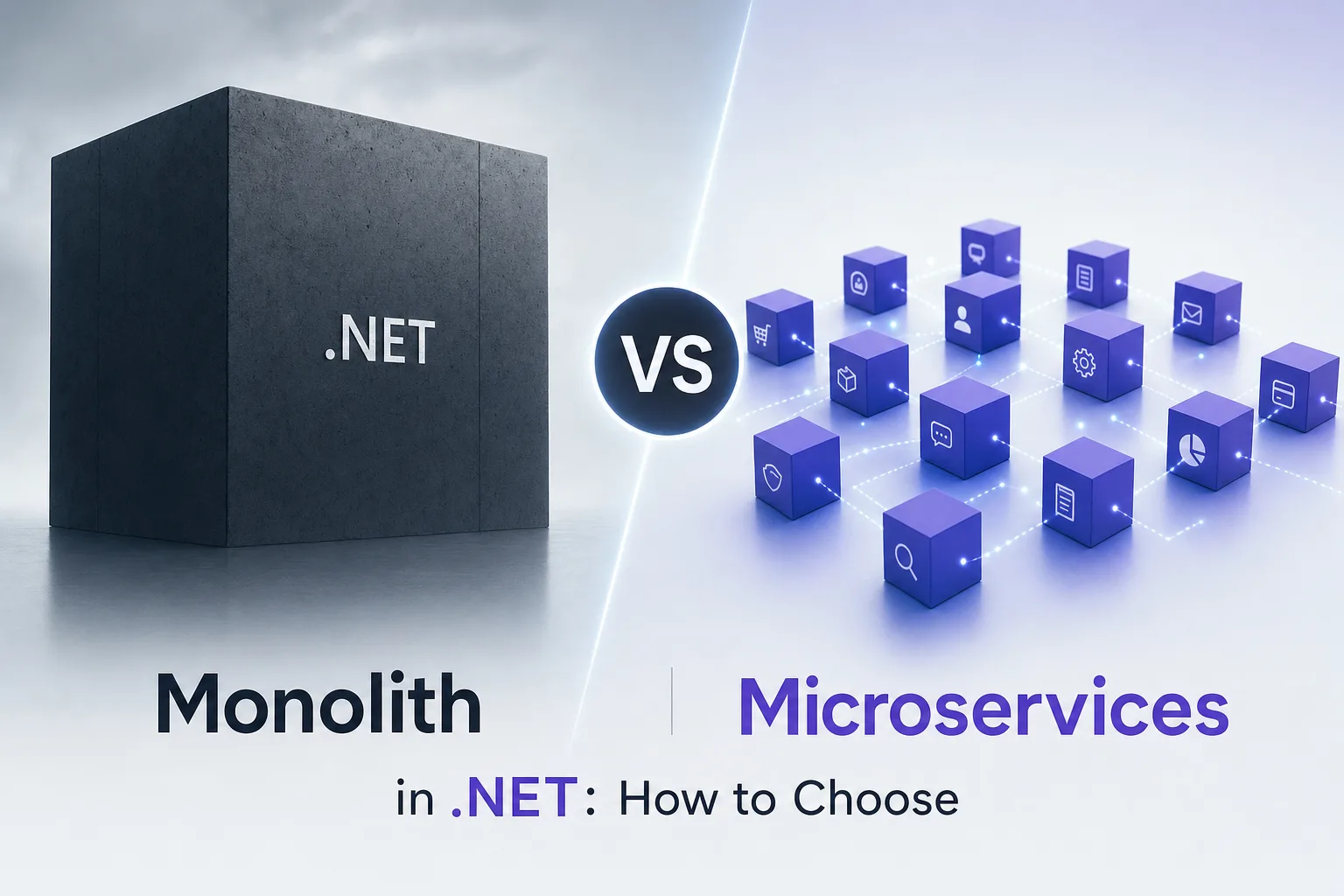
Every .NET architect eventually faces the same fork in the road: build one cohesive system, or split it into services that talk to each other? The wrong call costs months. Pick microservices too early and you are managing distributed complexity before your product is even stable. Stick with a monolith too long and you have a codebase nobody wants to touch.
This guide cuts through the noise. It covers what actually separates these two approaches in a .NET context, when each one makes sense, and how experienced teams think through the decision.
What We Are Actually Comparing
The Monolith
A monolithic .NET application is a single deployable unit. Your controllers, business logic, and data access layer all live in one codebase, typically one ASP.NET project. Everything runs in the same process.
This gets a bad reputation, but a well-structured monolith is fast to build, easy to debug, and straightforward to deploy. Inter-module calls are just method calls, not network requests. There is no distributed tracing to set up, no message broker to maintain.
The problems surface at scale: when multiple teams are stepping on each other's code, when a single slow feature drags down the whole app, or when you need to scale one part independently but cannot because everything deploys together.
Microservices
Microservices split your application into independently deployable services, each owning its own data and logic. In the .NET ecosystem, you might have an Order Service in ASP.NET Core, a Notification Service, a Payment Service, all communicating over HTTP or a message queue like RabbitMQ or Azure Service Bus.
The benefit is isolation. Teams can deploy their service without touching anyone else's. A spike in order volume does not affect the notification queue. You can rewrite one service in a newer framework without migrating the whole app.
The cost is real: network latency between services, distributed transaction headaches, a much heavier DevOps footprint, and the need to instrument everything for observability.
When a Monolith Is the Right Call
Early-Stage Products
If you are still figuring out product-market fit, building with microservices is borrowing complexity from a future that might not exist. A custom .NET development company working with a startup will almost always start with a well-structured monolith using ASP.NET Core and a clean layered or modular architecture.
You can still write modular code inside a monolith. Separate your concerns by domain (Orders, Inventory, Users), keep interfaces clean, and avoid tight coupling. If you eventually need to extract a service, you will have a much easier time.
Small Teams
Microservices assume you have enough people to own each service. A team of three engineers running five services is not enabling autonomy, it is creating toil. Each service needs its own CI/CD pipeline, its own monitoring, its own deployment configuration.
For small teams shipping .NET applications, a single deployable application with good internal structure is almost always the better tradeoff.
Consistent, Low-Scale Domains
An internal HR tool, a document management system, a B2B portal with predictable traffic: these are not microservices candidates. The operational complexity of distributed services is rarely worth it when your load is steady and your team is the primary user.
When Microservices Make More Sense
Large Teams, Multiple Domains
The original argument for microservices is organizational, not technical. When you have separate teams owning distinct business domains (payments, fulfillment, catalog), service boundaries create deployment independence. One team can ship without coordinating with three others.
In ASP.NET application development services for enterprise clients, this is where microservices pay off. Large engineering organizations with clear domain ownership and mature DevOps practices benefit from the isolation that separate services provide.
Wildly Different Scaling Requirements
If one part of your system receives ten times the traffic of everything else, a monolith forces you to scale the whole thing. Microservices let you run ten instances of your Product Search service and one instance of your Admin service.
This is a genuine advantage when traffic is uneven across domains. But be honest about whether you actually have that problem before designing for it.
Compliance and Data Isolation
Some domains carry stricter requirements. A payment processing module that needs PCI compliance may be better isolated as its own service with its own database, its own network rules, and its own audit trail. The same logic applies to HIPAA-regulated health data. Isolation in this context is not about scale, it is about reducing your compliance surface.
The Middle Path: Modular Monolith
There is a third option that does not get enough credit. A modular monolith is a single deployable unit internally organized by domain modules with strict boundaries enforced at the code level. Each module owns its own models, services, and database schema. Modules communicate through defined interfaces, not direct class references.
In .NET, this maps well to separate projects within a solution, each representing a domain boundary. You get most of the organizational benefits of microservices without the distributed systems overhead.
When the day comes that one module genuinely needs to be its own service, you extract it. The boundaries are already there.
Teams working with a custom .NET development company on ASP.NET development services often start here when the product is past MVP but not yet at the scale where independent deployments are needed.
What the Decision Actually Comes Down To
Ask these four questions before committing to either architecture:
1. How many teams will own this system? One team: monolith or modular monolith. Multiple teams with separate domains: microservices starts to make sense.
2. Do you have a mature DevOps practice? Microservices without good CI/CD, container orchestration (Kubernetes or Azure AKS), and observability tooling become a maintenance nightmare. If your deployment story is not solid, hold off.
3. Are your service boundaries clear? The hardest part of microservices is getting the boundaries right. If you are not sure where one service ends and another begins, you will end up with distributed monolith: all the complexity, none of the benefits.
4. What is the cost of getting this wrong? In a funded startup with a one-year runway, the cost of over-engineering early is high. In a multi-team enterprise building a core platform, the cost of under-engineering is also high. Calibrate the decision to your actual risk profile.
A Real-World Example
Consider an e-commerce platform built in .NET Core. At launch, a single ASP.NET application handled catalog, cart, checkout, and user accounts. Within 18 months, the catalog and search functionality had become the performance bottleneck due to product data volume.
Rather than migrating to microservices entirely, the team extracted the Catalog and Search domain as a standalone .NET service, backed by Elasticsearch, while everything else remained in the core application. Two services. The team grew from four to eight engineers, and the architecture grew with it, adding an Order Service when a third team joined to own fulfillment.
This is how most successful architectures evolve: not a big-bang microservices rewrite, but incremental extraction driven by real constraints.
Bringing in the Right Expertise
Architecture decisions carry long-term consequences. Working with an ASP.NET development service company or hiring ASP.NET developers who have built both types of systems gives you the benefit of pattern recognition. They have seen what breaks at scale, what slows down small teams, and where the common .NET architectural traps are.
MetaDesign Solutions works with teams at all stages of this decision, from early-stage product engineering to enterprise modernization of legacy .NET applications. Whether the right answer is a clean monolith, a modular architecture, or a phased migration to distributed services, the approach starts with understanding what you are actually building and who is building it.
Conclusion
There is no universal right answer here. Microservices are not better than monoliths. They are better for specific contexts: large teams, clear domain boundaries, uneven scaling requirements, and mature DevOps capabilities. Outside those conditions, they create more problems than they solve.
Start with the simplest architecture that solves your problem. Build clean boundaries from day one. Extract only when you have a genuine reason to. If you need help getting the architecture right from the start, talk to a team that has done it before.
Ready to make the right call for your .NET application? Talk to MetaDesign Solutions about your architecture.
Frequently Asked Questions
1. What is the main difference between a monolith and microservices in .NET?
A monolith is a single deployable .NET application where all modules share one codebase and process. Microservices splits that into separate, independently deployable services, each with its own database and deployment pipeline. The tradeoff is simplicity versus operational flexibility.
2. Should a startup choose microservices or a monolith in .NET?
Almost always a monolith or modular monolith first. Startups change requirements fast. Microservices lock you into service boundaries before you know what the right boundaries are, and the DevOps overhead slows down early iteration.
3. Can a .NET monolith handle high traffic?
Yes. A well-optimized ASP.NET Core application can handle significant load with caching, async patterns, and horizontal scaling behind a load balancer. Traffic alone is not a reason to switch to microservices.
4. What is a modular monolith in ASP.NET?
A modular monolith is a single deployable application with strict internal domain boundaries enforced through project structure and interfaces. You get clean code organization and easier future extraction without distributed systems complexity.
5. How do microservices communicate in .NET?
Typically via HTTP/REST using ASP.NET Core Web APIs, or asynchronously via message queues like RabbitMQ, Azure Service Bus, or MassTransit. The choice between sync and async communication depends on whether the caller needs an immediate response.
6. What is a distributed monolith and how do I avoid it?
A distributed monolith is what happens when you split an application into services but they are still tightly coupled, meaning a change to one requires changes to others, and they cannot deploy independently. Avoid it by defining service boundaries around business domains, not technical layers.
7. When should a .NET development company recommend microservices?
When there are multiple autonomous teams, clear domain boundaries, uneven scaling needs across subsystems, or specific isolation requirements such as compliance. If none of those apply, a simpler architecture is usually the right recommendation.
8. How do I migrate a .NET monolith to microservices?
Incrementally. Start by identifying the module with the strongest case for extraction, usually due to team ownership, scaling, or compliance. Extract it as a standalone ASP.NET Core service, define the API contract, and migrate dependencies. Avoid rewriting the whole system at once.
9. What tools help manage microservices in the .NET ecosystem?
Docker and Kubernetes (or Azure AKS) for containerization and orchestration. Ocelot or YARP for API gateways. Polly for resilience patterns. OpenTelemetry for distributed tracing. Dapr for service-to-service communication abstraction.
10. Should I hire ASP.NET developers who specialize in microservices or generalists?
Both matter. Generalists who understand clean architecture and domain-driven design are valuable regardless of the deployment model. If you are moving to microservices, you also want engineers with experience in distributed systems, API design, and DevOps practices specific to containerized .NET workloads.