
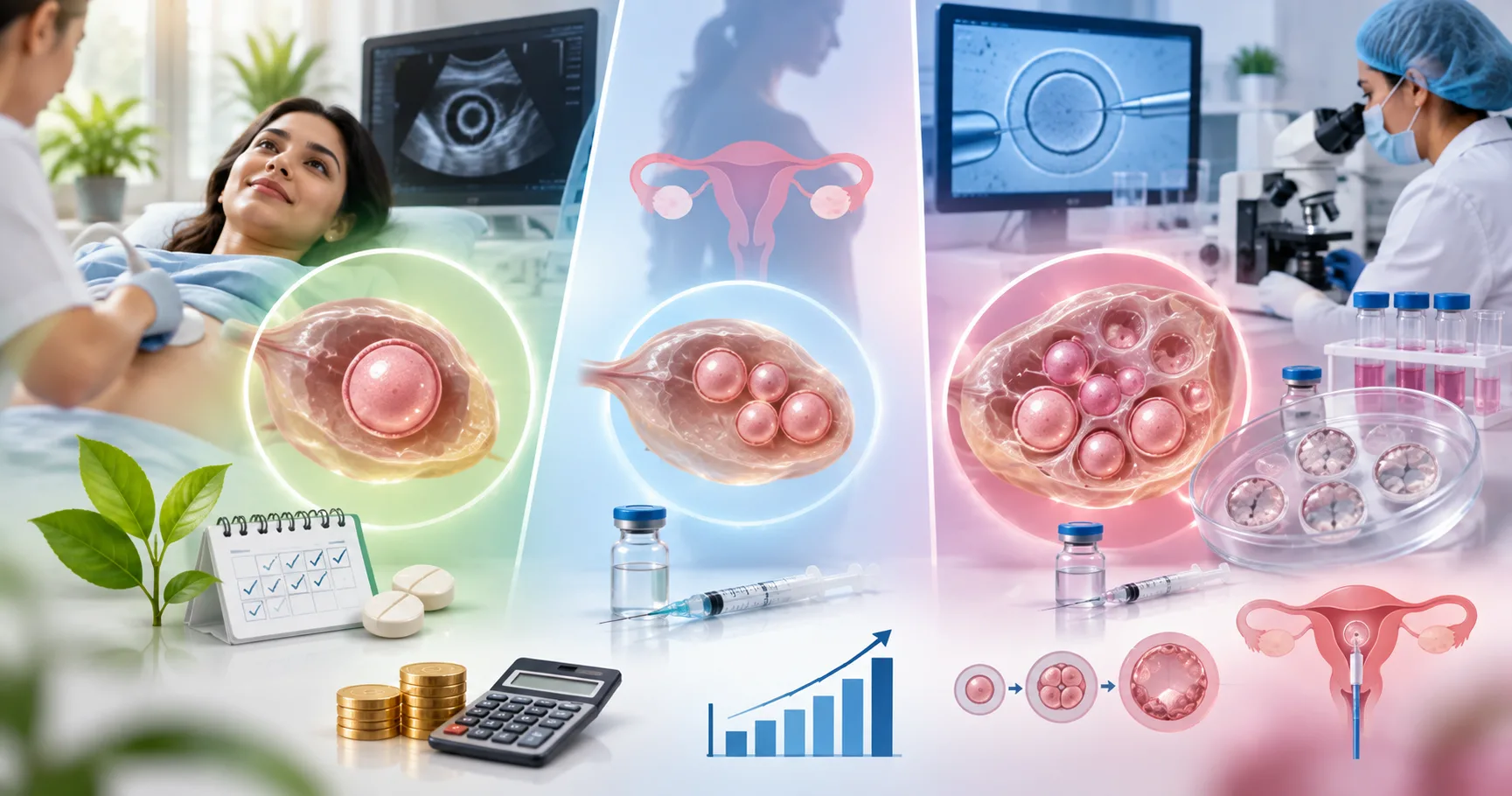
Choosing between natural cycle IVF vs IVF can be confusing because both treatments aim to achieve fertilisation outside the body, but they use ovarian stimulation differently. Natural cycle IVF generally works with the single egg that develops naturally during a menstrual cycle, while conventional IVF uses fertility medicines to stimulate the ovaries and usually retrieve multiple eggs.
There is also mini IVF, sometimes called mild or minimal-stimulation IVF, which sits between these approaches because it uses less ovarian stimulation than conventional IVF.
The right approach depends on factors such as age, ovarian reserve, previous IVF response, fertility diagnosis, sperm factors and the number of eggs expected. There is no single IVF protocol that is appropriate for everyone.
What Is Natural Cycle IVF?
Natural IVF is an IVF approach in which little or no ovarian stimulation medication is used. Instead of stimulating the ovaries to produce several eggs, the treatment monitors the naturally developing dominant follicle.
When the egg is ready, the clinic may use medication to help time ovulation, followed by egg retrieval. The retrieved egg is then fertilised in the laboratory, and if an embryo develops, it may be transferred to the uterus.
Because the body typically produces one dominant follicle during a natural cycle, natural cycle IVF usually results in fewer eggs being available for fertilisation.
What Is Conventional IVF?
In conventional IVF, fertility medicines called gonadotropins are generally used to stimulate the ovaries to develop multiple follicles.
The process commonly involves:
- Ovarian stimulation
- Ultrasound and hormone monitoring
- Trigger medication
- Egg retrieval
- Fertilisation in the laboratory
- Embryo culture
- Embryo transfer or freezing
HFEA describes conventional IVF as usually involving fertility hormones to stimulate the ovaries to produce several eggs before collection.
Producing multiple eggs can provide more opportunities for fertilisation and embryo development within one retrieval cycle.
Natural Cycle IVF vs Conventional IVF: Key Differences
FeatureNatural Cycle IVFConventional IVFOvarian stimulationLittle or noneHigher level of stimulationExpected eggsUsually oneUsually severalMedicationMinimal or noneMultiple fertility medicinesMonitoringRequiredRequiredEgg retrievalUsually one eggMultiple eggs may be retrievedEmbryo opportunitiesMore limited per cyclePotentially more embryos per retrievalMedication costGenerally lowerGenerally higherRisk of ovarian hyperstimulationVery lowPossible, depending on individual responseCycle cancellationCan occur if spontaneous ovulation happensCan also occur for different reasonsSuccess per cycleGenerally lower than conventional IVFDepends on age, diagnosis and treatment factorsThe differences are not simply about medication cost. The number of eggs available can influence the number of embryos that may be created from a single retrieval.
Mini IVF vs IVF
Mini IVF vs IVF is another comparison patients often encounter.
Mini IVF, also called mild or minimal-stimulation IVF, uses lower doses of ovarian stimulation medication than conventional IVF. The objective is generally to obtain a smaller number of eggs while reducing medication exposure.
It is therefore different from a completely natural cycle.
A simplified comparison looks like this:
Natural cycle IVF: little or no stimulation → usually one naturally developing egg
Mini IVF: lower stimulation → several or fewer eggs than conventional stimulation, depending on response
Conventional IVF: stronger stimulation → generally aims to recruit multiple follicles
The exact medication protocol can vary between clinics and patients.
Natural Cycle IVF Success Rate
People often search for the natural cycle IVF success rate, but there is no single percentage that applies to every patient.
Success can be affected by:
- Age
- Ovarian reserve
- Egg quality
- Sperm quality
- Embryo development
- Cause of infertility
- Previous treatment history
- Clinic and laboratory factors
HFEA states that IVF success depends on factors including the patient's age and cause of infertility. Its latest UK statistics report an average IVF birth rate of 30% per embryo transferred in 2024, with substantial differences between age groups.
That figure is not a natural-cycle IVF success rate. It illustrates why general IVF statistics should not be applied directly to a specific natural-cycle protocol.
Evidence comparing natural or modified-natural IVF with conventional stimulation is also limited in some patient groups. ESHRE's 2025 guideline says modified natural cycle treatment is not routinely recommended over conventional stimulation for low responders, while noting that clinicians may consider it in women with very low ovarian reserve.
Natural IVF Success Rate vs Conventional IVF Success Rate
It is tempting to ask which treatment has the higher success rate, but comparing percentages without considering the patient population can be misleading.
Natural-cycle IVF generally produces fewer eggs per retrieval. Conventional IVF aims to produce multiple eggs, potentially creating more embryos from one stimulation cycle.
HFEA reports that success rates vary considerably by age. In 2024, the average birth rate per embryo transferred was 38% for patients aged 18–34 compared with 8% for patients aged 43–44.
Therefore, when discussing natural IVF success rate, patients should ask their fertility specialist for outcomes relevant to their age, ovarian reserve and specific treatment protocol.
Natural Cycle IVF Cost vs Conventional IVF Cost
The natural cycle IVF cost can be lower than conventional IVF because fewer stimulation medicines may be required. However, the total price depends on the clinic, country, monitoring requirements, egg retrieval, laboratory charges, embryo transfer and additional services.
Conventional IVF can have higher medication and monitoring costs because ovarian stimulation is a central part of the treatment.
It is also important to look at the cost per treatment goal rather than simply the price of one cycle. If a natural cycle produces one egg and no transferable embryo, repeated cycles may be required.
A clinic should provide a detailed quotation covering:
- Consultation
- Scans and blood tests
- Medication
- Egg retrieval
- Laboratory and fertilisation charges
- Embryo culture
- Embryo transfer
- Embryo freezing
- Storage
- Additional procedures, if medically indicated
As a reference point, HFEA says the average cost of one IVF cycle in the UK is around £5,000, although costs vary considerably and additional charges may apply. This figure should not be used as an estimate for treatment in another country.
Who May Consider Natural Cycle IVF?
A fertility specialist may discuss natural or modified-natural treatment in situations such as:
- Very low ovarian reserve
- Previous poor response to stimulation
- Medical reasons for avoiding certain medications
- Personal preference regarding stimulation
- Situations where conventional stimulation is unlikely to produce substantially more eggs
However, suitability is individual. ESHRE notes that evidence supporting natural or modified-natural IVF in low responders remains limited.
Potential Advantages and Limitations
Potential Advantages of Natural IVF
- Less ovarian stimulation medication
- Lower medication exposure
- Lower risk of ovarian hyperstimulation
- May be considered when ovarian response to stimulation is expected to be low
Potential Limitations of Natural IVF
- Usually fewer eggs
- Fewer opportunities for embryo development per retrieval
- Cycle cancellation can occur
- Multiple cycles may be needed
- Success rates cannot be assumed from conventional IVF statistics
Potential Advantages of Conventional IVF
- Multiple follicles can potentially be developed
- More eggs may be retrieved in one cycle
- More embryos may be available for transfer or freezing
- Established treatment approach for many infertility situations
Potential Limitations of Conventional IVF
- Requires ovarian stimulation medication
- More monitoring and medication may be involved
- Ovarian hyperstimulation is a potential complication
- Treatment can involve higher costs
Which IVF Approach Should You Choose?
The decision between natural cycle IVF vs IVF should be based on your individual fertility assessment rather than the treatment name alone.
Your doctor may consider:
- Age
- AMH and ovarian reserve
- Antral follicle count
- Previous IVF response
- Sperm parameters
- Infertility diagnosis
- Previous pregnancies or IVF outcomes
- Risk factors associated with stimulation
The goal is to choose a treatment strategy that provides a reasonable opportunity for embryo development while considering safety, cost and the patient's circumstances.
FAQs
Is natural cycle IVF better than conventional IVF?
Neither approach is universally better. Natural-cycle IVF uses little or no stimulation, while conventional IVF aims to produce multiple follicles. Suitability depends on individual fertility factors.
Is mini IVF the same as natural IVF?
No. Mini IVF uses a reduced amount of ovarian stimulation medication, while natural-cycle IVF generally relies on the naturally developing follicle.
Does natural IVF have a lower success rate?
Natural-cycle IVF generally produces fewer eggs, and HFEA notes that success rates for less-medicated IVF approaches tend to be lower than conventional IVF. However, individual outcomes vary considerably.
Is natural cycle IVF cheaper?
It can be cheaper because fewer stimulation medicines may be required, but the total cost depends on the clinic and services included. Multiple cycles may also affect the overall treatment cost.
Can natural cycle IVF produce more than one egg?
Usually, natural-cycle IVF targets the naturally developing dominant follicle, so typically one egg is available. The exact response can vary.
Conclusion
The choice between natural cycle IVF vs conventional IVF involves more than comparing medication use or treatment prices. Natural IVF works with the body's natural cycle and generally produces fewer eggs, while conventional IVF uses ovarian stimulation to obtain multiple eggs.
Mini IVF vs IVF adds another option by using a milder stimulation approach.
Because age, ovarian reserve, sperm quality and previous treatment response can substantially affect outcomes, discuss the expected number of eggs, embryo development, estimated success rate and total treatment cost with a fertility specialist before choosing a protocol.