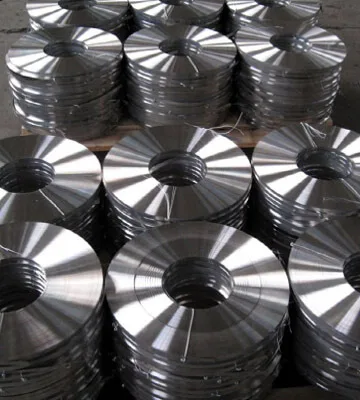
Nickel 270 Strips are made from a high-purity nickel grade known as UNS N02270. This material is produced using powder metallurgy and is known for its high purity, low electrical resistivity, good electrical and thermal conductivity, low base hardness, and high ductility.
Because of these properties, Nickel 270 is used where consistent electrical performance, controlled material chemistry, and high purity are important. Typical applications include electronic components, electrical resistance thermometers, hydrogen thyratron components, cathode-related components, and specialized battery connector applications.
Nickel 270 is available in strip form for applications that require thin, precise nickel material. The exact thickness, width, temper and surface condition should be selected according to the application and manufacturing requirements.
What Is Nickel 270?
Nickel 270 is a high-purity nickel grade with UNS designation N02270 and Werkstoff number 2.4050. It is produced through powder metallurgy, which allows very tight control of impurities.
Nickel Institute data lists Nickel 270 as approximately 99.98% nickel and identifies strip as one of its available forms. It also lists ASTM F specifications associated with this grade.
Special Metals identifies Nickel 270 as UNS N02270 / W. Nr. 2.4050 and specifies ASTM F3 among its major specifications.
The high purity of the grade gives it properties that can be useful in demanding electrical and electronic applications.
Nickel 270 Strip Chemical Composition
The chemistry of Nickel 270 is tightly controlled. A typical specification from Special Metals lists the following limits:
ElementMaximum / MinimumNickel + Cobalt99.9% minCopper0.01% maxIron0.05% maxManganese0.003% maxCarbon0.02% maxSulfur0.003% maxTitanium0.005% maxMagnesium0.005% maxSilicon0.005% maxExact chemistry should always be confirmed against the applicable material certificate and purchase specification.
Key Properties of Nickel 270 Strips
Nickel 270 is selected primarily for its purity and electrical characteristics.
1. High Purity
Nickel 270 has a very high nickel content with tightly controlled residual elements. This makes it suitable for applications where impurities can affect electrical, magnetic or electronic performance.
2. Low Electrical Resistivity
Special Metals reports an electrical resistivity of approximately 0.075 µΩ·m for Nickel 270. Its low resistivity makes it useful for electrical and electronic components where controlled resistance is important.
3. Good Thermal Conductivity
Nickel 270 has a reported thermal conductivity of approximately 86 W/m·°C. This can be useful in components where heat transfer is part of the design requirement.
4. High Ductility
The annealed material can have approximately 50% elongation, depending on the product condition and specification. This makes Nickel 270 suitable for forming operations when the correct temper is selected.
5. Low Base Hardness
One of the characteristics of Nickel 270 is its low base hardness. This is particularly useful where the material needs to be formed into small or intricate components.
6. Corrosion Resistance
Nickel 270 provides good corrosion resistance in many environments. However, the actual suitability of the strip should be evaluated against the specific chemical environment, temperature and operating conditions.
Nickel 270 Strip Technical Properties
Typical values reported for Nickel 270 include:
PropertyTypical ValueUNSN02270Werkstoff No.2.4050DensityApprox. 8.9 g/cm³Melting PointApprox. 1454°CThermal ConductivityApprox. 86 W/m·°CElectrical ResistivityApprox. 0.075 µΩ·mThermal ExpansionApprox. 13.3 µm/m·°CAnnealed Tensile StrengthApprox. 345 MPaAnnealed Yield StrengthApprox. 110 MPaAnnealed ElongationApprox. 50%These values are typical reference values and can vary with product form, processing and material condition. Always use the supplier's certified data for engineering decisions.
Nickel 270 Strip Specifications
Nickel 270 is commonly identified by:
- UNS N02270
- Werkstoff No. 2.4050
- ASTM F3
- Nickel 270 / HPM 270 terminology used by some producers
Special Metals lists ASTM F3 among the major specifications for Nickel 270.
Nickel Institute documentation also identifies Nickel 270 as UNS N02270 and lists ASTM F1, F2 and F3 in relation to Nickel 270 products.
When purchasing Nickel 270 Strip, the buyer should specify the required standard, thickness, width, temper, surface finish, edge condition and quantity rather than relying only on the grade name.
Nickel 270 Strip Sizes
Nickel 270 can be produced as precision strip in thin gauges.
For example, Hamilton Precision Metals lists HPM 270 Nickel strip from 0.0005 inch to 0.020 inch in thickness and widths up to 12 inches.
Other suppliers may offer different size ranges.
Common purchasing specifications include:
- Strip thickness
- Strip width
- Coil length
- Coil weight
- Straight lengths
- Annealed or cold-worked condition
- Slit or mill edges
- Surface finish
For a custom Nickel 270 Strip, buyers should provide a detailed dimensional drawing or specification sheet.