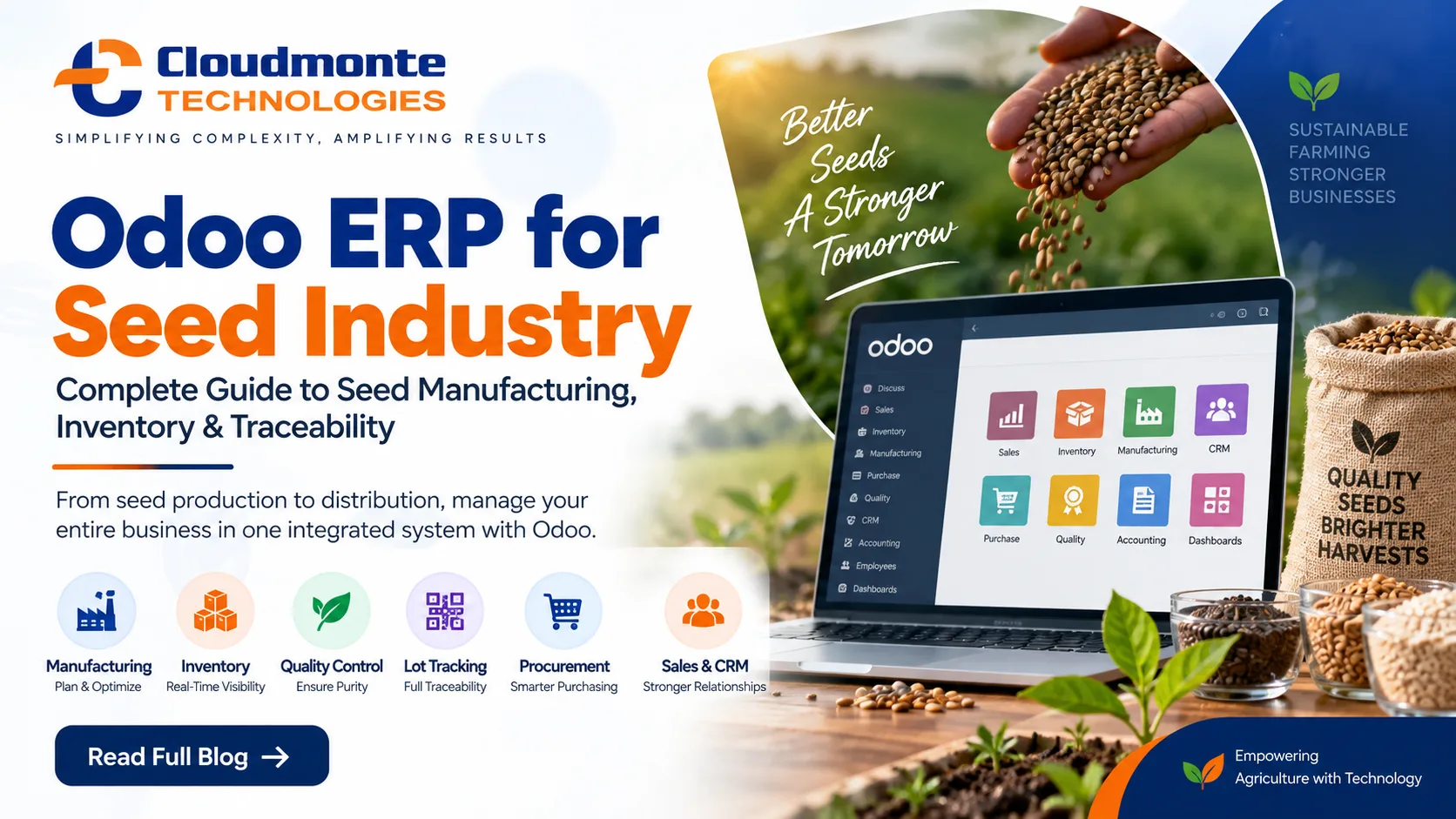
The seed industry operates on a combination of quality, timing, traceability, inventory accuracy, and efficient distribution. From procurement and seed processing to grading, packaging, warehousing, sales, and distribution, every stage needs accurate information and proper coordination.
However, many seed businesses still manage different operations through spreadsheets, disconnected software, paper records, or multiple systems. As the business grows, this can make it difficult to know the actual stock position, track seed lots, monitor production, manage quality checks, coordinate warehouses, and respond quickly to customer or dealer requirements.
This is where an integrated Odoo ERP for Seed Industry can make a significant difference.
Odoo brings manufacturing, inventory, purchase, sales, CRM, accounting, quality, maintenance, and other business processes into a connected ERP environment. For seed manufacturers, processors, distributors, and trading companies, this can create a more structured way to manage operations from procurement to final delivery.
In this guide, we will explore how Odoo ERP software for seed industry can support seed production, processing, inventory management, batch and lot tracking, quality control, supply chain operations, sales, and business growth.
Why Do Seed Companies Need ERP Software?
Seed businesses deal with products that require careful handling and detailed records. A company may manage different varieties, lots, grades, packaging sizes, warehouses, suppliers, dealers, customers, and production activities at the same time.
When these processes are managed separately, several operational problems can occur.
For example:
- Inventory information may not be updated in real time.
- Production teams may not have complete visibility into available materials.
- Tracking a specific seed lot can take unnecessary time.
- Warehouse teams may struggle to identify the right stock.
- Sales teams may not have accurate stock information.
- Procurement decisions may depend on outdated spreadsheets.
- Management may find it difficult to understand overall operational performance.
An integrated Seed Industry ERP Software solution can connect these activities and provide a central source of business information.
Instead of maintaining separate records for production, inventory, purchasing, sales, and customer management, companies can manage these workflows through a connected ERP platform.
How Odoo ERP Supports the Seed Industry
Odoo is a modular ERP platform that allows businesses to manage different functions through interconnected applications.
For a seed company, the ERP environment can be configured around its specific processes, including:
- Seed procurement
- Seed production
- Seed processing
- Quality inspection
- Batch and lot management
- Inventory management
- Warehouse operations
- Packaging
- Purchase management
- Sales management
- Dealer management
- CRM
- Accounting
- Maintenance
- Reporting and analytics
This integrated approach can help seed businesses reduce manual coordination and improve visibility across their operations.
1. Seed Production Management
Production planning is an important part of seed manufacturing.
A seed company may need to plan production based on demand, available raw materials, production capacity, seasonal requirements, and inventory levels.
With Seed Production Management Software, businesses can organize production activities and maintain better visibility into manufacturing operations.
Odoo Manufacturing can help companies manage:
- Manufacturing orders
- Bills of Materials (BOMs)
- Production planning
- Work orders
- Work centers
- Manufacturing operations
- Raw material requirements
- Finished products
- Production costs
- Manufacturing schedules
For example, if a seed company needs to process and package a particular seed variety, production information can be managed within the ERP rather than being maintained across separate spreadsheets.
This creates a more structured workflow from production planning to finished inventory.
2. Seed Processing Management
Seed processing can involve multiple stages depending on the product and business process.
These may include:
Raw Seed → Cleaning → Grading → Treatment → Processing → Packaging → Finished Product
Managing these stages manually can make it difficult to maintain accurate production records.
With Seed Processing Software, businesses can structure these processes within an ERP system.
Odoo can help organizations manage manufacturing operations, work orders, material consumption, and finished goods.
This can provide production teams with better visibility into what is being processed, what materials are being consumed, and what quantities are being produced.
3. Seed Inventory Management
Inventory is one of the most important areas for seed businesses.
Companies may manage:
- Raw seeds
- Processed seeds
- Finished seed products
- Packaging materials
- Consumables
- Different varieties
- Different grades
- Different pack sizes
Without accurate inventory information, businesses can experience stock shortages, excess inventory, inaccurate availability information, and unnecessary purchasing.
A Seed Inventory Management Software solution can centralize inventory information and provide better visibility across locations.
Odoo Inventory can support:
- Real-time inventory visibility
- Multi-warehouse management
- Stock transfers
- Product variants
- Reordering rules
- Inventory adjustments
- Barcode operations
- Lot and batch tracking
- Stock valuation
- Warehouse operations
This allows teams to work with a more consistent view of inventory.
4. Seed Lot and Batch Tracking
Traceability is particularly important in seed operations.
Seed companies may need to identify where a particular lot came from, how it was processed, where it is stored, and where it was ultimately sold or distributed.
This is where Seed Lot Tracking Software becomes valuable.
Odoo supports lot and batch tracking, allowing businesses to associate products with specific lot numbers.
For example:
Supplier → Raw Seed Lot → Processing → Quality Check → Finished Lot → Warehouse → Customer/Dealer
A connected system can make it easier to follow this journey.
If a business needs information about a specific lot, teams can retrieve the relevant records from the ERP instead of searching through multiple spreadsheets or paper documents.
5. Seed Traceability
Seed traceability is closely connected to lot management and quality control.
A well-structured ERP system can help businesses maintain records throughout different operational stages.
For example:
Procurement
Supplier and incoming material information
↓
Processing
Production and processing records
↓
Quality
Inspection and quality results
↓
Packaging
Finished product and packaging information
↓
Warehouse
Storage location and inventory
↓
Sales
Customer or dealer transaction
This connected flow can improve visibility and make it easier to investigate operational issues.
For businesses looking for Seed Traceability Software, an ERP-based approach can provide a centralized system for tracking important product information.
6. Quality Management for Seed Businesses
Quality is a critical consideration in the seed industry.
Depending on the company's processes, quality checks may be required at different stages of production and handling.
Odoo Quality can help businesses organize quality control activities around defined operations.
Possible quality workflows may include:
- Incoming material inspection
- Production quality checks
- Finished product inspection
- Lot-based quality checks
- Quality alerts
- Inspection points
- Corrective actions
- Quality documentation
Instead of keeping quality records separately from production and inventory, businesses can connect quality information with operational processes.
This can help teams build a more consistent quality management workflow.
7. Warehouse Management
Seed companies may operate multiple warehouses or storage locations.
Managing stock across several locations can become complicated when inventory information is maintained manually.
Odoo can support warehouse operations such as:
- Multiple warehouses
- Multiple storage locations
- Internal transfers
- Stock movements
- Receiving
- Delivery operations
- Barcode scanning
- Lot tracking
- Inventory adjustments
For a growing seed company, this can make it easier to understand where inventory is located and how stock is moving through the supply chain.
8. Procurement Management
Seed companies depend on reliable suppliers for raw materials, packaging materials, and other requirements.
Procurement teams need visibility into:
- Supplier information
- Purchase orders
- Product requirements
- Supplier pricing
- Incoming shipments
- Purchase history
- Inventory requirements
Odoo Purchase can connect procurement with inventory and other business processes.
For example, when inventory levels reach predefined thresholds, businesses can use reordering rules and procurement workflows to help maintain stock availability.
This reduces dependence on manually checking multiple spreadsheets before making purchasing decisions.
9. Seed Supply Chain Management
The seed supply chain can involve multiple parties, including suppliers, processing facilities, warehouses, distributors, dealers, and customers.
A Seed Supply Chain Management Software solution should help businesses connect these activities.
With an integrated ERP environment, companies can coordinate:
Procurement → Production → Quality → Inventory → Warehouse → Sales → Distribution
This connected workflow can improve operational visibility and reduce information gaps between departments.
10. Sales and Dealer Management
Seed businesses often work with distributors, dealers, retailers, farmers, and other customers.
Sales teams need quick access to:
- Customer information
- Product availability
- Pricing
- Sales orders
- Previous transactions
- Delivery status
- Customer communication
Odoo Sales and CRM can centralize these activities.
Sales representatives can manage customer information and follow sales opportunities while connecting them with orders and other business processes.
This can be especially useful for companies managing a large network of dealers and customers.
11. CRM for Seed Companies
Customer relationships are important for long-term growth.
A seed business may have different types of customers, including:
- Dealers
- Distributors
- Retailers
- Farmers
- Commercial buyers
- Institutional customers
Odoo CRM can help sales teams organize leads, opportunities, customer activities, follow-ups, and sales pipelines.
Instead of maintaining customer information in separate files, teams can maintain a centralized customer database.
This can help sales teams follow up more systematically and improve visibility into potential business opportunities.
12. Packaging Management
Packaging is another important stage in the seed business.
A single seed variety may be sold in multiple packaging sizes.
For example:
- 100 grams
- 250 grams
- 500 grams
- 1 kilogram
- 5 kilograms
- 10 kilograms
Managing these variations manually can create inventory and order-management challenges.
Odoo product variants and inventory features can help businesses manage different products, packaging formats, and stock requirements within the same ERP environment.
13. Reporting and Business Visibility
One of the biggest advantages of an integrated ERP system is centralized business information.
Management can use ERP data to understand areas such as:
- Inventory levels
- Sales performance
- Purchase activities
- Production output
- Warehouse movements
- Customer activity
- Product performance
- Operational costs
Instead of waiting for different departments to prepare separate reports, decision-makers can work with information maintained within the ERP system.
This can support faster operational decision-making.
Key Benefits of Odoo ERP for Seed Industry
Implementing Odoo ERP for Seed Manufacturing can provide several operational benefits.
Better Inventory Visibility
Businesses can get a more centralized view of stock across warehouses and locations.
Improved Traceability
Lot and batch tracking can make it easier to follow products through different operational stages.
Reduced Manual Work
Automating repetitive processes can reduce dependency on spreadsheets and manual data entry.
Better Production Planning
Production activities can be organized around demand, materials, resources, and manufacturing requirements.
Connected Departments
Production, inventory, purchase, sales, CRM, and accounting can work within one integrated environment.
Faster Access to Information
Teams can access relevant business information without searching through multiple systems.
Improved Customer Management
CRM and sales tools can help businesses manage leads, dealers, distributors, and customer interactions.
Scalable Business Operations
As a seed company grows, additional Odoo applications and workflows can be introduced according to business requirements.
Odoo Modules Useful for the Seed Industry
A seed company does not necessarily need every Odoo application. The right modules depend on the company's processes and business model.
Commonly relevant modules include:
Odoo ModulePotential UseManufacturingSeed production and processingInventoryStock and warehouse managementPurchaseSupplier and procurement managementSalesCustomer orders and salesCRMLeads, dealers and customer relationshipsQualityQuality inspections and alertsAccountingFinancial managementMaintenanceEquipment and machine maintenanceBarcodeWarehouse and stock operationsPLMProduct and process changesEmployeesWorkforce managementDocumentsCentralized document managementThe final module combination should be determined after analyzing the company's actual processes.
Why Choose Odoo for Seed Industry ERP?
The seed industry has different operational requirements from a standard trading business.
A company may need to manage manufacturing, processing, inventory, quality, traceability, warehouses, distribution, and customer relationships simultaneously.
Odoo provides a modular environment where these processes can be connected.
For businesses that require additional functionality, Odoo can also be configured and customized according to specific operational requirements.
This makes it possible to build an ERP environment around the company's workflow rather than forcing every department to work independently.
How to Implement Odoo ERP in a Seed Company
Successful ERP implementation is not simply about installing software.
A structured implementation approach is important.
Step 1: Analyze Existing Processes
First, understand how the company currently manages:
- Procurement
- Production
- Processing
- Quality
- Inventory
- Warehousing
- Sales
- Distribution
- Accounting
Step 2: Identify Process Gaps
Identify areas where the current system creates:
- Duplicate data
- Manual work
- Delays
- Inventory inaccuracies
- Reporting problems
- Traceability issues
Step 3: Select Required Odoo Modules
Choose the modules that directly support business requirements.
Step 4: Configure the ERP
Configure products, warehouses, workflows, users, access rights, manufacturing processes, and reporting.
Step 5: Customize Where Required
Some seed businesses may have specialized processes that require additional configuration or custom development.
Step 6: Migrate Data
Relevant product, customer, supplier, inventory, and other business data can be prepared and migrated into the new ERP environment.
Step 7: Train Users
Employees should understand how the new workflows operate before the system goes live.
Step 8: Go Live and Optimize
After implementation, monitor the system and continuously improve workflows based on actual business usage.
Common Challenges Seed Companies Face Without ERP
Many operational problems become more visible as the business grows.
Some common challenges include:
Disconnected Data
Different departments may maintain separate records.
Poor Inventory Visibility
Teams may not know the exact stock position across warehouses.
Difficult Traceability
Finding the history of a specific batch or lot can take time.
Manual Reporting
Management may depend on manually prepared Excel reports.
Production Delays
Production planning may be affected by inaccurate information about materials or demand.
Procurement Inefficiency
Purchasing decisions may not be properly connected with actual inventory requirements.
Customer Follow-Up Gaps
Sales teams may lose track of leads, dealer communication, or follow-ups.
An integrated ERP system can address many of these process-level challenges by connecting business information.
Is Odoo ERP Suitable for Small and Large Seed Companies?
Odoo can be considered by seed businesses of different sizes because its modular structure allows organizations to start with the applications they need and expand the system over time.
A smaller company may begin with:
Sales + Purchase + Inventory + Accounting
A manufacturing-focused company may require:
Manufacturing + Inventory + Purchase + Quality + Maintenance
A larger seed organization may require:
Manufacturing + Inventory + Quality + Purchase + Sales + CRM + Accounting + Barcode + Maintenance + Reporting
The appropriate configuration depends on the company's operational complexity, number of users, warehouses, products, and business requirements.
Final Thoughts
The seed industry requires more than basic inventory software. As companies grow, they need better coordination between procurement, seed processing, manufacturing, quality, inventory, warehouses, sales, distribution, and customer management.
An integrated Odoo ERP for Seed Industry can bring these processes into one connected business environment.
From seed production and processing to lot tracking, inventory management, quality control, warehouse operations, sales, and distribution, Odoo can help businesses build more structured and transparent workflows.
For seed companies evaluating ERP solutions, the most important step is not simply selecting software. It is understanding the existing business processes and designing an ERP system that supports those processes effectively.