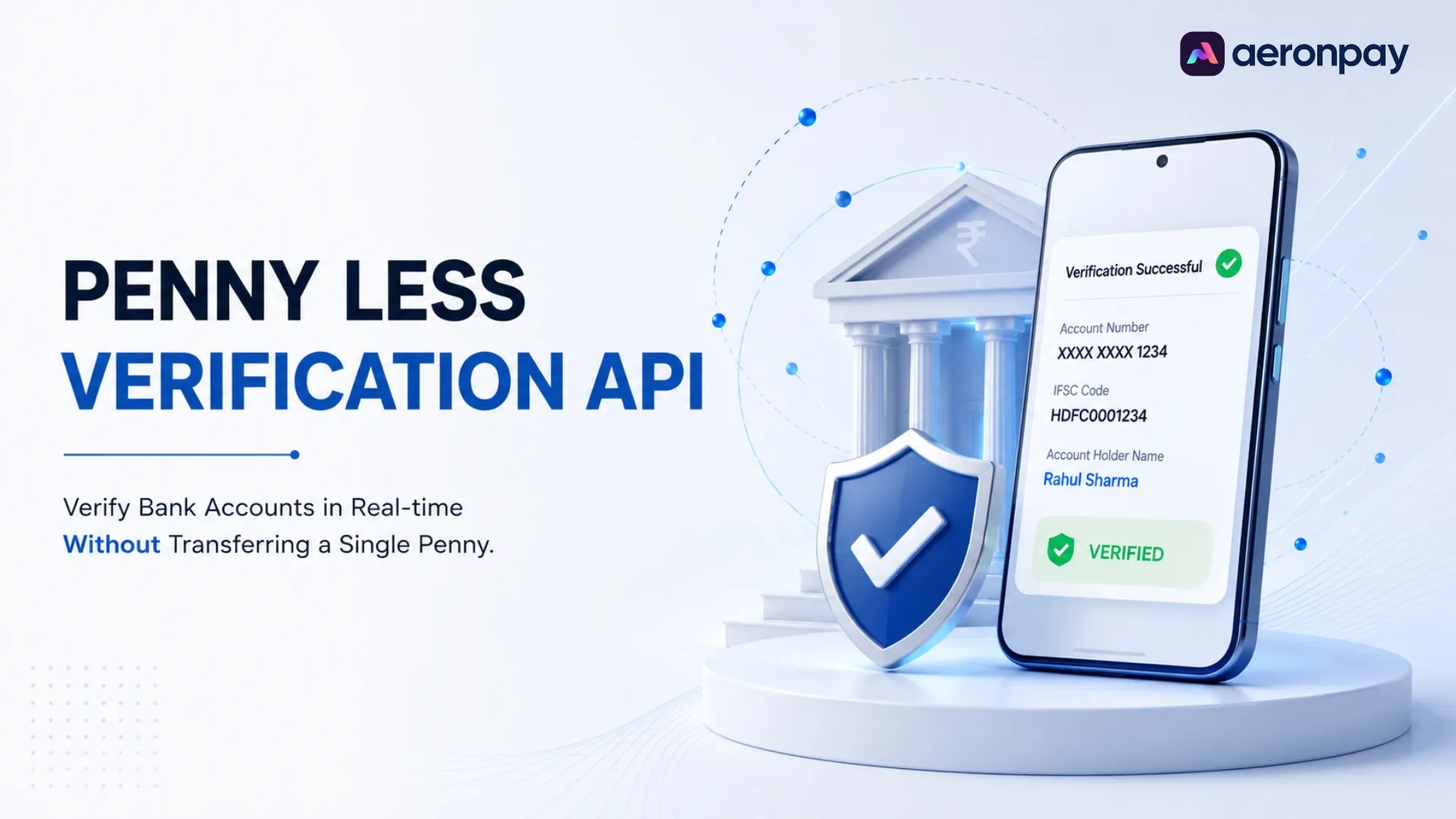
As digital onboarding accelerates, businesses are rethinking how bank account verification can become faster, more efficient, and more customer-friendly without compromising reliability.
The Hidden Cost of Bank Account Verification
Every digital business depends on one critical assumption: the bank account provided by a customer is accurate and valid.
Whether it's a fintech onboarding a new user, an NBFC disbursing loans, an insurance company processing claims, or an enterprise managing vendor payments, bank account verification sits at the centre of operational trust.
Yet many Businesses still view verification as a simple compliance step rather than a business-critical process.
The reality is different.
A failed payment, an incorrect beneficiary account, or a delayed transaction can trigger customer dissatisfaction, operational overhead, reconciliation challenges, and unnecessary support costs. As digital transaction volumes continue to grow, even small inefficiencies in verification workflows can create significant business impact at scale.
This is why the industry is increasingly shifting its attention toward Penny Less Bank Verification.
Why This Matters More Than Ever
The last few years have transformed customer expectations.
- Users expect instant onboarding.
- Businesses expect real-time verification.
- Operations teams expect fewer exceptions.
- Compliance teams expect stronger controls.
At the same time, businesses are under pressure to reduce operational costs while maintaining seamless customer experiences.
Traditional verification processes were designed for a different era, one where transaction volumes were lower, onboarding journeys were longer, and customer expectations were more forgiving.
Today's digital ecosystem demands infrastructure that is both faster and smarter.
Bank account verification is no exception.
The Challenge with Traditional Verification Workflows
Historically, businesses often relied on transaction-based methods to validate bank account details.
While effective in many scenarios, these approaches can introduce additional operational steps into the customer journey.
Businesses managing high-volume onboarding or payment operations often face challenges such as:
- Increased verification processing costs
- Additional reconciliation requirements
- Longer onboarding workflows
- Delays in account activation
- Higher operational complexity
Individually, these issues may appear manageable.
At scale, they become significant business concerns.
A fintech processing thousands of onboarding requests daily experiences these inefficiencies very differently from a business handling a few hundred verifications each month.
As growth accelerates, verification infrastructure must evolve accordingly.
Enter Penny Less Bank Verification
Penny Less Bank Verification represents a more modern approach to validating bank account information.
Instead of depending on transaction-led validation processes, businesses can verify account details through API-driven infrastructure that focuses on speed, efficiency, and operational simplicity.
The objective is straightforward:
Validate bank account information accurately while minimising unnecessary process layers.
For digital-first businesses, this shift creates meaningful advantages across product, operations, compliance, and customer experience functions.
The Operational Efficiency Advantage
One of the most immediate benefits of Penny Less Verification is workflow optimisation.
Verification is often one of several steps within a larger onboarding or transaction process.
When validation happens quickly and seamlessly, downstream operations become more efficient.
Businesses can:
- Reduce manual intervention
- Improve processing speed
- Minimise exception handling
- Streamline internal workflows
- Accelerate customer activation
For operations teams, the result is a cleaner and more scalable process.
For leadership teams, it translates into greater efficiency without increasing operational complexity.
Customer Experience Is Now a Competitive Differentiator
Verification processes are rarely visible when they work well.
Customers simply expect things to happen instantly.
However, verification delays can become highly visible when onboarding stalls or transactions are held up.
In a market where customer acquisition costs continue to rise, businesses cannot afford friction during critical customer journeys.
Penny Less Verification helps reduce unnecessary delays and contributes to a smoother onboarding experience.
The impact extends beyond convenience.
A faster onboarding journey often improves:
- Customer satisfaction
- Conversion rates
- Activation rates
- User retention
- Brand perception
Infrastructure decisions increasingly influence customer experience outcomes.
Verification is no longer just an operations function; it is a product experience function.
Strengthening Risk Management and Compliance
Speed should never come at the expense of control.
Financial institutions, fintechs, and regulated businesses operate in environments where verification accuracy remains essential.
Modern verification infrastructure helps Businesses strengthen controls by validating account information earlier and more efficiently within the customer journey.
When integrated properly, verification systems can support:
- Better data accuracy
- Reduced payment failures
- Improved operational controls
- Enhanced audit readiness
- Stronger compliance workflows
The goal is not merely verification.
The goal is to build confidence in every financial transaction that follows.
Building for Scale
One of the most overlooked aspects of verification infrastructure is scalability.
A process that works effectively for 10,000 verifications per month may struggle at 1 million.
As businesses grow, infrastructure choices become increasingly important.
Scalable verification systems help Businesses:
- Support growing transaction volumes.
- Reduce operational bottlenecks
- Maintain consistent customer experiences.
- Improve platform reliability
- Enable expansion into new business lines.
Growth often exposes weaknesses in operational infrastructure.
Forward-thinking companies address those challenges before they become obstacles.
The Future of Verification Infrastructure
- The direction of the industry is becoming increasingly clear.
- Financial infrastructure is moving toward real-time experiences.
- Customers expect instant outcomes.
- Businesses expect automation.
- Regulators expect stronger controls.
As a result, verification systems are evolving from standalone checks into embedded infrastructure layers that support onboarding, payments, compliance, and customer lifecycle management.
The future will likely bring:
- Greater automation
- Faster verification processes
- Deeper API integration
- More intelligent risk assessment
- Improved operational visibility
Businesses that modernise their verification infrastructure today will be better positioned to meet tomorrow's expectations.
Bank account verification has quietly become one of the most important building blocks of digital financial operations.
What was once considered a back-office process now directly influences customer experience, operational efficiency, compliance readiness, and business scalability.
Penny Less Bank Verification reflects a broader industry shift toward smarter, faster, and more streamlined financial infrastructure.
For businesses navigating rapid digital growth, the question is no longer whether verification matters.
The question is whether existing verification processes are ready for the future.
The most effective financial infrastructure is often the infrastructure customers never notice because it works seamlessly, reliably, and at scale.