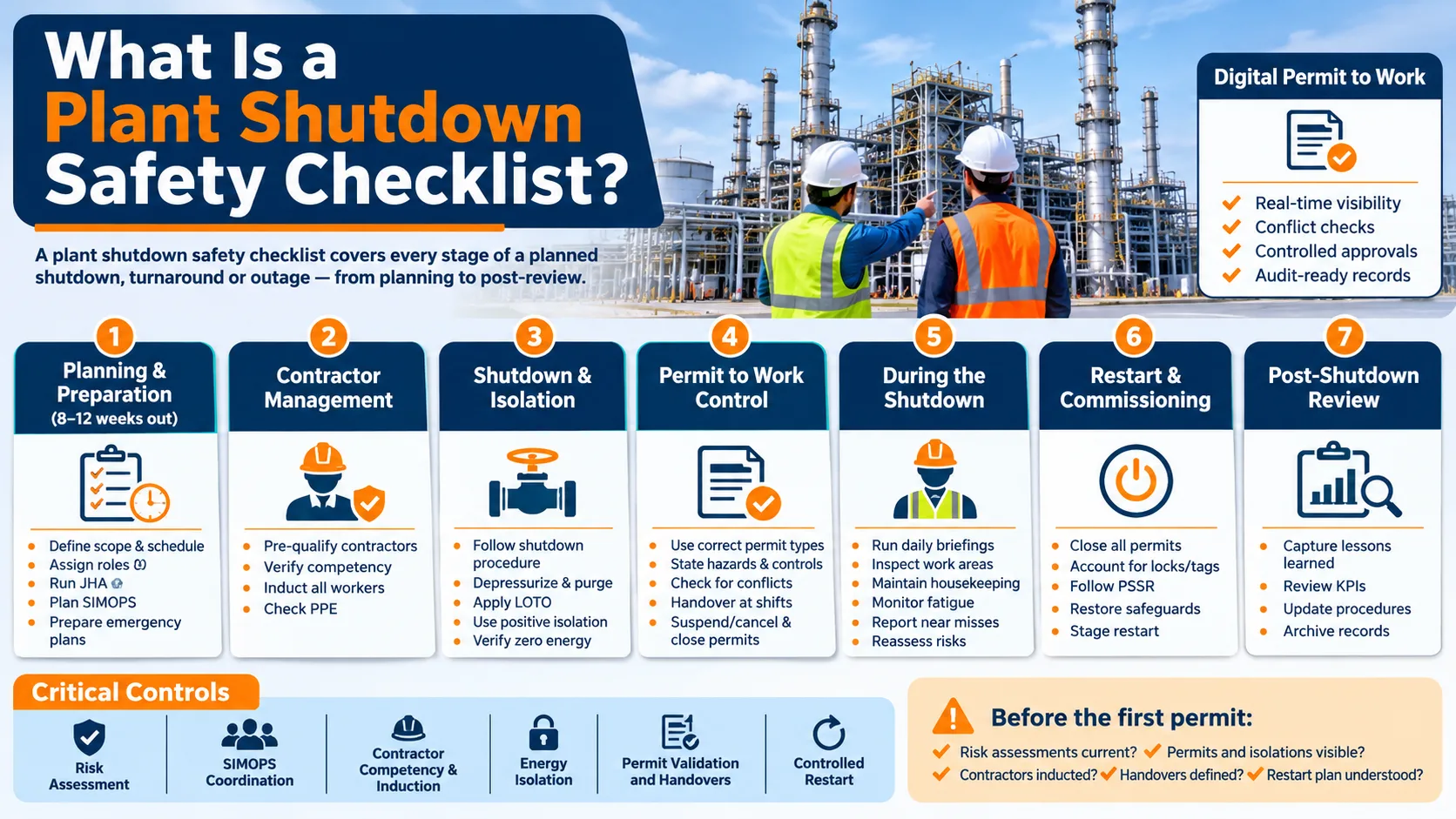
What Is a Plant Shutdown Safety Checklist?
A plant shutdown safety checklist is a structured list of safety checks that covers every stage of a planned shutdown, turnaround or outage: planning, risk assessment, isolation, permits, contractor control, execution, restart and post-shutdown review. Its goal is simple: make sure every hazard is identified and controlled before work starts, while it runs, and before the plant comes back online.
A digital permit to work system strengthens that checklist by replacing paper permits with real-time, auditable, searchable approvals, so nobody has to chase signatures across a 40-hectare site at 2 a.m.
Why Plant Shutdowns Are the Riskiest Weeks of Your Year
If you have ever managed a turnaround, you know the feeling. Normal operations suddenly look nothing like normal. Hundreds of contractors arrive. Hot work, confined space entry, work at height and heavy lifting all happen at once, often in the same area, often under heavy schedule pressure.
That combination is exactly why shutdowns carry elevated risk:
- Many people, short time. Large contractor headcounts, many of them new to your site.
- Simultaneous operations (SIMOPS). Several high-risk jobs close together can create hazards none of them has alone.
- Non-routine work. Crews are opening equipment that normally stays closed.
- Schedule pressure. Every day offline costs money, and that pressure can quietly push people toward shortcuts.
- Communication gaps. Shift handovers, changing scopes and paper permits make it easy for information to slip.
The good news: most shutdown incidents trace back to controllable failures, such as missed isolations, unclear permits, poor handovers or untested restart conditions. A solid checklist closes those gaps.
The Complete Plant Shutdown Safety Checklist
Use this as a starting template and adapt it to your site, your industry and your regulatory requirements.
Phase 1: Planning and Preparation (8 to 12 weeks out)
- Define the shutdown scope, schedule and critical path, and freeze the scope as early as practical. Late additions are a major source of risk.
- Appoint a shutdown safety lead and clarify roles for operations, maintenance, EHS, contractors and permit issuers.
- Review lessons learned from the previous shutdown and near-miss reports.
- Run a job hazard analysis (JHA) or task risk assessment for every high-risk activity.
- Identify SIMOPS conflicts and plan work areas, sequences and exclusion zones.
- Confirm legal and regulatory requirements for your region and industry (for example OSHA, local factory rules, process safety standards).
- Prepare emergency response plans for the shutdown period, including rescue plans for confined spaces and heights.
- Decide how permits will be issued, tracked and closed out. This is the point where moving to a digital permit to work system pays off, because you can configure permit types, approval chains and rules before work begins.
Phase 2: Contractor Management
- Pre-qualify contractors using safety performance, certifications and past incident data.
- Verify worker competency: confined space, hot work, work at height, rigging, gas testing and so on.
- Run a site induction for every worker, with a record of attendance.
- Confirm contractor supervisors understand permit conditions and stop-work authority.
- Check insurance, medical fitness and PPE standards.
- Set clear communication channels and a daily toolbox talk routine.
Phase 3: Shutdown and Isolation
- Follow a documented, sequenced shutdown procedure. Do not improvise under time pressure.
- Depressurize, drain, purge, vent and clean equipment as required.
- Apply energy isolation and lockout/tagout (LOTO) to all energy sources: electrical, mechanical, hydraulic, pneumatic, thermal, chemical and stored energy.
- Use positive isolation (blinds, spades, double block and bleed) where required.
- Verify zero energy with a try-out or test, and record who verified it.
- Keep an isolation register that is visible to everyone who needs it.
- Confirm any atmospheric testing is done by a competent person, with calibrated instruments.
Phase 4: Permit to Work Control
- Issue permits only after the area is made safe and the isolation is verified.
- Match each permit type to the job: hot work, confined space, electrical, work at height, excavation, lifting, general work.
- Make sure permits state the exact location, scope, hazards, controls, validity period and the people involved.
- Cross-check permits to avoid conflicting work in the same area.
- Hold a handover at every shift change, and revalidate permits instead of assuming they are still safe.
- Suspend or cancel permits immediately when conditions change.
- Close out every permit formally, confirming the area is clean, safe and handed back.
Phase 5: During the Shutdown
- Run daily safety briefings and review the day's high-risk permits.
- Carry out field inspections and permit audits, especially on night shifts and weekends.
- Monitor housekeeping, scaffolding, lifting equipment and temporary electrical installations.
- Track fatigue. Long shifts and consecutive days raise error rates significantly.
- Investigate near misses immediately and share findings with all crews the same day.
- Re-assess the risk whenever the scope changes or unexpected findings appear (corrosion, damage, hidden energy sources).
- Reinforce stop-work authority, and make it clear no one will be penalized for using it.
Phase 6: Restart and Commissioning
- Confirm that all permits are closed and every lock, tag and blind is accounted for.
- Complete a pre-startup safety review (PSSR): equipment, instrumentation, safety systems, relief devices and procedures.
- Verify that guards, covers and temporary modifications are restored or formally handled through management of change (MOC).
- Clear all personnel from the area and communicate the start-up plan to every team.
- Restart in a controlled, staged sequence, with the right people present and emergency support on standby.
- Keep a close watch on first-hour and first-day performance.
Phase 7: Post-Shutdown Review
- Hold a lessons-learned session with operations, maintenance, contractors and EHS.
- Review safety KPIs: incidents, near misses, permit compliance, audit findings, stop-work events.
- Analyse permit data to spot recurring issues (late closures, repeated corrections, bottleneck approvers).
- Update procedures, templates and training based on what you learned.
- Archive records for audits and regulatory requirements.
Common Plant Shutdown Safety Mistakes (and How to Avoid Them)
1. Treating the permit as paperwork. A permit is a control, not a form. If people sign without walking the job site, it has no value.
2. Weak shift handovers. Information lost at 6 a.m. and 6 p.m. is behind many serious incidents. Make handovers structured and recorded.
3. Incomplete isolation. A missed energy source or an unverified blind can turn into a fatality. Always verify, never assume.
4. Ignoring SIMOPS. Welding above a crew doing solvent cleaning is the classic example. Visual permit maps help you spot such conflicts early.
5. Scope creep late in the game. Every unplanned job needs the same risk assessment as a planned one.
6. Rushing the restart. The pressure to be back online is highest at the end. This is the very moment to slow down and verify.
Why a Digital Permit to Work System Makes Shutdowns Safer
Paper permits worked for decades, but shutdowns expose their limits: lost copies, illegible handwriting, delayed approvals, no easy view of who is working where, and audits that mean digging through binders.
A digital permit to work system gives EHS managers a single live view of every permit across the plant. Here is what typically changes:
- Real-time visibility. See all active, suspended and closed permits on one dashboard, by area, contractor or permit type.
- Built-in conflict checks. The system can flag overlapping hot work and confined space entry in the same zone before approval.
- Faster, controlled approvals. Configurable workflows route permits to the right approvers, and mobile access avoids the walk back to the control room.
- Linked isolations. Connect LOTO and isolation certificates directly to permits, so work cannot proceed until isolation is confirmed.
- Consistent standards. Mandatory fields, checklists and gas test records mean nothing gets skipped.
- Audit-ready records. Every action is time-stamped and traceable, which makes regulatory audits and incident investigations far simpler.
- Data for improvement. Permit trends reveal bottlenecks and recurring risks that you can address before the next shutdown.
If you are evaluating options, take a look at TechEHS Permit to Work Software to see how a digital permit to work system can support planned shutdowns, turnarounds and daily maintenance.
What to Look for in a Digital Permit to Work System
- Configurable permit types and approval workflows that match your site
- Mobile and offline-friendly use for field teams
- Integration with isolation, LOTO, JHA and contractor management
- Visual maps or dashboards for SIMOPS
- Strong reporting, audit trails and role-based access
- Easy onboarding for contractors who only work on site for a few weeks
Quick Pre-Shutdown Readiness Test
Before the first permit is issued, ask your team these five questions. If any answer is "not sure", you have found your next action item.
- Does every high-risk task have a current risk assessment?
- Can we see all active permits and isolations in one place right now?
- Does every contractor worker have a verified induction and competency record?
- Do we have a clear process for handovers, scope changes and permit suspension?
- Is the restart plan written, reviewed and understood by everyone involved?
Frequently Asked Questions
What is the purpose of a plant shutdown safety checklist?
It ensures hazards are identified and controlled at every stage of a shutdown, from planning through restart, and gives EHS teams a consistent way to verify that nothing has been missed.
When should shutdown safety planning begin?
Ideally 8 to 12 weeks before the shutdown, and for major turnarounds, many months before. Early planning allows time for risk assessments, contractor pre-qualification and system setup.
What is a digital permit to work system?
It is software that manages the full permit lifecycle (request, risk review, approval, issue, monitoring, handover and close-out) electronically, with real-time visibility and a complete audit trail.
Is a digital permit to work system better than paper permits?
For complex, high-activity periods like shutdowns, usually yes. It reduces delays, errors and lost documents, and gives better control of simultaneous work. Paper can still function, but it makes oversight much harder at scale.
What permits are commonly needed during a plant shutdown?
Hot work, confined space entry, electrical isolation, work at height, excavation, lifting operations and general maintenance permits are the most common.
How do you manage contractor safety during a shutdown?
Pre-qualify contractors, verify competencies, run site inductions, brief supervisors on permit conditions, hold daily toolbox talks and audit work in the field, including night shifts.
What is the most important step before restarting a plant?
A pre-startup safety review, with confirmation that all permits are closed, all isolations are removed and accounted for, and all safety systems are functioning.