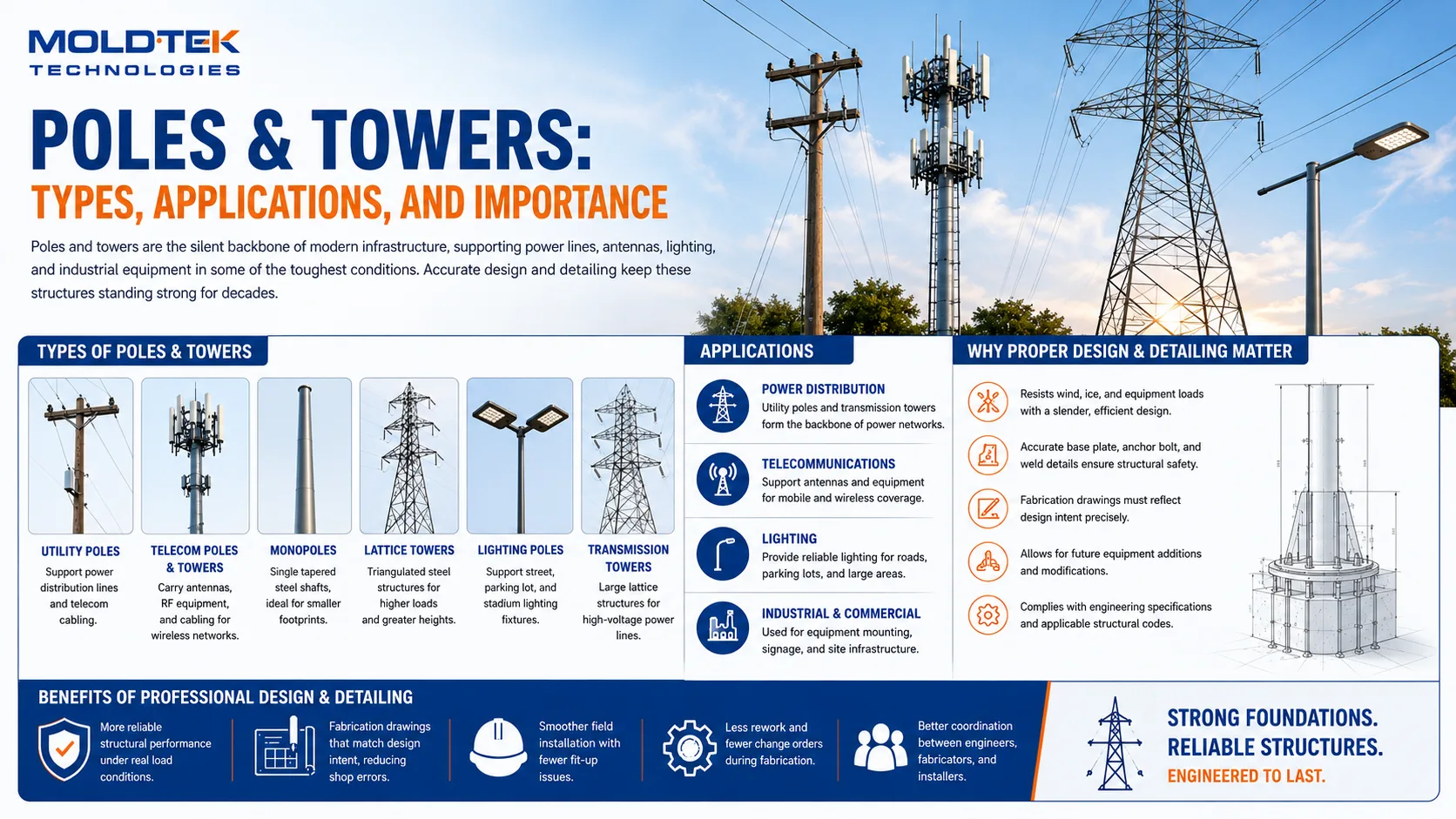
Poles and towers are some of the most common structures in the built environment, yet they rarely get a second look until one fails or needs replacing. They carry power lines, hold up antennas, light up streets, and support industrial equipment - quietly doing structural work in wind, ice, and vibration loads that most buildings never see. Getting their design and detailing right is what keeps them standing reliably for decades.
What Are Poles and Towers?
At their core, poles and towers are vertical support structures designed to carry a specific load - cables, antennas, luminaires, or transmission equipment - at height. A pole is typically a single tapered or uniform shaft, while a tower is usually a taller, braced structure built from multiple members. Both rely on a base connection (a base plate and anchor bolts, or a direct-embed foundation), a shaft or lattice body, and attachment points for whatever equipment they're supporting. Height, wind exposure, and the loads attached determine the structural design far more than aesthetics do.
Types of Poles & Towers
- Utility poles – support power distribution lines and, often, telecom cabling on shared attachments.
- Telecom poles and towers – carry antennas, RF equipment, and cabling for wireless networks.
- Monopoles – single tapered steel shafts, common where a smaller footprint is needed.
- Lattice towers – open, triangulated steel structures used where higher loads or heights require more structural depth.
- Lighting poles – support street, parking lot, and stadium lighting fixtures.
- Transmission towers – large lattice structures carrying high-voltage power lines over long spans.
Applications of Poles & Towers
Utility poles and transmission towers form the backbone of power distribution networks. Telecom poles and monopoles carry the antennas behind cellular and wireless coverage. Lighting poles handle roadway, parking, and area lighting for commercial and municipal projects. Industrial facilities use poles and towers for equipment mounting, signage, and site lighting. Each application brings its own load case - wind on a wide-span transmission tower behaves differently than wind on a slender lighting pole - so the structural approach has to match the use.
Why Proper Design and Detailing Matter
A pole or tower has to resist wind loads, ice loading in some regions, and the dead weight of everything attached to it, often with a slender profile that leaves little margin for error. Base plate sizing, anchor bolt patterns, and weld details all have to be worked out correctly, and fabrication drawings need to reflect those calculations precisely - a base connection that's undersized or misdetailed is a structural risk, not just a rework issue. Detailing also has to account for future equipment additions, since telecom and utility structures are frequently modified after installation. Work should follow the project's engineering specifications and applicable structural codes.
Benefits of Professional Poles & Towers Design and Detailing
- More reliable structural performance under real load conditions
- Fabrication drawings that match design intent, reducing shop errors
- Smoother field installation with fewer fit-up issues
- Less rework and fewer change orders during fabrication
- Better coordination between engineers, fabricators, and installers
Conclusion
Poles and towers look simple compared to buildings and bridges, but their slenderness and exposure to wind and equipment loads make accurate design and detailing essential. Whether it's a utility pole carrying distribution lines or a lattice tower supporting transmission equipment, structures that are properly engineered and detailed from the start hold up better, install more smoothly, and require far less correction down the line.