
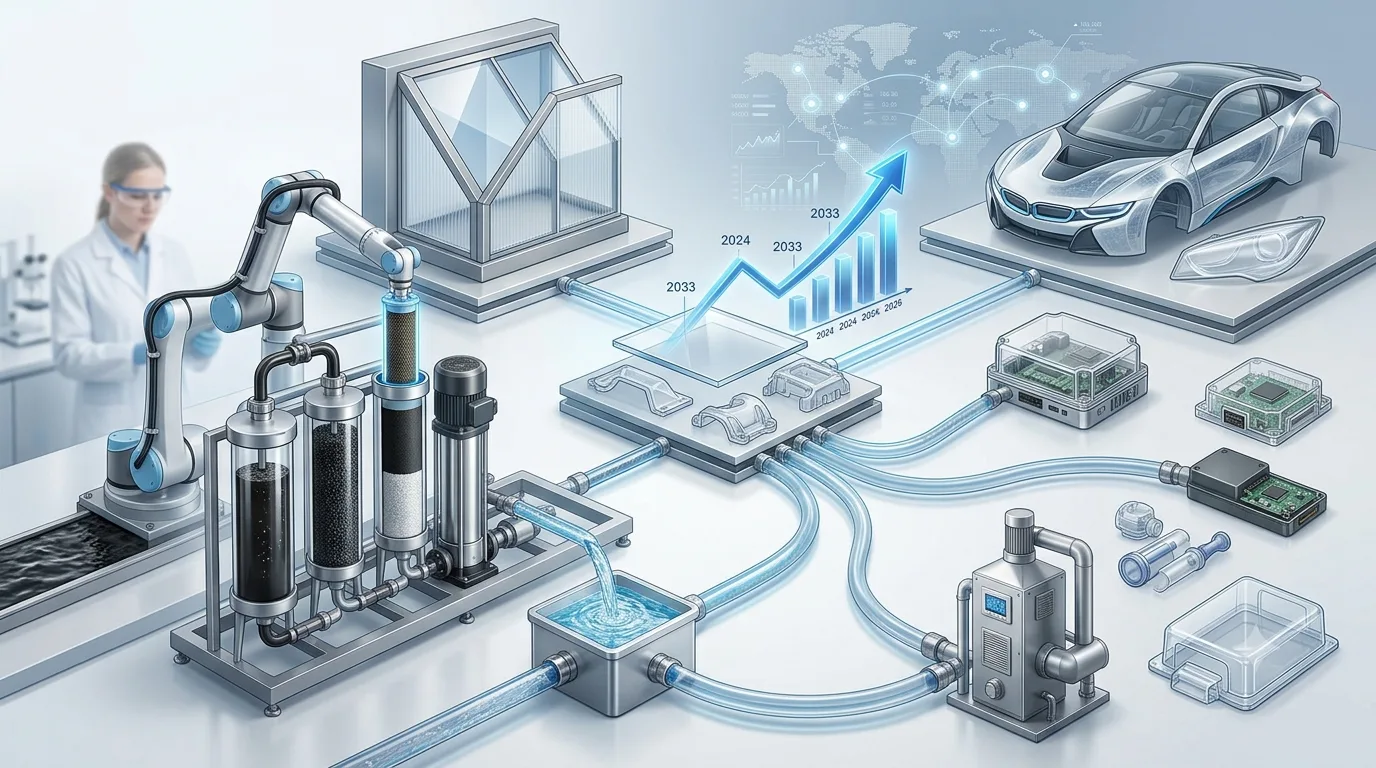
According to Dimension Market Research, the Polycarbonate Market is entering a period of steady expansion as manufacturers across automotive, electronics, construction, packaging, and medical equipment increasingly seek materials that combine strength, lightweight performance, transparency, and dimensional stability. The market is estimated at USD 15.0 billion in 2024 and is projected to reach USD 25.6 billion by 2033, expanding at a 6.2% CAGR during the forecast period.
Polycarbonate is a high-performance thermoplastic valued for its exceptional impact resistance, optical clarity, toughness, creep resistance, and dimensional stability. These properties allow it to replace heavier or more fragile materials in applications ranging from automotive components and electrical housings to medical devices, safety equipment, glazing, and packaging.
Why Is the Polycarbonate Market Growing?
One of the strongest growth factors is the automotive industry's continuing focus on lightweight materials. Polycarbonate can reduce component weight while maintaining durability and impact resistance. It is used in headlamp lenses, interior components, sunroofs, glazing, handles, bezels, and other vehicle parts.
According to DMR, automotive represented the leading application segment, accounting for approximately 38% of the market in 2023. Lightweighting remains important because automakers are looking for materials that can contribute to fuel efficiency and support the development of electric vehicles.
The electronics industry is another important demand center. Polycarbonate provides electrical insulation, flame-retardant characteristics, and mechanical strength, making it suitable for housings, connectors, switchgear, and electronic components.
Medical equipment is also creating opportunities because selected polycarbonate grades can offer durability, transparency, sterilization tolerance, and suitability for demanding healthcare applications.
Market Segmentation
By Grade
The market is segmented into:
- Standard Purpose Grade
- Flame Retardant Grade
- Medical Grade
- Food Grade
- Others
Standard Purpose Grade is currently the dominant category. DMR estimates that this segment held around 45% market share in 2023, supported by widespread use in automotive parts, electrical housings, industrial products, and consumer applications.
Flame-retardant grades are particularly important in electrical and electronic applications where fire safety is a critical requirement. Medical and food grades address more specialized regulatory and performance requirements.
By Application
Major application areas include:
- Electrical
- Construction
- Packaging
- Automotive
- Medical Equipment
- Others
The diversity of these applications gives polycarbonate manufacturers access to multiple demand streams and reduces dependence on a single end-use sector.
Regional Outlook
Asia-Pacific represents the largest regional market, accounting for approximately 50% share in 2023, according to DMR. Rapid industrialization, expanding electronics manufacturing, automotive production, urban development, and infrastructure investment are supporting regional consumption.
China, Japan, South Korea, and India remain important manufacturing and consumption centers. North America and Europe also maintain strong demand, particularly from automotive, medical, electronics, and construction applications.
Middle Eastern markets offer additional opportunities through construction and infrastructure development, while emerging economies across Asia and Latin America can support future demand as industrial production expands.
Sustainability Is Becoming More Important
Environmental considerations are increasingly influencing material selection. Polycarbonate producers are exploring recycled, recyclable, and bio-based solutions to reduce environmental impact and respond to changing regulations.
DMR identifies sustainable manufacturing and recycling initiatives as significant trends in the industry. Manufacturers are also developing materials with improved UV resistance, flame retardancy, durability, and application-specific performance.
Key Challenges
Despite strong application potential, the industry faces several challenges. Raw-material price fluctuations can affect production economics and supplier margins. Bisphenol A-related environmental and health concerns also contribute to regulatory pressure and encourage manufacturers to investigate alternative chemistries and formulations.
Competition from other engineering plastics and advanced materials can further influence purchasing decisions. As a result, producers need to balance performance, price, regulatory compliance, and sustainability.
Competitive Landscape
The Polycarbonate Market includes established material and chemical companies competing through product development, capacity expansion, sustainability initiatives, and strategic partnerships.
Key companies identified by Dimension Market Research include Covestro, SABIC, Lotte Chem, Teijin Industries, Mitsubishi Engineering Plastics Corp., Trinseo, Idemitsu Kosan Co. Ltd., Lone Star Chemical, Chi Mei Corporation, Entec Polymers, RTP Company, and LG Chem.
Related Advanced Material Markets
Polycarbonate is part of a wider advanced-material ecosystem. Businesses evaluating lightweight, durable, and high-performance material opportunities may also examine:
- Automotive Carbon Fiber Market Size, Share & Growth Outlook
- Carbon Fiber Market Size, Share & Growth Outlook
- Carbon Nanotubes Market Size, Share & Growth Outlook
- Activated Carbon Market Size, Share & Growth Outlook
Business Outlook
The long-term opportunity for polycarbonate is closely connected with the shift toward lightweight vehicles, advanced electronics, durable medical equipment, modern construction materials, and more sustainable manufacturing.
Companies operating across the value chain can benefit by investing in specialized grades, recycled feedstocks, application-specific formulations, and regional production capacity. For buyers, manufacturers, investors, and strategy teams, understanding segment-level demand and competitive positioning is essential for identifying the most attractive opportunities.
Conclusion
The Polycarbonate Market is expected to maintain steady growth through 2033, supported by expanding automotive, electronics, medical, construction, and packaging applications. With the market projected to rise from USD 15.0 billion in 2024 to USD 25.6 billion by 2033, material innovation and sustainability will remain important competitive factors.
For detailed market sizing, segmentation, regional analysis, competitive intelligence, and forecast data, explore the Dimension Market Research Polycarbonate Market Report.