
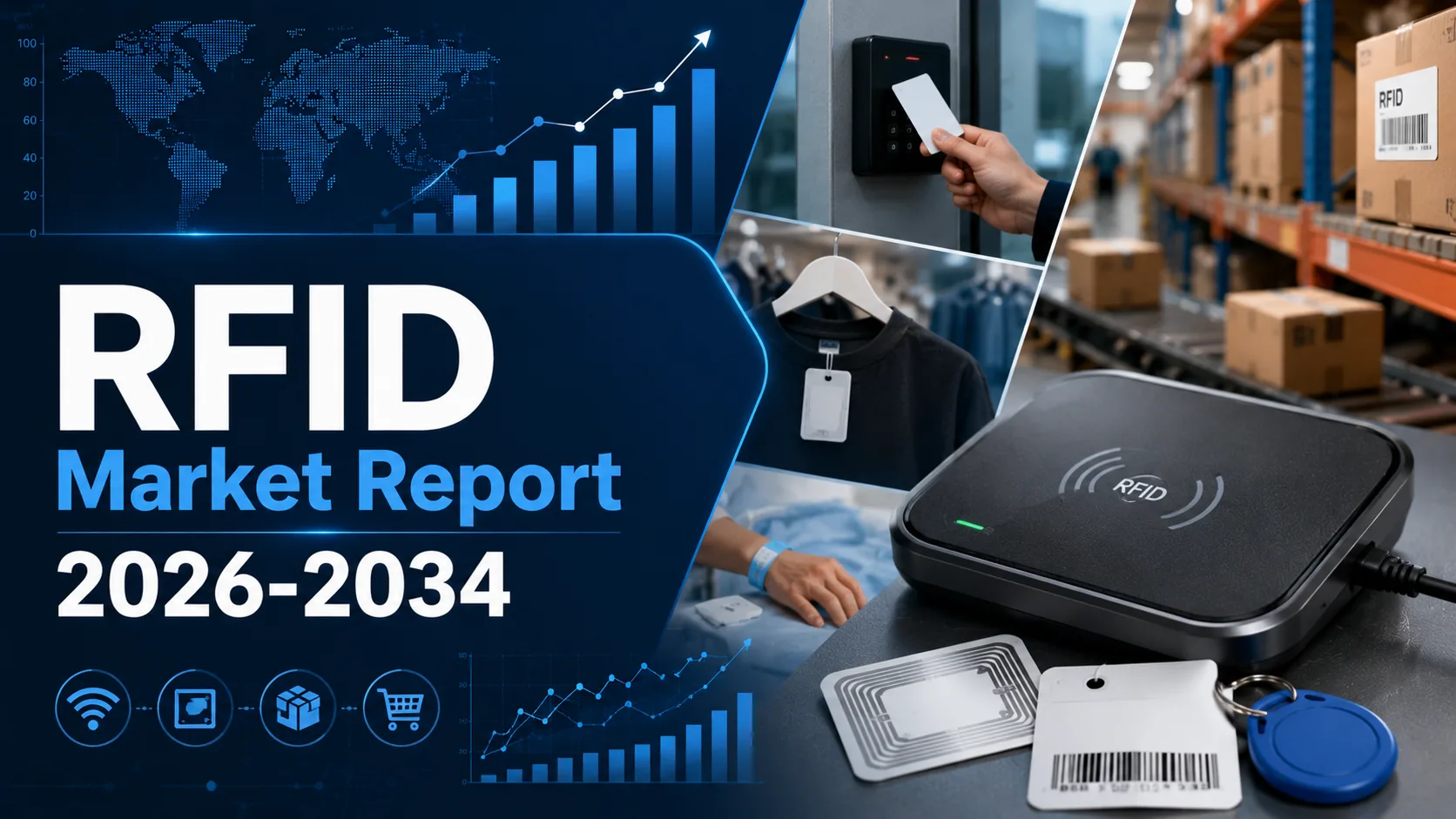
Market Overview
According to IMARC Group's latest research publication, "RFID Market: Global Industry Trends, Share, Size, Growth, Opportunity and Forecast", the global RFID market size reached USD 16.1 Billion in 2025. Looking forward, IMARC Group expects the market to reach USD 47.4 Billion by 2034, exhibiting a growth rate (CAGR) of 12.37%, and automation across supply chains, retail operations, and industrial environments. Rising adoption of item-level tagging, asset tracking, and inventory optimization continues increasing demand for cost-effective and scalable RFID systems, with UHF RFID tags leading the technology segment and retail commanding the largest end-use application.
Radio-frequency identification systems use electromagnetic fields to automatically identify and track tags attached to objects, enabling real-time visibility across supply chains without requiring direct line of sight. Retailers and logistics operators continue deploying RFID to improve inventory accuracy, reduce shrinkage, and enable omnichannel fulfillment, while in industrial and healthcare settings, RFID supports asset utilization tracking, workflow automation, and regulatory compliance monitoring. Advances in UHF RFID performance, reader sensitivity, and tag miniaturization continue improving read reliability in dense and complex environments.
Grab a sample copy of this report: https://www.imarcgroup.com/rfid-market-report/requestsample
How AI Is Reshaping the Future of the RFID Market
- AI-driven inventory analytics platforms integrated with RFID sensor labels are enabling retailers to improve freshness management and reduce food waste through real-time monitoring of perishable inventory.
- Machine learning-based demand forecasting combined with RFID-collected data is helping supply chain operators optimize inventory placement and replenishment across omnichannel fulfillment networks.
- AI-enhanced reader systems are improving read accuracy in dense, high-interference environments, addressing longstanding reliability challenges in crowded retail and warehouse settings.
- Predictive analytics embedded in asset-tracking RFID platforms are helping healthcare facilities anticipate equipment maintenance needs and improve surgical instrument utilization rates.
- AI-based anti-counterfeiting systems paired with next-generation RFID chips are strengthening brand protection and supply chain authentication across pharmaceutical and luxury goods sectors.
Key Trends in the RFID Market
- Retail Item-Level Tagging Expansion: Retailers and brand owners continue deploying RFID at the item level to improve inventory accuracy, loss prevention, and omnichannel fulfillment, with major retailers partnering directly with RFID material suppliers to deploy sensor-enabled labels across fresh food categories.
- Sustainable and Plastic-Free RFID Materials: Manufacturers are increasingly investing in sustainable materials and intelligent labeling technologies, developing entirely plastic-free inlay ranges that apply antennas and chips directly on paper to meet evolving regulatory and customer sustainability requirements.
- Healthcare Sterilization and Asset Tracking: Healthcare facilities are increasingly adopting RFID technology capable of surviving sterilization processes, enabling continuous tracking of medical devices and surgical instruments throughout their entire lifecycle without compromising functionality.
- Next-Generation Chip Integration: Leading RFID inlay manufacturers continue collaborating with chip developers to integrate next-generation semiconductor technology, supporting enhanced inventory control, item tracking, and anti-counterfeiting measures across global supply chains.
- Industrial UHF RFID Adoption: Growing deployment of ruggedized UHF RFID inlays and tags designed for industrial applications is expanding RFID's addressable market beyond traditional retail into manufacturing and logistics environments.
Growth Factors in the RFID Market
- Supply Chain Visibility Demand: The growing need for real-time visibility, traceability, and automation across supply chains continues to be the primary market driver, as enterprises adopt RFID to improve inventory accuracy and operational transparency.
- Retail Inventory Optimization: Rising adoption of item-level tagging and inventory optimization by retailers and logistics operators continues driving demand for cost-effective, scalable RFID systems that reduce shrinkage and enable seamless omnichannel fulfillment.
- Healthcare Compliance and Asset Tracking: Growing regulatory compliance requirements in healthcare settings continue expanding RFID adoption for workflow automation, asset utilization tracking, and surgical instrument traceability throughout sterilization cycles.
- Technological Advancements in Tag Miniaturization: Continued advances in UHF RFID performance, reader sensitivity, and tag miniaturization are improving read reliability in dense and complex environments, broadening the range of viable applications.
- Food Traceability and Waste Reduction: Rising retailer investment in RFID-enabled sensor labels for fresh food categories continues expanding demand as businesses seek to improve freshness management and reduce spoilage-related losses.
Leading Companies Operating in the Global RFID Industry
- Alien Technology Corporation
- Avery Dennison Corporation
- Checkpoint Systems, Inc.
- Datalogic S.p.A.
- HID Global Corporation
- Honeywell International Inc.
- Identiv, Inc.
- Impinj, Inc.
- Invengo Information Technology Co. Ltd.
- NXP Semiconductors NV
- Zebra Technologies Corporation
RFID Market Report Segmentation
Breakup by Product Type:
- Tags
- Readers
- Software and Services
RFID tags represent the core growth driver of the market, encompassing UHF inlays, HF and NFC formats, and specialized ruggedized variants designed for retail, industrial, and healthcare traceability applications.
Breakup by Technology:
- UHF RFID
- HF RFID
- LF RFID
UHF RFID leads the technology segment, favored for its longer read range and high-volume commercial applicability across retail, logistics, food, and pharmaceutical supply chains requiring scalable manufacturing and cost optimization.
Breakup by End-Use Industry:
- Retail
- Healthcare
- Logistics and Transportation
- Manufacturing
- Others
Retail commands the largest end-use share, with retailers and brand owners deploying RFID at scale for inventory accuracy, loss prevention, and omnichannel fulfillment across grocery, apparel, and general merchandise categories.
Breakup by Region:
- North America (United States, Canada)
- Asia Pacific (China, Japan, India, South Korea, Australia, Indonesia, Others)
- Europe (Germany, France, United Kingdom, Italy, Spain, Russia, Others)
- Latin America (Brazil, Mexico, Others)
- Middle East and Africa
North America leads the market, anchored by major retailers and material science companies driving item-level tagging adoption across fresh food and general merchandise categories, while Asia Pacific continues expanding rapidly on the back of strong electronics manufacturing infrastructure and rising logistics automation investment.
Recent News and Developments in the RFID Market
- July 2025: Avery Dennison announced the launch of its RFID-enabled In-Mold Label portfolio, expanding tagging capabilities directly into product packaging manufacturing processes for improved traceability.
- September 2025: Avery Dennison announced that its leading portfolio of RFID inlays now features next-generation Impinj Gen2X chips, ushering in developments supporting enhanced inventory control, item tracking, and anti-counterfeiting measures across the industry.
- October 2025: Walmart and Avery Dennison collaborated to deploy RFID-enabled sensor labels in fresh food categories, improving inventory accuracy, freshness management, and food waste reduction across grocery operations.
- March 2026: Avery Dennison launched a new sterilization-compatible RFID portfolio, enabling healthcare facilities to track medical devices and surgical instruments through the entire sterilization process without compromising tag functionality.
Note: If you require specific details, data, or insights that are not currently included in the scope of this report, we are happy to accommodate your request. As part of our customization service, we will gather and provide the additional information you need, tailored to your specific requirements. Please let us know your exact needs, and we will ensure the report is updated accordingly to meet your expectations.
About Us
IMARC Group is a global management consulting firm that helps the world's most ambitious changemakers create a lasting impact. The company provides a comprehensive suite of market entry and expansion services. IMARC offerings include thorough market assessment, feasibility studies, company incorporation assistance, factory setup support, regulatory approvals and licensing navigation, branding, marketing and sales strategies, competitive landscape and benchmarking analyses, pricing and cost research, and procurement research.
Contact Us
IMARC Group
134 N 4th St. Brooklyn, NY 11249, USA
Email: sales@imarcgroup.com
Tel No: (D) +91 120 433 0800
United States: +1-201-971-6302