In modern industrial manufacturing, selecting the right metal component is essential for ensuring product strength, reliability, durability, and long-term operational efficiency. This is particularly important when manufacturing large, heavy-duty components used in industries such as power generation, oil and gas, aerospace, mining, construction, and heavy engineering.
Among these components, metal rings play a critical role in applications that demand high mechanical strength and dimensional accuracy. However, manufacturers often face an important question: Should they choose rolled rings or cast rings?
Both manufacturing processes offer distinct advantages, but their performance can differ significantly depending on the application, material requirements, operating conditions, and expected service life.
In this article, we explore the differences between rolled rings and cast rings, examine their manufacturing processes, and explain which option may deliver better performance for demanding industrial applications.
What Are Rolled Rings?
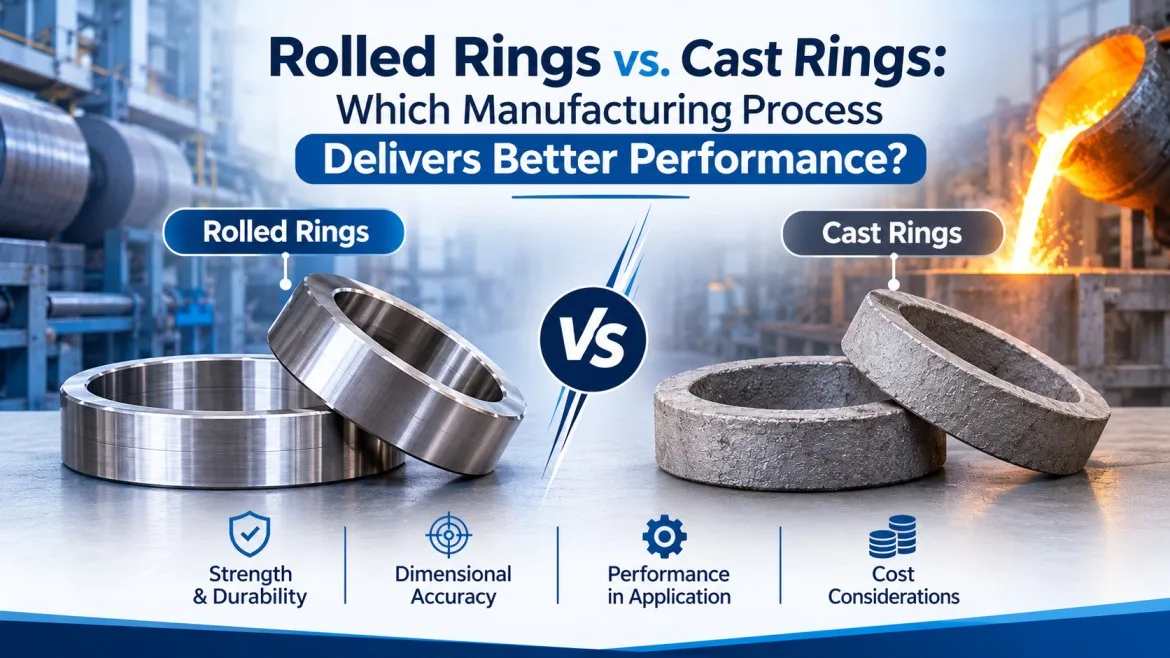
Rolled rings are seamless metal components manufactured through a specialised forging process known as ring rolling.
The process generally begins with a heated metal billet or preform containing a central opening. The material is compressed and shaped using specialised rolling equipment. As the ring moves between the rolls, its wall thickness decreases while its diameter increases.
This process produces a seamless ring with a continuous grain flow that follows the circular geometry of the component.
Rolled rings are commonly manufactured using carbon steel, alloy steel, stainless steel, and other industrial-grade metals.
Key Characteristics of Rolled Rings
- Improved mechanical strength through the forging process.
- Continuous grain flow following the ring's geometry.
- Good resistance to fatigue under properly designed operating conditions.
- High structural integrity when manufactured and inspected correctly.
- Suitable for large-diameter and heavy-duty industrial components.
- Flexibility in manufacturing different dimensions and material grades.
These characteristics make rolled rings suitable for applications where mechanical reliability and consistent performance are important.
What Are Cast Rings?
Cast rings are produced through a metal casting process in which molten metal is poured into a mould designed to achieve the required ring shape.
After the molten metal cools and solidifies, the component is removed from the mould and undergoes further operations such as machining, heat treatment, and inspection.
Depending on the casting method, material, and quality controls, cast rings can be manufactured in different sizes and configurations.
Key Characteristics of Cast Rings
- Suitable for producing complex geometries.
- Can accommodate a wide range of metal alloys.
- Useful for components with intricate design requirements.
- Can be economical for certain production volumes and component designs.
- May require additional machining and finishing operations.
- Mechanical properties depend heavily on solidification conditions and casting quality.
Casting can be an effective manufacturing solution, particularly when component geometry or material requirements make other processes less practical.
Rolled Rings vs. Cast Rings: What Are the Major Differences?
Although both processes produce ring-shaped metal components, they differ in how the material is formed and how its internal structure develops.
1. Mechanical Strength and Structural Integrity
One of the most important differences between rolled rings and cast rings is their mechanical behaviour.
During ring rolling, the metal undergoes controlled plastic deformation. This helps refine the material's microstructure and creates grain flow that follows the ring's geometry.
As a result, properly manufactured rolled rings can offer excellent mechanical properties and structural reliability.
Cast rings, on the other hand, develop their internal structure during solidification. Their properties depend on factors such as cooling rates, alloy composition, mould design, and casting quality.
Performance advantage: Rolled rings are often preferred for applications involving demanding mechanical loads, although the final performance must always be verified through material testing and engineering evaluation.
2. Fatigue Resistance
Industrial components frequently experience repeated loading, vibration, pressure variations, and rotational forces.
These operating conditions can lead to fatigue-related failures over time.
The controlled deformation and favourable grain-flow characteristics of forged rolled rings can contribute to improved fatigue performance, particularly when the ring is properly designed and manufactured.
Cast rings may contain internal discontinuities, such as shrinkage porosity or inclusions, depending on the casting process and quality controls. These defects can become potential fatigue-crack initiation points.
Performance advantage: Rolled rings generally offer an advantage in demanding fatigue-sensitive applications, provided that material quality, heat treatment, and inspection requirements are properly controlled.
3. Material Uniformity
Material consistency is another important factor when selecting an industrial ring component.
The ring-rolling process applies mechanical deformation to the metal, helping produce a refined and relatively uniform microstructure.
Casting involves the cooling and solidification of molten metal. Differences in cooling rates can result in variations in grain structure and local material properties.
However, modern casting technologies and quality-control systems can significantly improve casting consistency.
Performance advantage: Rolled rings are generally preferred where predictable mechanical properties and consistent material structure are critical.
4. Manufacturing Flexibility
Both processes provide manufacturing flexibility, but their strengths are different.
Ring rolling is particularly suitable for seamless rings in a wide range of diameters, wall thicknesses, and heights.
Casting offers greater flexibility for intricate geometries, integrated features, and shapes that may be difficult or expensive to produce through forging.
Performance advantage: Rolled rings are advantageous for seamless, load-bearing ring components, while casting may be more suitable for complex component geometries.
5. Material Utilisation and Machining Requirements
Manufacturing efficiency also plays an important role in component selection.
Rolled rings are formed through controlled deformation, and their near-net-shape production can help reduce machining requirements compared with manufacturing the same component from a solid block.
Cast rings can also be produced close to their final dimensions. However, depending on the casting process and required surface quality, additional machining may be necessary.
The actual material utilisation and manufacturing cost depend on component geometry, production volume, material grade, and process capabilities.
Performance advantage: Neither process is universally more economical. Rolled rings can offer material and machining benefits for suitable geometries, while casting may be cost-effective for particular complex designs.
Where Are Rolled Rings Commonly Used?
Rolled rings are widely used in industries where components must withstand significant mechanical stress, pressure, temperature variations, and continuous operational loads.
Some major applications include:
1. Oil and Gas Industry
Rolled rings are used in selected pressure-containing and heavy-engineering applications, including flanges, connectors, and specialised equipment components. Material traceability and compliance with applicable engineering standards are particularly important in this sector.
2. Power Generation
Power plants use forged ring components in selected turbine, generator, and other heavy rotating equipment applications.
3. Aerospace Industry
High-performance forged rings are used in selected aerospace structural and engine-related applications where material integrity and mechanical performance are critical.
4. Heavy Engineering
Industrial machinery, large equipment assemblies, and heavy-duty mechanical systems often require custom-engineered rolled rings.
5. Mining and Construction
Certain mining and construction equipment applications require robust metal components capable of operating under demanding mechanical conditions.
When Should Manufacturers Choose Cast Rings?
Despite the advantages of rolled rings, casting remains an important manufacturing process.
Cast rings may be a suitable option when:
- The component requires a complex or intricate geometry.
- Integrated features are difficult to achieve through forging.
- The selected alloy is more practical to process through casting.
- Production economics favour casting for the required design and volume.
- Engineering calculations and testing confirm that casting meets the required performance specifications.
The correct manufacturing process should always be selected according to the component's functional requirements rather than assuming that one process is suitable for every application.
How Should You Select the Right Manufacturing Process?
Before choosing between rolled rings and cast rings, manufacturers should evaluate several important factors.
1. Operating Conditions: Consider the expected mechanical loads, pressure, temperature, vibration, and operating environment.
2. Material Requirements: Evaluate the required alloy composition, tensile strength, toughness, hardness, and other mechanical properties.
3. Component Geometry: Determine whether the design requires a seamless ring, complex geometry, specialised dimensions, or integrated features.
4. Quality and Inspection Requirements: Review applicable material standards, ultrasonic testing requirements, dimensional tolerances, and traceability expectations.
5. Total Manufacturing Cost: Consider material utilisation, machining, heat treatment, inspection, production volume, and expected component service life.
A detailed engineering assessment helps manufacturers choose a process that balances performance, quality, and cost.
Why Are Rolled Rings Preferred for Demanding Industrial Applications?
For many heavy-duty applications, rolled rings offer a combination of mechanical strength, favourable grain flow, structural reliability, and manufacturing flexibility.
Their advantages become particularly relevant when components are exposed to repeated loading, high mechanical stresses, and demanding operating conditions.
However, the performance of a rolled ring is not determined by the manufacturing process alone. Material selection, forging temperature, reduction ratios, heat treatment, machining, and non-destructive testing all influence the final component quality.
Similarly, high-quality cast rings can deliver reliable performance when the casting process is properly designed and controlled.
Therefore, the best manufacturing choice depends on the engineering requirements of the application.
Conclusion: Rolled Rings or Cast Rings – Which Is Better?
There is no universal answer to whether rolled rings or cast rings are better. Both manufacturing processes serve important purposes in modern industrial production.
However, rolled rings are generally the preferred choice for seamless, load-bearing components where mechanical strength, fatigue performance, and favourable grain flow are important.
Cast rings remain a practical solution for applications involving complex geometries, specific alloy requirements, and suitable production economics.
For manufacturers, OEMs, and procurement teams, the key is to evaluate the component's operating conditions, material specifications, quality requirements, and long-term performance expectations before making a decision.
Working with an experienced forging manufacturer can also help ensure that the selected component meets the required engineering and quality standards.
Manufacturers such as CHW Forge specialise in custom-engineered forged components, including hollow forgings, sleeves, hollow cylinders, and shells for demanding industrial applications. Selecting the right forged component and manufacturing specifications can contribute to dependable performance across heavy-engineering applications.