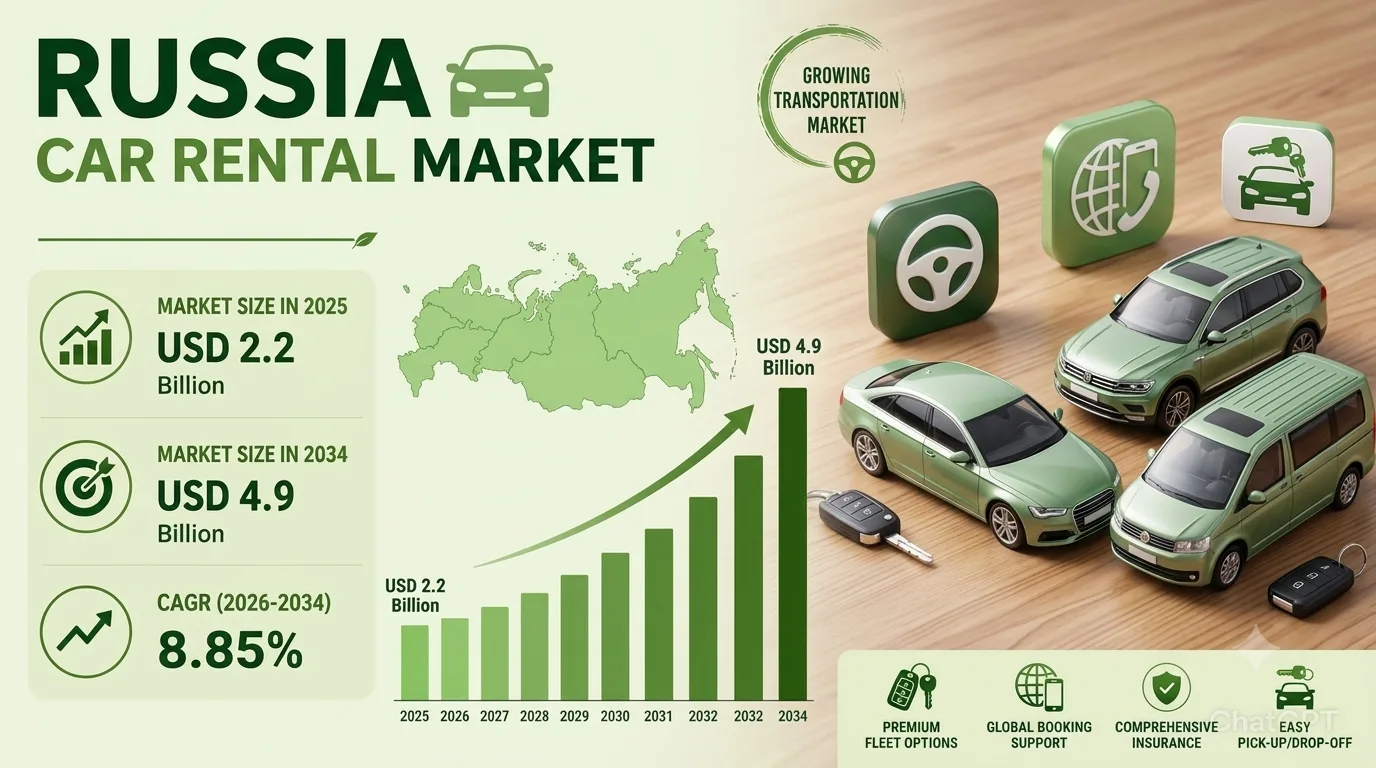
The Russia car rental market size was valued at USD 2.2 Billion in 2025. Looking forward, IMARC Group estimates the market to reach USD 4.9 Billion by 2034, exhibiting a CAGR of 8.85% from 2026-2034. The market share is expanding due to rising domestic and international tourism, increasing business travel, adoption of digital booking platforms, heightened popularity of short-term and subscription-based rentals, growing demand for electric and hybrid vehicles, government infrastructure investments, and affordability-driven consumer preferences, with technology-driven contactless services and corporate leasing.
Russia is an enormous country with a rich history, stunning landscapes, and cultural landmarks that attract millions of tourists each year. The flow of foreign tourists to Russia by the end of 2024 rose to 95 percent in comparison to its 2023 levels and will amount to approximately 2.5 million trips, as per the data by the Association of Tour Operators of Russia (ATOR). From the grand architecture of Moscow and St. Petersburg to the natural beauty of Lake Baikal and Kamchatka, both domestic and international travelers explore different regions. As a result, the Russia rental car market demand among tourists keeps rising. It gives them the flexibility to explore destinations at their own pace without relying on rigid train or bus schedules. Renting a car allows them to reach locations where public transportation is either scarce or nonexistent.
Moreover, domestic tourism has been rising due to geopolitical shifts and restrictions on international travel. In January-September 2024, Russia saw 65.5 million domestic tourist trips, an 11% increase from the year 2023. Siberia, southern Russia, and the North Caucasus were the most popular destinations. With many Russians now preferring to explore their own country, the demand for car rentals has surged. The government has also been promoting domestic tourism through initiatives like subsidized travel programs and infrastructure improvements. With ongoing government efforts to develop tourism and improve road infrastructure, this trend is expected to continue, making car rentals a preferred mode of travel for both domestic and international tourists.
RUSSIA CAR RENTAL MARKET SUMMARY
- The Russia car rental market was valued at USD 2.2 Billion in 2025 and is projected to reach USD 4.9 Billion by 2034, growing at a CAGR of 8.85% during 2026-2034.
- The market is driven by rising domestic and international tourism, increasing business travel, and the adoption of digital booking platforms.
- Short-term and subscription-based rentals are gaining popularity, particularly among younger consumers and urban residents.
- The shift toward electric and hybrid vehicles is creating new opportunities in the rental fleet segment.
- Government infrastructure investments and affordability-driven consumer preferences are supporting market expansion.
- Technology-driven contactless services and corporate leasing are emerging as key trends.
- The competitive landscape features both domestic players and international companies navigating geopolitical complexities.
- Key segments include booking type, rental length, vehicle type, application, end user, and region.
PORTER'S FIVE FORCES ANALYSIS – RUSSIA CAR RENTAL MARKET
The competitive dynamics of the Russia car rental market can be analyzed using Porter's Five Forces framework.
Porter's Five Forces Analysis – Russia Car Rental Market
- Competitive Rivalry: High. The market features intense competition among domestic players like Delimobil, Yandex.Drive, and RentMotors, alongside international brands. Rivalry is driven by fleet expansion, pricing strategies, digital innovation, and service differentiation. Business implication: Companies must invest in technology, customer experience, and fleet modernization to maintain market share.
- Supplier Power (Vehicle Manufacturers): Moderate. Automakers and fleet suppliers have moderate bargaining power due to the availability of multiple brands and the growing presence of Chinese manufacturers. However, supply chain disruptions and sanctions have created uncertainties. Business implication: Rental firms should diversify supplier relationships and explore alternative vehicle sources to mitigate risks.
- Buyer Power (Customers): High. Individual and corporate customers have significant bargaining power due to low switching costs, price transparency through digital platforms, and abundant choices. Business implication: Rental companies must offer competitive pricing, loyalty programs, and value-added services to retain customers.
- Threat of Substitutes: Moderate to High. Alternatives include public transportation, ride-sharing services, car-sharing platforms, and traditional taxis. The growing popularity of shared mobility and subscription models poses a significant threat. Business implication: Car rental firms must innovate with flexible rental models and integrate with mobility ecosystems to remain relevant.
- Threat of New Entrants: Moderate. Barriers to entry include high capital requirements for fleet acquisition, regulatory compliance, and brand establishment. However, digital platforms and aggregator models have lowered entry barriers for niche players. Business implication: Established players should build defensible positions through scale, technology, and customer loyalty.
Competitive Rivalry – High (Intense)
- Multi-tier competition spans domestic leaders (Delimobil, Yandex.Drive, RentMotors), international brands (Avis, Budget, Hertz through franchise arrangements), and emerging digital-first platforms — driving differentiation through pricing, fleet quality, digital experience, and service innovation rather than destructive price competition alone.
- Delimobil's IPO on the Moscow Exchange in February 2024, raising 4.2 billion rubles and becoming Russia's first publicly traded carsharing operator, reflects the growing maturity and investment potential of the market. RexRent's fleet expansion by 14% in January 2024 and plans to introduce Chinese-made hybrid cars demonstrate active strategic repositioning to align with sustainability trends.
Request for Sample Report: https://www.imarcgroup.com/russia-car-rental-market/requestsample
MARKET GROWTH DRIVERS:
Growth in Business Travel and Corporate Leasing
Business travel plays a major role in the Russian car rental market growth. As one of the largest economies in the world, Russia has a significant number of corporate hubs, particularly in Moscow, St. Petersburg, and major industrial cities like Yekaterinburg and Novosibirsk. Large multinational companies, startups, and government organizations frequently require transport solutions for their employees, executives, and business partners. Corporate leasing has become an attractive option for businesses that need a fleet of vehicles but do not want to deal with ownership costs, maintenance, and depreciation. Instead of buying company cars, many firms prefer renting vehicles on long-term contracts. This not only reduces operational expenses but also allows companies to access the latest models with advanced safety and technology features.
Expansion of Digital Booking Platforms and Contactless Services
The rise of digitalization has transformed the car rental industry in Russia, making it easier than ever for customers to book a vehicle through mobile apps and websites. With the proliferation of smartphones and improved internet connectivity, consumers now prefer digital booking over traditional rental offices. For instance, during the first half of the year in 2024, smartphone sales in the Russian market increased by 24%, boosting its major use among the people of the country. This has increased the focus of car rental companies on integrating their services with mobile applications. As a result, major car rental companies have launched intuitive apps that enable customers to browse available vehicles, compare prices, book rentals, and make payments online. Some platforms even offer real-time tracking of vehicle availability, making the entire rental process smooth and hassle-free.
Increasing Demand for Short-Term and Subscription-Based Rental
The way people approach car ownership is changing. Instead of buying cars outright, many Russians, especially younger consumers, are opting for short-term rentals or subscription-based car services. This shift is fueled by various factors, such as rising vehicle costs, maintenance expenses, and the increasing demand for flexible mobility options. Subscription-based car rentals allow users to access a vehicle for a monthly fee without worrying about insurance, maintenance, or depreciation. Customers can switch between different car models depending on their needs, making this an attractive alternative to traditional car ownership. Short-term rentals, often spanning a few hours to a few days, have gained traction in urban areas where people need cars occasionally but do not want the burden of ownership. Ride-sharing and car-sharing services, such as Delimobil and Yandex.Drive, have further popularized this trend.
RUSSIA CAR RENTAL MARKET SEGMENTATION
Segmentation analysis provides a detailed view of the Russia car rental market by category:
- Booking Type Insights: Offline Booking, Online Booking.
- Rental Length Insights: Short Term, Long Term.
- Vehicle Type Insights: Luxury, Executive, Economy, SUVs, Others.
- Application Insights: Leisure/Tourism, Business.
- End User Insights: Self-Driven, Chauffeur-Driven.
- Regional Insights: Central District, Volga District, Urals District, Northwestern District, Siberian District, Others.
COMPETITIVE LANDSCAPE
The Russia car rental market features a competitive landscape with both domestic and international players. Key companies operating in the market include:
- Delimobil
- Yandex.Drive
- RentMotors
- RexRent (formerly Avis/Budget)
- Avis Russia
- Budget Russia
- Hertz Russia
- Local and regional rental operators
Strategic developments are shaping the competitive arena, notably Delimobil's IPO on the Moscow Exchange in February 2024, raising 4.2 billion rubles and becoming the country's first publicly traded carsharing operator. The company boasts a fleet exceeding 18,000 vehicles and serves over 7.1 million members across multiple cities, including Moscow, Saint Petersburg, and Nizhny Novgorod. Additionally, RexRent expanded its fleet by 14% in January 2024, reaching 1,648 vehicles, and planned to introduce Chinese-made hybrid cars into its rental lineup.
REGIONAL ANALYSIS:
Regional dynamics within the Russia car rental market are shaped by varying levels of industrial concentration, tourism activity, and infrastructure development.
- Central District: Home to Moscow and surrounding regions, this is the most lucrative car rental market in Russia, driven by high business activity, tourism, and urban mobility needs. Moscow, as the political, financial, and corporate hub, sees strong demand for both self-driven and chauffeur-driven rentals, especially from business travelers, diplomats, and international tourists. Luxury and executive rentals are particularly popular among corporate clients, while economy and SUV rentals cater to domestic travelers exploring nearby attractions like the Golden Ring. The district's extensive road network and high population density sustain rental demand year-round.
- Volga District: An industrial and economic hub, has a growing car rental market driven by corporate leasing, domestic tourism, and government fleet requirements. Business travelers in the automotive, oil, and manufacturing industries frequently rent vehicles for corporate mobility, while tourists visiting cultural and historical landmarks contribute to leisure rental demand. The region's improving road infrastructure and economic development initiatives are further expanding the market, with economy and mid-range sedans being the most sought-after rental choices.
- Urals District: Serves as a major industrial and logistical center, driving demand for both short-term and long-term rentals. Business rentals are prominent in this region due to its strong mining, metallurgy, and energy industries, with companies leasing executive sedans and SUVs for corporate use. Additionally, self-drive rentals are popular among professionals and residents traveling between cities for work. Adventure travelers exploring the Ural Mountains and natural reserves contribute to the demand for SUVs and off-road vehicles.
- Northwestern District: Has a thriving car rental market supported by international tourism, government activities, and cross-border travel. St. Petersburg, Russia's cultural capital, attracts millions of tourists annually, driving strong demand for short-term self-driven rentals, particularly economy cars and SUVs. Additionally, luxury and chauffeur-driven rentals are widely used for business travel, diplomatic transport, and high-end tourism. The region's proximity to Finland and the Baltics also fuels cross-border rentals.
- Siberian District: Sees steady car rental demand primarily from domestic tourists, corporate clients, and government agencies. Adventure tourism plays a key role, with travelers renting SUVs for road trips to Lake Baikal, Altai Mountains, and remote Siberian destinations. Business rentals are driven by oil, gas, and mining industries, where companies lease rugged vehicles for field operations. Harsh winter conditions increase demand for all-wheel-drive SUVs and high-clearance vehicles.
RECENT INDUSTRY DEVELOPMENTS
December 2024: RentMotors, a prominent car rental service operating across Russia and the CIS, expanded its presence with new rental locations, including in Moscow. The company offers a diverse fleet, ranging from economy cars to premium vehicles, and provides flexible rental terms, including options for international travel.
February 2024: Delimobil, one of Russia's leading carsharing companies, held an Initial Public Offering (IPO) on the Moscow Exchange, raising 4.2 billion rubles and becoming the country's first publicly traded carsharing operator. The company boasts a fleet exceeding 18,000 vehicles and serves over 7.1 million members across multiple cities.
January 2024: RexRent, formerly operating under the Avis/Budget brand, expanded its fleet by 14%, reaching 1,648 vehicles. The company planned to introduce Chinese-made hybrid cars into its rental lineup in 2024, reflecting a commitment to sustainable transportation options. RexRent offers subscription services, short-term rentals, and operating leases across 20 Russian cities.
Key Aspects Required for the Russia Car Rental Market
- Market Performance: USD 2.2 Billion in 2025, with a projected trajectory to USD 4.9 Billion by 2034.
- Market Outlook: A 8.85% CAGR through 2034 indicates robust growth across leisure, business, and corporate leasing segments.
- Growth Drivers: Rising domestic and international tourism; increasing business travel and corporate leasing; digital transformation and contactless services; growing popularity of short-term and subscription-based rentals; demand for electric and hybrid vehicles; government infrastructure investments.
- Competitive Landscape: A competitive structure with domestic leaders (Delimobil, Yandex.Drive, RentMotors) and international brands (Avis, Budget, Hertz), with moderate concentration at the operator level.
- Value Chain Analysis: From fleet acquisition and maintenance through digital booking platforms, customer acquisition, rental operations, and vehicle disposal.
- Industry Trends: Digital booking platforms and mobile apps; subscription-based car rental models; adoption of electric and hybrid vehicles; growth of car-sharing and ride-sharing services; corporate leasing expansion; contactless rental experiences.
- Strategic Recommendations: Focus on digital transformation and app-based services; expand fleet with eco-friendly vehicles; develop flexible subscription and long-term leasing models; strengthen corporate partnerships; build strong relationships with tourism and business travel networks.
Note: If you need any specific information that is not covered currently within the scope of the report, we will provide the same as a part of customization.
Request Customization: https://www.imarcgroup.com/request?type=report&id=25171&flag=E
About Us
- Report Format, Delivery, and Customization Details
- Report Format Mode: PPT, PDF, and Excel
- Report Delivery Mode: Online Delivery, Physical Delivery
- Report Delivery Time: Report Delivered Over Email within 24 to 48 hours. If requested by the client, a physical copy will be delivered within three to ten days.
- Report Confirmation Mode: Yes via Email
- Report Customization Mode: Yes via Email / Call
- Report Table of Content: Yes
- Report List of Figures: Yes
- Report Methodology Mode: Yes
- Request For Sample Report: Yes