
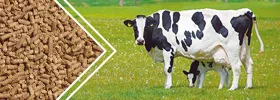
Cattle feed production is becoming increasingly important as livestock farms move toward more scientific and efficient feeding systems. Instead of purchasing all feed from outside suppliers, many farms and small feed manufacturers choose to produce their own cattle feed. This allows them to control feed formulas, utilize locally available raw materials, reduce transportation costs, and adjust production according to the nutritional requirements of different cattle groups.
For farms that need more efficiency than manual feed processing but do not require a fully automated factory, a semi automatic cattle feed plant can be a practical solution. It combines mechanical processing equipment with manual operation at selected stages, offering a balance between investment cost, production efficiency, flexibility, and labor requirements.
What Is a Semi Automatic Cattle Feed Plant
A semi automatic cattle feed plant is a feed production system in which major processing operations are completed by mechanical equipment, while some material feeding, ingredient loading, transfer, or packaging operations may still require workers.
Unlike a completely manual production system, a semi-automatic plant can use dedicated machines for crushing, mixing, pelletizing, cooling, and screening. However, operators may manually load certain ingredients, control some production steps, or move finished feed between stages.
This type of system is especially suitable for small and medium-sized cattle farms, cooperatives, agricultural businesses, and emerging feed manufacturers. It can provide considerably higher productivity than traditional manual processing without requiring the investment associated with a highly automated commercial feed factory.
(view more: https://pelletisingmachine.com/cattle-feed-production-line/)
Why Produce Cattle Feed Pellets
Cattle feed can be prepared in different forms, including mash feed, loose forage mixtures, and pellets. Pelletizing offers several practical advantages for livestock producers.
During pelleting, different ingredients are compressed into uniform particles. This can reduce ingredient separation during transportation and feeding. Pellets are also easier to handle, measure, transport, and store.
A well-designed feed formula can combine energy sources, protein ingredients, fiber sources, minerals, vitamins, and other additives into one finished product. This makes it easier for farmers to provide consistent feed to their cattle.
Pellet production can also make use of agricultural by-products that might otherwise have limited economic value. Depending on the formula, materials such as bran, crop residues, alfalfa, grass, and other suitable resources can be incorporated into cattle feed.
Common Raw Materials for Cattle Feed
The raw materials used in cattle feed vary according to local availability and nutritional requirements.
Corn is commonly used as an energy ingredient, while wheat and barley can also contribute energy to the formulation. Soybean meal and other oilseed meals are frequently used as protein sources.
Forage materials such as alfalfa, grass, hay, and certain types of straw provide fiber. Bran and other agricultural by-products can also be incorporated into appropriate formulations.
Mineral premixes, salt, vitamins, and other additives may be added in smaller quantities. Liquid ingredients such as molasses or oil can also be included when required by the feed formula.
Before designing a production line, the characteristics of these materials should be carefully evaluated. Moisture content, particle size, fiber content, bulk density, and ingredient structure can all affect equipment selection and production performance.
Main Process of Semi Automatic Cattle Feed Production
Although the exact process varies according to the raw materials and final product, a typical semi-automatic cattle feed production process includes raw material preparation, crushing, batching, mixing, pelleting, cooling, screening, and packaging.
Raw Material Preparation
The first stage is receiving and preparing the raw materials.
Grains and other ingredients should be stored in a clean and dry area. Bulky forage materials may need to be chopped before entering the feed production system.
Foreign materials such as stones, metal pieces, and other impurities should be removed to protect processing equipment and improve feed quality.
Crushing
Raw materials that are too large should be reduced to a suitable particle size.
A hammer mill is commonly used for crushing grains and other relatively dry feed materials. For long fiber materials, additional chopping or grinding equipment may be necessary.
Proper particle size improves mixing uniformity and can make the subsequent pelletizing process more stable.
The required particle size should be determined according to the feed formula and pellet specifications rather than simply grinding all ingredients as finely as possible.
Batching
In a semi-automatic system, ingredient batching can be performed through weighing equipment with operator assistance.
The operator prepares different ingredients according to the selected formula and weighs them according to the required proportions.
Compared with completely manual measurement, a weighing system can significantly improve accuracy. At the same time, the operator retains flexibility when changing formulas or processing relatively small batches.
This is one of the reasons semi-automatic systems can be attractive to growing farms that produce several types of cattle feed.
Mixing
After weighing, the ingredients are transferred into a feed mixer.
The mixer combines different materials to create a relatively uniform feed mixture. Proper mixing is particularly important when the formula contains small quantities of additives, minerals, or vitamins.
Liquid ingredients can be added during mixing when required. The addition rate should be controlled carefully to avoid excessive moisture or material adhesion.
A good mixing process creates a consistent material stream for the pellet mill.
Pelletizing
The mixed feed is then sent to a commercial cattle feed pellet machine.
Inside the pellet mill, the feed mixture is compressed through die holes by rotating rollers. The compressed material forms continuous strands and is cut into pellets.
The die diameter can be selected according to the desired finished pellet size.
Pellet quality is affected by several factors, including raw material characteristics, moisture content, formula composition, conditioning conditions, die specifications, and pellet mill operating parameters.
For a semi-automatic production line, operators should monitor the pellet mill carefully and adjust the feed rate when necessary to maintain stable production.
Cooling
Fresh pellets leave the pellet mill at an elevated temperature and should normally be cooled before storage.
A pellet cooler uses airflow to reduce pellet temperature and remove excess moisture.
For smaller production capacities, the cooling configuration can be relatively simple. For larger systems, a dedicated counterflow cooler may provide more efficient continuous cooling.
Proper cooling is essential because insufficiently cooled pellets can experience condensation or quality deterioration during storage.
Screening
After cooling, the pellets can be screened to separate qualified pellets from fines.
The fines can often be returned to the production process, depending on the system design and feed formulation.
Screening helps improve finished product consistency and reduces the amount of loose material in packaged feed.
Packaging
The final cattle feed can be weighed and packed into bags.
In a semi-automatic plant, workers may manually position bags, supervise weighing, and sew or seal the bags after filling.
Although this requires more labor than a fully automatic packaging system, it can reduce initial investment and provide greater flexibility for farms producing relatively limited quantities.
Advantages of a Semi Automatic System
One of the biggest advantages of a semi-automatic cattle feed plant is its balance between machinery and manual operation.
Lower Initial Investment
A semi-automatic system generally requires less automation equipment than a fully automatic feed factory.
For businesses with limited capital, this can make it easier to enter the cattle feed production market.
The saved investment can instead be allocated to essential equipment such as crushers, mixers, pellet mills, cooling systems, and storage facilities.
Flexible Operation
Semi-automatic systems allow operators to adjust production relatively easily.
When the farm needs to change feed formulas, production quantities, or raw materials, operators can make adjustments without relying entirely on a centralized automated system.
This flexibility is useful for farms that produce feed for different cattle groups.
Suitable for Small and Medium Production
Not every cattle farm needs a large industrial feed factory.
A small or medium-sized farm may only need to produce enough feed for its own cattle or supply feed to a limited number of nearby farms.
For such applications, investing in a very large automated plant may not be economically justified.
A semi-automatic configuration can provide sufficient production capacity while keeping the project relatively simple.
Easier to Operate
A semi-automatic plant generally has a straightforward operating structure.
Workers can directly observe material conditions and equipment performance during production. With appropriate training, operators can quickly become familiar with the production process.
Convenient Future Expansion
Another advantage is that semi-automatic systems can often be upgraded.
As production increases, additional conveyors, automatic batching equipment, automatic packaging systems, storage silos, or centralized control functions can be introduced.
This allows the plant to develop gradually rather than requiring a large initial investment.
Who Should Choose a Semi Automatic Cattle Feed Plant
A semi-automatic plant can be suitable for several types of users.
Small and medium-sized cattle farms may choose this configuration to produce feed for their own livestock.
Agricultural cooperatives can also use the system to process locally available feed ingredients and distribute finished feed among members.
Small commercial feed manufacturers may select semi-automatic equipment when they want to enter the local cattle feed market without building a large industrial facility.
It can also be suitable for investors who expect production demand to increase gradually. Starting with a manageable production capacity and upgrading the system later can reduce financial pressure during the early stage of the business.
Factors to Consider Before Building the Plant
Before purchasing equipment, several important factors should be evaluated.
Production Capacity
Determine how much cattle feed needs to be produced per hour or per day.
The capacity should reflect current demand as well as potential future growth. Equipment capacity should also be properly matched so that one machine does not become a bottleneck for the entire system.
Raw Material Availability
Local raw material availability has a major influence on production costs.
If corn, wheat, barley, alfalfa, straw, soybean meal, or other ingredients are readily available locally, they may provide a cost advantage.
The plant should be designed according to the actual raw materials rather than based on a standard equipment list.
Feed Formula
The formula determines which ingredients need to be processed and how accurately they need to be dosed.
A formula containing a large proportion of forage may require stronger crushing and feeding equipment than a formula based primarily on grains and protein meals.
Pellet Size
The required pellet diameter should be determined before selecting the pellet mill die.
Different cattle categories may have different feeding requirements, so producers who intend to manufacture multiple products should consider whether changing dies will be necessary.
Factory Layout
The workshop layout should allow a logical material flow.
Raw materials should enter the plant from the receiving area and move progressively through crushing, batching, mixing, pelleting, cooling, screening, and packaging.
Good layout planning can reduce unnecessary material movement and improve production efficiency.
Semi Automatic vs Fully Automatic Production
The choice between semi-automatic and fully automatic production depends largely on production scale, budget, labor availability, and management requirements.
A semi-automatic plant requires more operator participation. However, it normally has a lower initial investment and can provide greater flexibility for smaller production operations.
A fully automatic system requires less manual intervention and can provide centralized control over batching, material transfer, processing, and packaging. It is generally more suitable for larger commercial feed factories with high production volumes.
Therefore, automation level should not be selected simply because a higher level of automation appears more advanced. The best solution is the one that matches the actual production requirements and expected return on investment.
How to Improve Semi Automatic Cattle Feed Production
Although operators are involved in the production process, several measures can significantly improve efficiency.
First, raw materials should be prepared in advance according to the production schedule. This reduces waiting time between processing stages.
Second, ingredients should be weighed accurately before mixing. A clear formula management system can help prevent mistakes.
Third, the mixer should be operated for an appropriate period to achieve sufficient uniformity without unnecessary energy consumption.
Fourth, operators should monitor pellet mill load, feed rate, and pellet appearance during production.
Fifth, the cooling system should be properly matched with pellet mill output.
Finally, routine maintenance should be performed on all machines. Wear parts should be inspected regularly and replaced when necessary.
Maintenance Requirements
Regular maintenance helps extend equipment service life and maintain stable production.
The crusher should be checked for hammer and screen wear. Bearings, belts, and drive components should also be inspected.
For mixers, operators should check the mixing chamber, paddles or blades, drive system, and seals.
The pellet mill requires particular attention because the die and rollers are major wear components. Proper lubrication and timely replacement of worn parts are important for maintaining production efficiency.
Conveyors and elevators should be inspected for belt alignment, chain condition, bearings, and material accumulation.
The cooler and screening equipment should also be cleaned regularly to prevent material buildup.
A simple preventive maintenance schedule can reduce unexpected downtime and improve overall plant reliability.
Turnkey Support for Cattle Feed Projects
Building a cattle feed pellet plant involves much more than selecting individual machines.
A professional supplier can help analyze raw materials, determine the production process, calculate equipment capacity, design the factory layout, manufacture the equipment, and provide installation and commissioning support.
For customers purchasing a semi-automatic cattle feed plant, the project can be customized according to production capacity, feed formula, pellet diameter, available workshop space, and budget.
Technical training is also important. Operators should understand how to start and stop equipment, adjust production parameters, identify abnormal operating conditions, perform routine maintenance, and handle common problems.
With appropriate technical support, a semi-automatic system can provide a reliable foundation for long-term cattle feed production.
Conclusion
Cattle feed production is an important investment for farms and feed manufacturers seeking better control over feed quality and production costs. A semi automatic cattle feed plant provides a practical middle ground between manual processing and fully automated industrial production.
By integrating key equipment such as crushers, batching systems, mixers, cattle feed pellet mills, coolers, screens, and packaging machines, the system can significantly improve production efficiency while maintaining relatively simple operation.
Its lower initial investment, flexible operation, manageable production scale, and potential for future upgrades make it suitable for many small and medium-sized cattle feed projects.
The most important step is to design the plant according to actual raw materials, feed formulas, target capacity, pellet specifications, labor conditions, factory layout, and investment budget. With the right equipment combination and production process, a semi-automatic system can provide an efficient and economical solution for producing consistent, high-quality cattle feed pellets.