
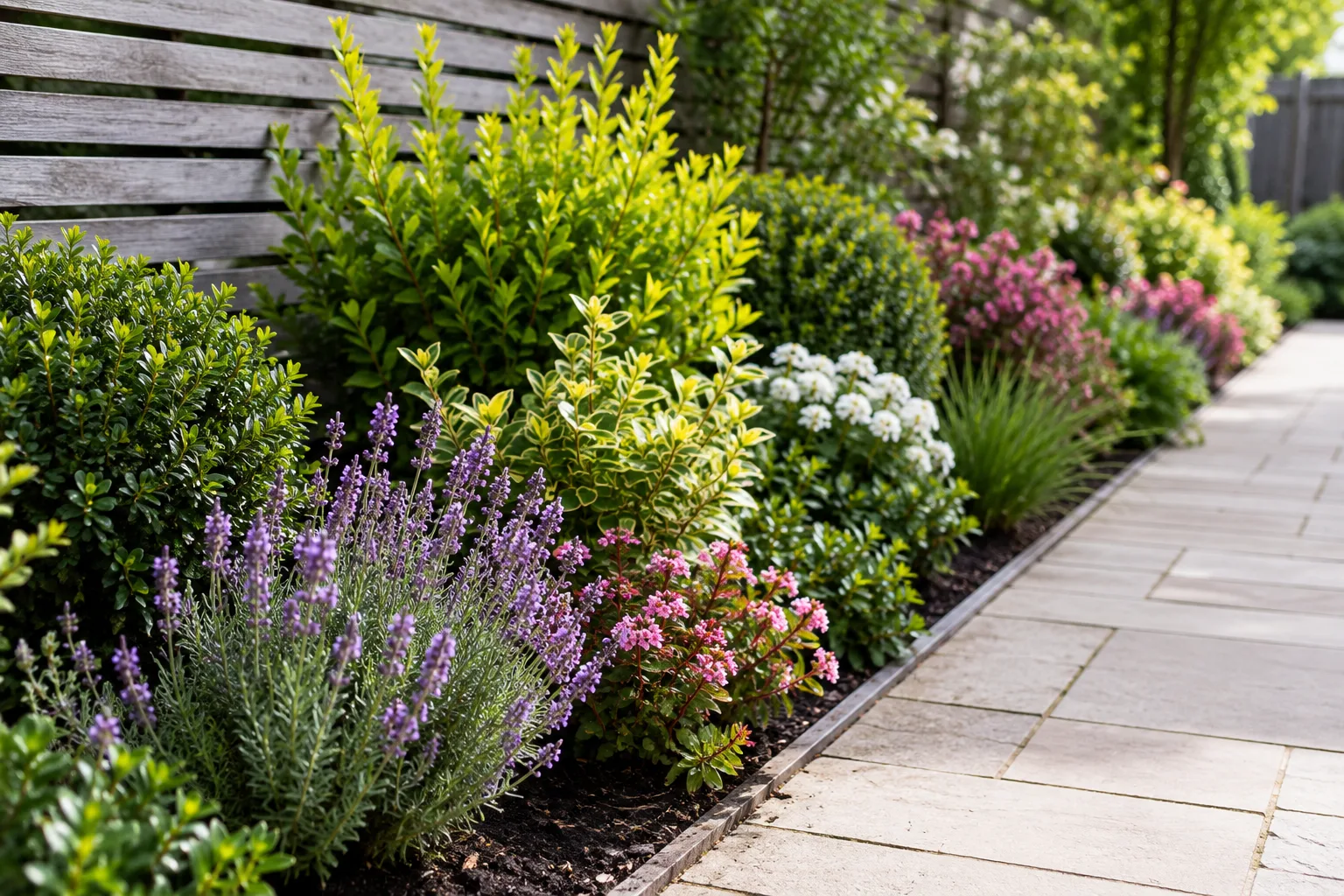
A narrow border can be one of the trickiest spaces to plant. You want greenery, colour and structure, but there is always the risk of choosing plants that eventually become too wide and take over the path, lawn or usable garden space.
The good news is that a narrow border does not mean you have to avoid shrubs altogether. The key is to choose plants according to their mature size and natural growth habit, rather than how small they look when you first buy them.
With thoughtful plant selection, spacing and pruning, even a relatively slim planting area can become a useful part of your garden design.
Why Narrow Borders Need Careful Plant Selection
When planning a narrow planting bed, it is tempting to look at the size of the plant in its pot and assume it will remain roughly that size.
This is one of the most common mistakes gardeners make.
A young shrub may fit comfortably beside a path, but its eventual width could be several times greater. If several plants are positioned too closely together, the border can quickly become overcrowded.
This can lead to:
- Plants competing for water and nutrients
- Poor airflow between branches
- More frequent pruning
- Plants spreading over paths
- A crowded appearance
- Less room for other planting
Instead, consider the space available at the plant's mature size.
Everything Plants offers a wide range of shrubs with different growth habits and characteristics, making it easier to select plants according to the conditions and dimensions of your garden.
What Counts as a Narrow Border?
There is no single measurement that defines a narrow garden border.
A border might run alongside a driveway, fence, wall, patio or garden path and could be only a few feet wide.
The important question is not simply:
"How wide is my border?"
Instead, ask:
"How much space can I realistically allow the plants to occupy once they mature?"
For example, a border beside a pathway needs enough clearance for people to walk comfortably. A border against a fence may have slightly more flexibility because plants can grow towards the boundary.
Before buying anything, measure the available planting area and consider the mature width of each shrub you are considering.
Look at Mature Width, Not Pot Size
This is perhaps the most important rule when choosing shrubs for narrow borders.
A small plant in a container can give a misleading impression of how much room it will eventually require.
Always check:
- Mature height
- Mature width
- Growth rate
- Growth habit
- Whether the plant is evergreen or deciduous
- How much pruning it normally needs
A naturally compact shrub may be much easier to manage in a narrow border than a vigorous plant that needs regular cutting to keep it within bounds.
This approach can also save money in the long term. Choosing the wrong shrub and repeatedly having to cut it back, move it or replace it can become considerably more expensive than selecting the right plant initially.
Choose Shrubs With the Right Growth Habit
Height is only part of the equation.
Two shrubs can reach a similar height but behave very differently in a narrow border.
A naturally upright or compact plant may occupy relatively little horizontal space, while a spreading shrub can quickly extend into surrounding areas.
When selecting plants, consider whether you want:
Upright growth
Upright shrubs can be useful where you want height without excessive spread.
They can help draw the eye upwards and make a narrow garden feel more layered without using too much ground space.
Compact growth
Compact shrubs are particularly useful at the front of borders, around patios or beside paths.
They can provide structure while remaining easier to manage.
Low or spreading growth
Low growing shrubs can work well where you want foliage close to the ground.
However, spreading plants still need sufficient room to reach their mature width, so they should not automatically be considered suitable simply because they remain short.
Evergreen Shrubs Can Make Narrow Borders Feel Fuller
One advantage of evergreen shrubs is that they provide structure throughout the year.
In a small garden, every planting decision can have a noticeable visual impact. When deciduous plants lose their leaves in winter, a border can sometimes appear sparse.
Evergreen shrubs help maintain a consistent framework.
For example, Everything Plants stocks several Euonymus varieties, including Euonymus Fortunei 'Emerald Gaiety' and Euonymus Fortunei 'Emerald 'N' Gold', as well as other evergreen options such as Viburnum Davidii and Osmanthus Burkwoodii.
You can naturally explore the Everything Plants shrubs collection when comparing different evergreen and flowering options for your planting scheme.
The aim is not necessarily to fill every centimetre of the border with evergreen foliage. Instead, use evergreen plants strategically to create structure between seasonal displays.
Mix Evergreen and Flowering Shrubs
A narrow border does not have to be visually boring.
One effective approach is to combine dependable foliage with seasonal flowers.
For example, you could use evergreen shrubs as the structural element and introduce flowering shrubs to provide seasonal colour.
Everything Plants' current shrub range includes options such as Forsythia 'Lynwood Gold', Escallonia, Weigela, Ceanothus and Lavender alongside evergreen varieties.
This allows you to create a border that changes throughout the year without requiring a large planting area.
A spring flowering shrub could provide an early burst of colour, followed by summer flowering plants, while evergreen foliage maintains the underlying structure.
For more ideas, the guide to shrubs for year round colour explores how flowering, evergreen and foliage plants can work together across different seasons.
How Far Apart Should Shrubs Be in a Narrow Border?
There is no universal spacing measurement that works for every shrub.
Spacing should be based on the plant's expected mature size and how quickly you want the border to fill.
Planting too closely can create an attractive effect initially, but problems may develop as the plants mature.
On the other hand, spacing everything too far apart can leave a new border looking bare for several years.
A sensible approach is to consider the mature width of each plant and decide whether you want:
Faster visual coverage: Plants positioned somewhat closer together, provided their mature size and growing conditions allow it.
Long term individual definition: More generous spacing so each shrub has room to develop naturally.
For a permanent border, it is usually better to tolerate a little initial space than to create an overcrowded planting scheme that needs constant pruning.
Consider the Light Before Choosing Your Shrubs
The narrowness of the border is only one consideration.
Light levels can make a significant difference to how successfully a shrub establishes.
Before choosing your plants, observe the border throughout the day.
Ask yourself:
- Does it receive full sun?
- Is it shaded by a wall or fence?
- Does it receive morning sun but afternoon shade?
- Is it exposed to strong winds?
- Does the area remain damp after rainfall?
- Is the soil free draining?
A plant that looks perfect in a catalogue may struggle if the conditions do not suit it.
This is particularly important in narrow borders beside buildings because walls and fences can change light, wind and moisture conditions.
Think About Maintenance Before Planting
One of the biggest benefits of using shrubs is that they can provide long term structure without needing to be replanted every year.
However, some shrubs require more maintenance than others.
If your border sits beside a frequently used path, you may want to prioritise plants that naturally maintain a manageable shape.
Think about how often you are realistically prepared to prune.
A plant that requires repeated hard pruning to prevent it from blocking a walkway may not be the best choice, even if it technically fits the space.
For practical advice, Everything Plants also has a seasonal pruning guide for shrubs, roses and climbers covering when different types of shrubs should be pruned and why timing matters.
Use Layering to Make a Narrow Border Look Bigger
A narrow border can still have depth.
Instead of planting everything at the same height, create subtle layers.
For example:
Back: Taller structural shrubs
Middle: Medium sized flowering or evergreen shrubs
Front: Compact shrubs and lower planting
This creates visual depth without requiring a wide planting bed.
However, avoid making the border too complicated. In a small space, repeating a few complementary plants can often look more cohesive than filling the area with lots of different varieties.
Don't Forget the Space Around the Shrub
The plant itself is not the only thing that needs space.
You also need room for:
- Air circulation
- Watering
- Pruning
- Mulching
- Access to surrounding plants
- Pathways and garden furniture
A shrub that technically fits the border but grows directly across a path is not a successful choice.
When planning, imagine the mature plant rather than the young plant you are purchasing.
This simple change in perspective can make a major difference to the finished garden.
Can You Use Shrubs in Very Narrow Borders?
Yes, but plant selection becomes increasingly important as the available space decreases.
For particularly narrow planting areas, consider compact shrubs, smaller cultivars or plants with a naturally restrained growth habit.
You can also combine shrubs with other planting rather than trying to create a continuous wall of greenery.
For example, pockets of shrubs can be separated with lower plants, gravel or other decorative features.
This creates breathing space and can actually make the border appear larger.
If you are working with limited outdoor space, Everything Plants also has a range of low maintenance shrubs that can help when planning a garden where ongoing maintenance needs to remain manageable.
Common Mistakes to Avoid
Choosing based only on current size
A small shrub can become a large shrub. Always check mature dimensions.
Ignoring the planting conditions
The right plant in the wrong location can struggle regardless of how carefully you maintain it.
Planting everything too close
Dense planting may look good initially but can create overcrowding later.
Relying too heavily on pruning
Pruning can control growth, but it should not be used as a substitute for choosing a suitable plant.
Forgetting winter appearance
Consider how the border will look when flowering plants are dormant.
Trying to fit too many varieties
A narrow border often benefits from repetition and simplicity rather than an excessive number of different plants.
Frequently Asked Questions
What are the best shrubs for narrow borders?
The best shrubs depend on the border's width, light levels, soil and desired height. Compact Euonymus, Lonicera, Lavender and other smaller growing options can be useful, while the wider shrub collection provides choices for different garden conditions.
How wide should a border be for shrubs?
There is no universal minimum width. The border needs to accommodate the mature spread of the plants while leaving sufficient space for paths, access and maintenance. Always check the expected mature width before planting.
Can I plant evergreen shrubs in a narrow border?
Yes. Evergreen shrubs can be particularly useful because they provide foliage and structure throughout the year. Compact varieties are often easier to incorporate into restricted spaces.
Should shrubs be planted close together for a fuller border?
Not necessarily. Planting too closely can result in overcrowding as plants mature. Use mature width as your starting point and consider how quickly you want the border to fill.
What shrubs are good for small gardens?
Compact shrubs, naturally restrained varieties and plants that respond well to pruning can work well in small gardens. The best choice depends on sunlight, soil, mature dimensions and the overall garden design.
How do I stop shrubs from taking over a narrow path?
Choose plants with an appropriate mature width and growth habit. Leave sufficient clearance from the path and prune according to the plant's requirements rather than repeatedly cutting back excessive growth.
Conclusion
A narrow border does not mean you have to compromise on greenery, seasonal colour or garden structure.
The secret is to think beyond the size of the plant when you buy it. Mature width, growth habit, light levels, soil conditions and maintenance requirements all need to be considered before planting.
Compact and evergreen shrubs can provide reliable structure, while flowering varieties can introduce seasonal colour and interest. By combining plants carefully and allowing enough room for them to develop, even a slim border can become an attractive and practical part of your garden.
If you are unsure which shrubs will work best for your available space, explore the Everything Plants shrubs collection and consider the mature characteristics of each plant before making your choice.
Ready to create a better planting scheme for your garden? Browse the collection today or contact Everything Plants for advice on choosing shrubs that suit your space, planting conditions and long term garden plans.