Managing sludge is one of the most challenging parts of wastewater treatment. Sludge typically contains a high percentage of water, which makes it heavy, bulky, expensive to transport, and difficult to handle or dispose of. Sludge dryers provide an effective way to remove much of this moisture and convert wet sludge into a drier, more manageable material.
Depending on the sludge characteristics, required moisture level, plant capacity, available energy sources, and intended end use, different drying technologies can be used. These include direct and indirect dryers, belt dryers, paddle dryers, and fluidized-bed dryers.
This guide explains what a sludge dryer is, how sludge drying works, the main types of sludge dryers, their benefits, applications, energy-efficiency options, and the key factors to consider when selecting a system.
1. What Is a Sludge Dryer?
A sludge dryer is an industrial drying system designed to remove water from sludge generated during wastewater treatment and other industrial processes. By applying heat and controlled airflow or heat transfer, the dryer evaporates moisture from the sludge and produces a significantly drier solid.
Sludge from wastewater treatment plants can contain a large proportion of water. Mechanical dewatering equipment such as centrifuges, filter presses, and belt filter presses can remove a substantial amount of free water, but they generally cannot achieve the low moisture levels possible with thermal drying.
A sludge dryer takes the dewatered sludge and uses thermal energy to evaporate the remaining moisture. The resulting dried sludge is lighter, easier to store and transport, and may be suitable for further processing or beneficial use, depending on its composition and applicable regulations.
Basic Working Principle of a Sludge Dryer
The basic principle is relatively simple:
Dewatered sludge → Heat transfer → Moisture evaporation → Vapour removal → Dried sludge discharge
The dewatered sludge enters the dryer, where it comes into contact with a heated medium or a heated surface. As the sludge temperature rises, its moisture evaporates. The resulting water vapour is separated from the dried material and managed through an exhaust, condensation, filtration, or other vapour-treatment system.
The exact drying mechanism varies by dryer design. Some systems use heated air directly, while others transfer heat indirectly through heated surfaces.
2. How Does a Sludge Dryer Work?
Although sludge dryers differ in design, most thermal drying systems follow several fundamental stages.
Sludge Feeding
The process begins with dewatered sludge feeding. Sludge may come from a centrifuge, belt filter press, filter press, screw press, or another dewatering system.
Consistent feeding is important because sludge can vary considerably in moisture content, particle size, viscosity, and composition. Depending on the technology, pumps, conveyors, screws, or other feeding equipment may be used to introduce sludge into the dryer.
For sticky or highly viscous sludge, the feeding and mixing arrangement is particularly important. Poor feed consistency can affect heat transfer, drying performance, and the stability of the overall process.
Heating and Moisture Evaporation
Once inside the dryer, the sludge receives thermal energy. This energy raises the temperature of the material and causes water to evaporate.
In a direct dryer, heated gas or air comes into direct contact with the sludge. Heat is transferred directly to the wet material, while the moisture becomes part of the exhaust gas stream.
In an indirect dryer, heat is transferred through a heated surface, such as a jacket, paddle, disc, or tube. The heating medium does not normally come into direct contact with the sludge.
The required heat depends on factors such as the initial moisture content, target final moisture, sludge composition, feed temperature, dryer efficiency, and heat losses.
Drying Process
Drying generally progresses through different stages rather than occurring at one constant rate.
Initially, relatively accessible surface moisture can evaporate readily. As drying continues, moisture within the sludge particles must migrate toward the surface before it can be removed. The sludge may also change physically during drying, becoming less sticky and more granular as water is removed.
Good mixing and heat transfer help expose more sludge surface area and promote uniform drying.
The target moisture content depends on the application. Some facilities may require partial drying to improve handling, while others may aim for a much lower moisture content to reduce volume or prepare the material for subsequent thermal or beneficial-use processes.
Discharge of Dried Sludge
After reaching the desired moisture level, the dried sludge is discharged from the dryer.
Depending on the dryer design and final moisture content, the product may leave as granules, pellets, flakes, crumbs, or a relatively dry solid. Additional equipment such as conveyors, coolers, screens, crushers, or storage systems may be incorporated downstream.
Cooling can be particularly useful before storage because dried material may leave the dryer at an elevated temperature.
Moisture and Air Handling
Thermal drying produces a moisture-laden gas stream. Proper vapour, air, dust, and odour management is therefore an important part of the overall system.
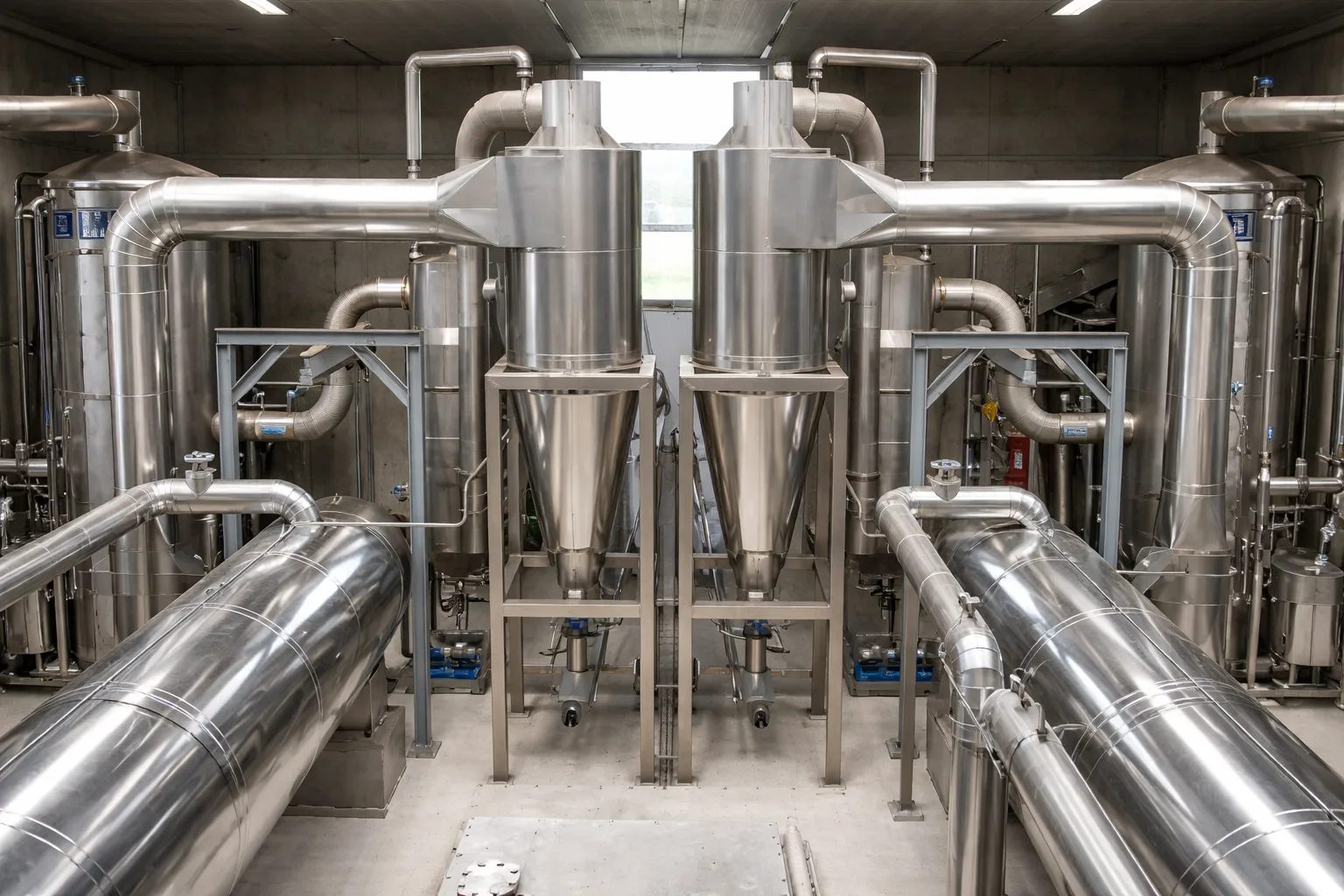
Depending on the process, the exhaust may pass through equipment such as cyclones, filters, condensers, scrubbers, or other treatment systems before the gas is discharged or recirculated.
Closed-loop systems can recirculate process gas and recover heat, potentially reducing energy consumption and controlling emissions more effectively.
3. Types of Sludge Dryers
There is no single sludge dryer suitable for every application. Dryer selection depends on sludge properties, throughput, available heat, desired final moisture, operating conditions, and downstream use.
Direct Sludge Dryers
Direct sludge dryers transfer heat by bringing heated air or gas into direct contact with the sludge.
As the hot gas contacts the wet sludge, heat is transferred to the material and water evaporates. The moisture-laden gas is then removed from the dryer.
Direct systems can provide effective heat and mass transfer and may be suitable for applications requiring relatively high evaporation rates. However, the exhaust gas can contain dust, odours, and other contaminants, so an appropriate gas-treatment system may be required.
Indirect Sludge Dryers
Indirect sludge dryers transfer heat through a heated surface rather than directly mixing the heating medium with the sludge.
Examples include dryers using heated paddles, discs, tubes, or jackets. A thermal fluid, steam, hot water, or another heating medium can provide the required heat.
One advantage of indirect drying is that the drying gas and sludge do not need to be directly mixed. This can simplify process-gas management in certain applications and can make the technology attractive when heat recovery or controlled-atmosphere operation is important.
Belt Dryers
Belt dryers use a perforated or specially designed moving belt to carry sludge through a controlled drying chamber.
Heated air circulates through or around the sludge layer, gradually removing moisture as the material travels through different drying zones.
Belt dryers can be useful for continuous processing and can provide relatively gentle drying conditions. They are commonly considered where large quantities of dewatered sludge need to be dried continuously and where a controlled final moisture content is required.
The sludge feed must generally be prepared appropriately to ensure consistent air contact and avoid excessive sticking or uneven drying.
Paddle Dryers
Paddle dryers use rotating paddles mounted on shafts to mix and move sludge while transferring heat through heated surfaces.
The paddles continuously agitate the material, improving contact with the heated surfaces and helping prevent excessive accumulation of wet sludge.
Because paddle dryers provide both mixing and heat transfer, they can be suitable for sludges with challenging physical characteristics. They can also be designed for indirect operation, which can help control the process atmosphere and exhaust volume.
Fluidized-Bed Dryers
Fluidized-bed dryers use an upward flow of heated gas to suspend and agitate suitably prepared particles, creating a fluid-like drying bed.
The high degree of contact between the drying gas and particles can provide efficient heat and mass transfer. However, the feed generally needs to have appropriate particle characteristics for effective fluidization.
For sludge applications, upstream conditioning or pelletization may therefore be necessary depending on the specific material and dryer design.
4. Benefits of Sludge Dryers
Thermal sludge drying can provide several operational and economic benefits when properly integrated into a wastewater or industrial sludge-management system.
Significant Moisture Reduction
The primary purpose of a sludge dryer is to remove moisture.
Mechanical dewatering alone leaves a considerable amount of water in many sludge streams. Thermal drying can reduce the remaining moisture much further, depending on the technology and operating conditions.
Lower moisture content can substantially improve the physical characteristics of the sludge and make subsequent handling easier.
Reduced Sludge Volume
Removing water directly reduces the mass and volume associated with the sludge stream.
This can be particularly important for facilities dealing with large quantities of sludge every day. Less material needs to be stored, transported, and handled after drying.
The exact reduction depends on the initial and final moisture contents, so facilities should evaluate mass balance calculations rather than relying on a generic percentage reduction.
Lower Transportation and Disposal Costs
Water is heavy. Transporting wet sludge therefore means paying to move significant quantities of water along with the solids.
By reducing moisture before transportation or disposal, a sludge dryer can reduce the amount of material that must be moved. This may lower transportation requirements and, depending on the disposal arrangement, potentially reduce disposal costs.
The financial benefit depends on local transport distances, disposal fees, energy costs, and the characteristics of the sludge.
Potential Fuel or Agricultural Applications
Dried sludge may have potential for fuel-related or agricultural applications, depending on its composition, treatment history, contamination levels, local regulations, and end-use requirements.
Some sewage sludge products can have useful calorific value after drying and may be considered for thermal applications where permitted. Other treated sludge materials may be suitable for land application under applicable regulatory requirements.
Importantly, drying does not automatically make sludge suitable for any particular end use. Heavy metals, pathogens, persistent contaminants, nutrient content, ash characteristics, and regulatory requirements must be assessed before beneficial use.
5. Where Are Sludge Dryers Used?
Sludge drying is used across a wide range of industries and wastewater-treatment applications.
Municipal Wastewater Treatment Plants
Municipal wastewater treatment plants generate sludge as part of biological and solids-treatment processes.
A sludge dryer can be installed downstream of mechanical dewatering to further reduce moisture before transportation, disposal, incineration, or another approved end use.
For large municipal plants, continuous drying systems can provide a way to integrate sludge treatment into an overall solids-management strategy.
Industrial Wastewater Treatment
Industrial facilities can generate sludge with very different characteristics depending on the manufacturing process.
Food, textile, chemical, metal-processing, pharmaceutical, and other industries may produce sludges with different moisture levels, organic content, salts, oils, and inorganic solids.
A dryer must therefore be selected based on the specific sludge properties, rather than simply the industry category.
Food-Processing Industries
Food-processing operations can produce organic-rich sludge from wastewater treatment.
Depending on its composition and applicable regulations, drying can reduce moisture and improve handling, storage, and transportation.
Because organic sludges can be biodegradable and odorous, proper drying, air handling, and odour control are important considerations.
Chemical and Pharmaceutical Industries
Chemical and pharmaceutical wastewater can produce complex sludge streams containing inorganic and organic compounds.
Thermal drying can reduce moisture and make the resulting material easier to handle, but careful assessment of the sludge composition is essential. In some cases, volatile or hazardous compounds may require specialized process design and exhaust treatment.
Paper and Pulp Industries
Paper and pulp mills can generate substantial quantities of sludge containing fibres, fillers, minerals, and other solids.
Drying can reduce the mass and volume of this material and, where permitted and technically appropriate, support energy recovery or other downstream applications.
6. Factors to Consider When Choosing a Sludge Dryer
Selecting a sludge dryer should be based on the complete process rather than the dryer alone. Several factors can significantly affect performance, operating cost, and system reliability.
Sludge Type and Characteristics
First, understand the sludge itself.
Important characteristics can include:
- Organic and inorganic content
- Particle size
- Viscosity
- Stickiness
- Bulk density
- Thermal properties
- Presence of oils or chemicals
- Corrosive components
- Volatile compounds
- Odour potential
A sludge that is easy to dry in one dryer may behave very differently in another.
Initial Moisture Content
The initial moisture content has a major impact on energy requirements.
For example, drying sludge from 80% moisture to 20% moisture is a very different thermal task from drying sludge from 60% to 20%. The amount of water that must be evaporated should therefore be calculated during system design.
Required Final Moisture Level
The target final moisture should be determined by the intended application.
A lower moisture target generally requires more evaporation and therefore more energy. Over-drying material beyond what is necessary can increase operating costs without providing a corresponding benefit.
Processing Capacity
The dryer must be sized according to the required sludge throughput.
Capacity should be evaluated in terms of both wet-feed throughput and evaporation duty, because two sludge streams with the same wet mass flow can require very different amounts of thermal energy depending on their moisture content.
Energy Consumption
Energy consumption is one of the most important considerations in thermal sludge drying.
The available energy source could include steam, natural gas, biogas, electricity, thermal oil, waste heat, solar thermal energy, or a combination of sources.
A proper evaluation should consider not only the dryer's nominal thermal efficiency but the energy performance of the entire drying system.
Operating and Maintenance Requirements
A dryer should also be evaluated for practical operation.
Consider:
- Cleaning requirements
- Wear and replacement parts
- Maintenance intervals
- Automation level
- Operator requirements
- Feed-system reliability
- Availability of spare parts
- Ease of inspection
- Safety systems
A system with good theoretical efficiency may not deliver the expected results if it is difficult to operate or maintain.
Emission and Odour-Control Requirements
Drying can release water vapour as well as dust, odorous compounds, and potentially other volatile substances.
The required treatment depends on sludge composition and dryer design. Equipment such as condensers, cyclones, bag filters, scrubbers, thermal treatment units, and other gas-treatment technologies may be integrated into the process.
Environmental permitting and local emission standards should be considered during the design stage.
7. Energy Efficiency and Sustainability
Because thermal drying requires energy to evaporate water, energy efficiency is a critical consideration. Modern sludge-drying systems can incorporate heat recovery and alternative energy sources to reduce overall energy demand.
Waste-Heat Utilization
One of the most attractive approaches is using waste heat from an existing industrial or wastewater-treatment process.
Heat that would otherwise be released into the environment can potentially be recovered and used for sludge drying. This can reduce the requirement for additional fuel or electricity.
The feasibility depends on the temperature, availability, quality, and consistency of the waste-heat source.
Solar Thermal Energy
Solar thermal systems can provide heat for sludge drying in locations with suitable solar resources.
Solar energy can be particularly attractive when drying requirements align with available solar radiation. However, weather conditions, land requirements, seasonal variations, and the need for backup energy must be considered.
Heat-Pump Drying
Heat-pump drying can use electricity to transfer heat efficiently from one location to another.
In suitable applications, heat pumps can recover and reuse heat from humid exhaust streams, reducing the amount of external energy required.
Their effectiveness depends on factors such as the required drying temperature, ambient conditions, electricity cost, and available heat sources.
Energy Recovery
Dried sludge may contain useful energy, particularly when it has a high proportion of organic matter.
Where regulations and plant economics allow, dried sludge can potentially be used in thermal applications or integrated with energy-recovery systems.
This creates an important distinction between simply treating sludge as waste and treating it as a potential resource.
Closed-Loop Drying Systems
Closed-loop drying systems recirculate process gas rather than continuously exhausting large quantities of heated air.
The humid gas can be cooled or condensed to remove moisture, while recovered heat is returned to the drying process.
This approach can reduce heat losses and may also provide better control of odours and emissions. Closed-loop systems can be particularly attractive where environmental controls and energy efficiency are major priorities.
8. How to Select the Right Sludge Dryer
Choosing the right sludge dryer requires looking at the complete material and energy balance.
A practical evaluation should start with the quantity of wet sludge generated, its initial moisture content, and the desired final moisture content. From there, the amount of water requiring evaporation can be estimated.
The next step is to consider the sludge's physical and chemical characteristics. Sticky sludge, fibrous sludge, granular material, oily sludge, and inorganic-rich sludge can behave very differently during drying.
The available energy source is another major factor. A facility with access to low-grade waste heat may have a very different optimal configuration from a plant that relies entirely on purchased electricity or fuel.
Finally, the intended destination of the dried product should be considered. Disposal, agricultural use, fuel use, incineration, or further processing can require different final moisture levels and product characteristics.
Pilot testing can also be valuable for difficult sludge streams because laboratory or pilot-scale trials can help determine drying behaviour, energy requirements, product characteristics, and potential operational challenges before a full-scale system is installed.
9. Conclusion
Sludge dryers provide an effective method for reducing the moisture content, mass, and volume of wastewater and industrial sludge. By applying controlled thermal energy, they transform dewatered sludge into a drier and easier-to-handle material, potentially reducing transportation and disposal requirements while opening opportunities for further processing or beneficial use.
Direct dryers, indirect dryers, belt dryers, paddle dryers, and fluidized-bed dryers each use different approaches to achieve moisture removal. The right technology depends on the sludge's physical and chemical characteristics, feed moisture, required final moisture, processing capacity, available energy, operating requirements, and environmental controls.
Energy efficiency is becoming increasingly important, making waste-heat recovery, heat pumps, solar thermal systems, energy recovery, and closed-loop drying valuable considerations for modern sludge-management projects.
Ultimately, a sludge dryer should not be selected based on drying capacity alone. A successful system considers the entire sludge-treatment process from dewatering and thermal drying to air handling, storage, transportation, disposal, and potential end use. With the right technology and process design, sludge drying can become an important part of a more efficient and sustainable solids-management strategy.