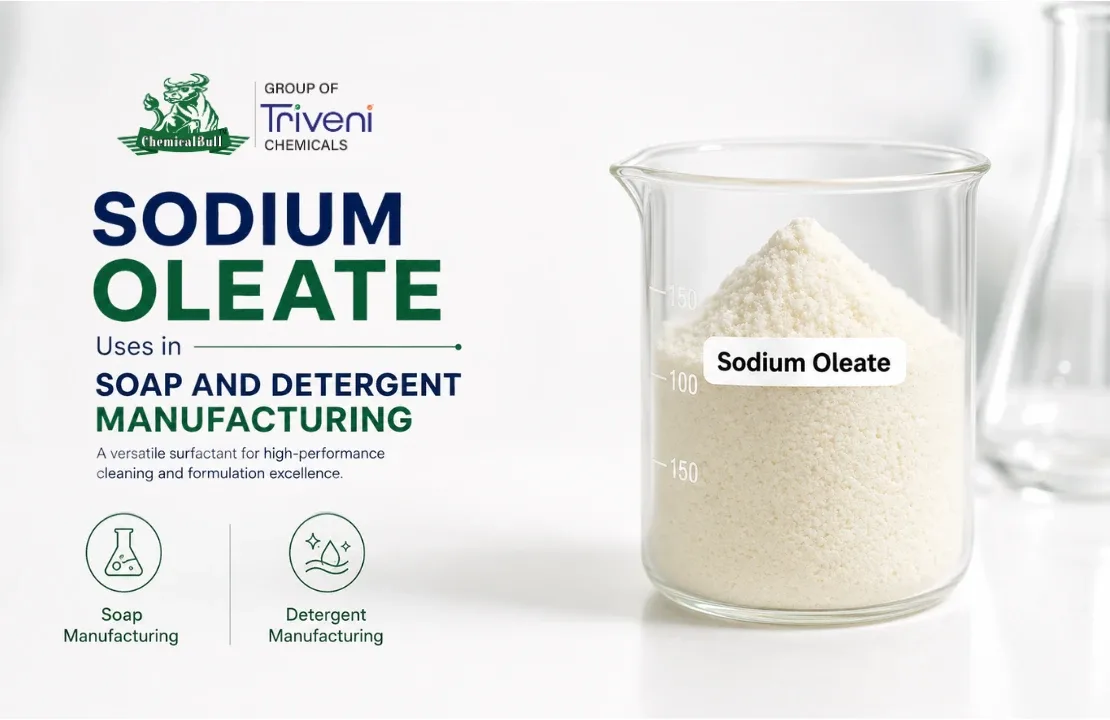
Sodium oleate is an important fatty acid salt used in a range of formulations where cleansing, emulsification, wetting, and interaction with oily materials are required. As the sodium salt of oleic acid, it belongs to the family of fatty acid soaps and has applications extending from conventional soap manufacturing to industrial cleaning and processing.
Its amphiphilic structure allows sodium oleate to interact with both water and oil-based substances. This property makes it useful for manufacturers developing formulations that need surface activity and improved handling of oily contaminants.
Chemical Bull supplies the Sodium oleate in bulk quantity with competitive pricing.
Understanding the Chemistry of Sodium Oleate
Sodium oleate is formed from oleic acid and sodium. Oleic acid is a monounsaturated fatty acid with a long hydrocarbon chain, while the carboxylate portion interacts more readily with water.
This dual nature gives sodium oleate its surface-active characteristics. In aqueous systems, it can help facilitate interaction between water and hydrophobic substances such as oils and grease.
The basic structure of sodium oleate makes it relevant to several formulation functions, including:
- Cleaning and soil removal
- Oil dispersion
- Emulsification
- Wetting
- Surface activity
- Soap formation
These properties explain why sodium oleate continues to be considered for different industrial formulation requirements.
Sodium Oleate and Traditional Soap Chemistry
Fatty acid soaps are among the oldest surfactant systems used for cleaning. Sodium oleate fits into this chemistry because it is a sodium salt of a fatty acid.
When fatty acid salts are placed in water, their molecules can organize at interfaces and interact with oily substances. This behavior contributes to the cleansing mechanism associated with soap-based formulations.
Manufacturers may combine sodium oleate with other fatty acid salts to modify the characteristics of a finished soap system. The choice of fatty acid composition can influence properties such as hardness, lather, solubility, and cleansing behavior.
For additional information on the subject, manufacturers can explore this detailed resource on Sodium Oleate Uses in Soap and Detergent Manufacturing.
How Sodium Oleate Supports Emulsification
Many industrial processes involve materials that do not naturally mix, particularly water and oils. Emulsification helps distribute one phase within another and can be important for producing stable or functional formulations.
Sodium oleate can act at the interface between aqueous and oily phases. Its molecular structure enables it to associate with hydrophobic materials while maintaining interaction with water.
Depending on the formulation, this can support:
- Oil dispersion in aqueous systems
- Improved wetting of oily surfaces
- Reduction of interfacial tension
- Distribution of hydrophobic components
- Formation of fatty-acid-based emulsifying systems
The effectiveness of sodium oleate depends on factors such as concentration, temperature, pH, water composition, and the presence of other formulation ingredients.
Use of Sodium Oleate in Cleaning Formulations
Industrial cleaning is an important application area for fatty acid soaps. Manufacturing equipment, machinery, tools, and industrial surfaces can accumulate oil, grease, and other hydrophobic residues.
Sodium oleate can contribute to cleaning systems by helping water interact more effectively with oily contaminants. Once the contaminant is dispersed, it can be removed from the surface during the washing process.
This makes sodium oleate relevant to selected:
- Industrial cleaners
- Degreasing systems
- Soap-based cleaning products
- Equipment cleaning formulations
- Surface-cleaning applications
The formulation must be designed according to the type of contamination and the surface being cleaned.
Sodium Oleate in Textile Processing
The textile industry uses various chemical auxiliaries during cleaning, processing, dyeing, and finishing operations. Surface-active ingredients can assist with wetting and removal of oils or processing residues.
Sodium oleate may be considered for selected textile formulations where fatty acid soap chemistry is suitable. Its interaction with oils and aqueous systems can support specific cleaning or processing requirements.
Its use will depend on the textile material, process conditions, water quality, and other auxiliaries present in the formulation.
Applications in Metalworking
Metalworking processes frequently involve oils, lubricants, and other materials used to protect or process metal surfaces. Fatty acid salts can have applications in systems involving lubrication, emulsification, or surface treatment.
Sodium oleate can therefore be evaluated for selected metalworking formulations where its surface-active and fatty-acid-based properties are appropriate.
For industrial users, the selection of sodium oleate should be based on the required performance characteristics and compatibility with the complete formulation.
Effect of Water Quality on Performance
Water composition can have a significant effect on traditional soap systems. Hard water contains calcium and magnesium ions that can interact with fatty acid salts.
These interactions may reduce the effectiveness or solubility of soap-based materials and can contribute to deposits under certain conditions.
For this reason, manufacturers using sodium oleate in aqueous formulations should consider:
- Water hardness
- Mineral content
- pH
- Temperature
- Concentration
- Other surfactants and additives
Understanding these variables helps formulators develop more consistent cleaning and processing systems.
Factors to Consider When Selecting Sodium Oleate
For commercial applications, selecting the right material is only one part of the procurement process. Manufacturers should also consider the consistency and documentation provided by their chemical supplier.
Important purchasing factors can include:
- Product specifications
- Grade and intended application
- Certificate of Analysis (COA)
- Technical documentation
- Packaging requirements
- Batch consistency
- Order quantity
- Delivery schedule
- Export support
Reliable documentation is particularly important for businesses purchasing chemicals repeatedly for manufacturing operations.
Sourcing Sodium Oleate for Industrial Requirements
Manufacturers, distributors, and formulators may require sodium oleate in different quantities depending on their production needs. A supplier with experience in industrial chemical sourcing can help buyers evaluate specifications and commercial requirements.
Chemical Bull supplies and supports sourcing of chemicals for various industrial applications. Its chemical portfolio serves businesses involved in manufacturing, formulation, cleaning, personal care, and related sectors.
For buyers evaluating sodium oleate, discussing grade, packaging, quantity, documentation, and delivery requirements with a supplier can help establish a suitable procurement process.
Conclusion
Sodium oleate remains a useful fatty acid soap for applications involving cleaning, emulsification, wetting, and interaction with oily substances. Its chemistry makes it relevant to traditional soap systems as well as selected industrial applications in cleaning, textile processing, and metalworking.
Understanding how sodium oleate behaves in different formulation environments allows manufacturers to assess where it can provide practical value. Water quality, concentration, temperature, formulation composition, and application requirements should all be considered when developing a sodium oleate-based system.
Recommended backlink anchor text: Sodium Oleate Uses in Soap and Detergent Manufacturing