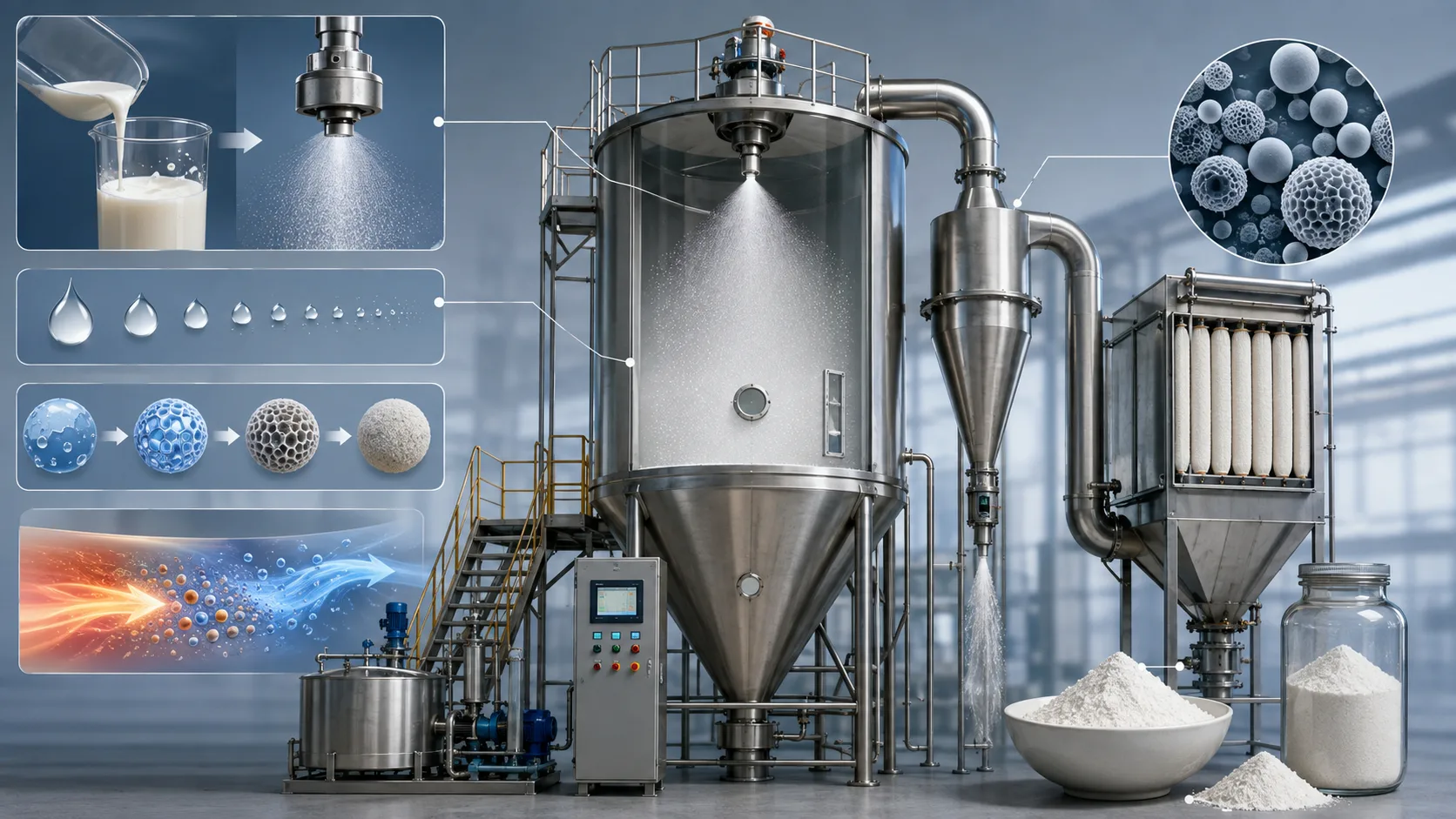
A spray dryer is often explained in one sentence: a liquid feed is converted into dry powder by spraying it into a stream of hot air. While that describes the basic operation, it does not explain why two spray drying processes using similar equipment can produce very different powders.
The important details are found in the relationship between the liquid feed, droplet size, drying air, residence time, and powder collection system. For many applications, controlling these factors is more useful than simply increasing the inlet air temperature.
The process starts with the feed liquid. Its solids content, viscosity, temperature, density, and surface characteristics can influence atomization. A dilute liquid behaves differently from a concentrated slurry. As the solid’s concentration changes, the amount of water that must be removed also changes. The feed may also become more difficult to pump or atomize as its concentration increases.
Spray drying is a process were feed preparations really important. If the feed is stable, it makes the step, which is atomization, more predictable. When the viscosity of the feed changes it can affect the way the spray comes out. If the solids concentration changes it can affect the final powder, like how much moisture it has and what the particles look like.
The atomization part is right in the middle of the process. This is where the liquid is broken down into droplets using a special device like a pressure nozzle or a rotary atomizer. The size of these droplets is really important because it affects how the drying happens. Smaller droplets have a surface area so the moisture can evaporate quickly. But larger droplets take longer to dry so they need time.
However, making all the droplets small is not always the best thing to do. Fine particles can create a lot of dust affect how well the powder is recovered and even change the properties of the final product. So the size of the particles depends on what the powder's going to be used for after it is dried.
This is why designing a spray dryer is about finding a balance between atomization and handling the powder. If a process makes a fine powder, it might behave differently in the equipment that collects the powder compared to a process that makes larger particles.
Temperature is also something that people often do not understand about spray drying. Just because the inlet temperature is high does not mean the product itself gets that hot. When water evaporates from a droplet it takes heat away, from the droplet. So, the actual temperature of the product depends on the stage of drying, how much moisture is left the air conditions and how long it takes.
This distinction can be particularly important for heat-sensitive materials. The purpose of a well-controlled spray drying process is not simply to expose the feed to the highest possible temperature. It is to create sufficient driving force for moisture removal while keeping the product within an acceptable thermal range.
The outlet temperature therefore deserves much attention as the inlet temperature. It provides information about the balance between heat input, moisture evaporation and powder discharge conditions. A changing outlet temperature can indicate changes in feed rate, feed moisture, air conditions or other process variables.
Residence time also affects the result. After atomization droplets pass through a drying chamber while moisture evaporates. The actual time available for drying depends on chamber design, air velocity, droplet size, feed rate and the properties of the material. If the drying time is insufficient the powder may leave with moisture. Excessive residence time or inappropriate thermal conditions can contribute to product changes.
The drying chamber itself needs consideration. Air and droplets must meet in a way that provides contact without causing excessive deposition, on the chamber walls. Sticky materials can create deposits that gradually reduce chamber volume or interfere with operation. Wall build-up can also affect cleaning requirements and production continuity.
Powder recovery is another part of the process that's easy to overlook. Not all particles behave the way once they leave the drying chamber. Larger particles may be easier to collect while fine particles can remain suspended in the exhaust gas. Cyclones, filters or combinations of collection methods may be used depending on the powder characteristics and required recovery rate.
The final powder properties can also be influenced by the way droplets dry internally. Depending on the formulation and operating conditions particles may become dense, porous, hollow or irregular. Those differences can affect density, flowability, solubility, reconstitution and handling.
Moisture is not always the quality indicator. Two powders can have moisture content while having different particle structures and flow properties. This is why spray drying development considers particle size distribution, bulk density, residual moisture, flowability and other application-specific characteristics.
Energy use is another practical concern. Spray drying requires substantial energy because a large quantity of water must be evaporated. One way to improve the process is to examine the feed concentration before drying. Removing some water upstream through concentration or another suitable process can reduce the evaporation load placed on the spray dryer.
Heat recovery can also be relevant. Exhaust air contains useful thermal energy, although the economic value of recovery depends on the process conditions, equipment arrangement, and operating profile. A spray drying system should therefore be evaluated as part of the wider production line rather than as an isolated piece of equipment.
Cleaning should also be included in the initial design discussion. Product residues may accumulate in the chamber, nozzles, ducts, and collection equipment. The cleaning method and frequency can affect production scheduling, water use, labour requirements, and hygiene where applicable.
For industries considering a spray dryer for milk powder, food ingredients, extracts, chemicals, ceramics, or other liquid feeds, the most useful questions are not limited to drying capacity. Feed concentration, atomizer selection, droplet size, air conditions, chamber geometry, residence time, powder recovery, and cleaning requirements all contribute to the practical performance of the system.
A spray dryer is therefore more than a machine for removing water. It is a system for controlling how a liquid becomes a powder. The better the relationship between feed properties, atomization, air movement, heat transfer, and collection, the more predictable the final product is likely to be.