Steel is one of the most important materials used in modern construction. From residential houses and apartment buildings to commercial complexes and industrial structures, reinforcement steel provides the strength needed in reinforced concrete structures.
Before starting a construction project, builders and contractors must estimate how much steel is required. Purchasing too much steel can increase project expenses, while ordering insufficient quantities can interrupt construction activities.
A steel quantity calculator helps estimate the amount of reinforcement steel required based on bar diameter, length, and quantity. It also helps contractors plan material procurement and manage construction budgets.
In this guide, we will explain how to estimate steel quantities, calculate TMT bar weight, and improve material planning for construction projects.
What Is a Steel Quantity Calculator?
A steel quantity calculator is a tool used to estimate the total weight of reinforcement steel required for a construction project.
It generally uses three important inputs:
- Steel bar diameter in millimetres
- Length of each bar in meters
- Number of bars required
By entering these details, users can calculate the approximate steel weight in kilograms or metric tonnes.
This calculation is useful for civil engineers, quantity surveyors, contractors, builders, and homeowners.
Steel Quantity Calculation Formula
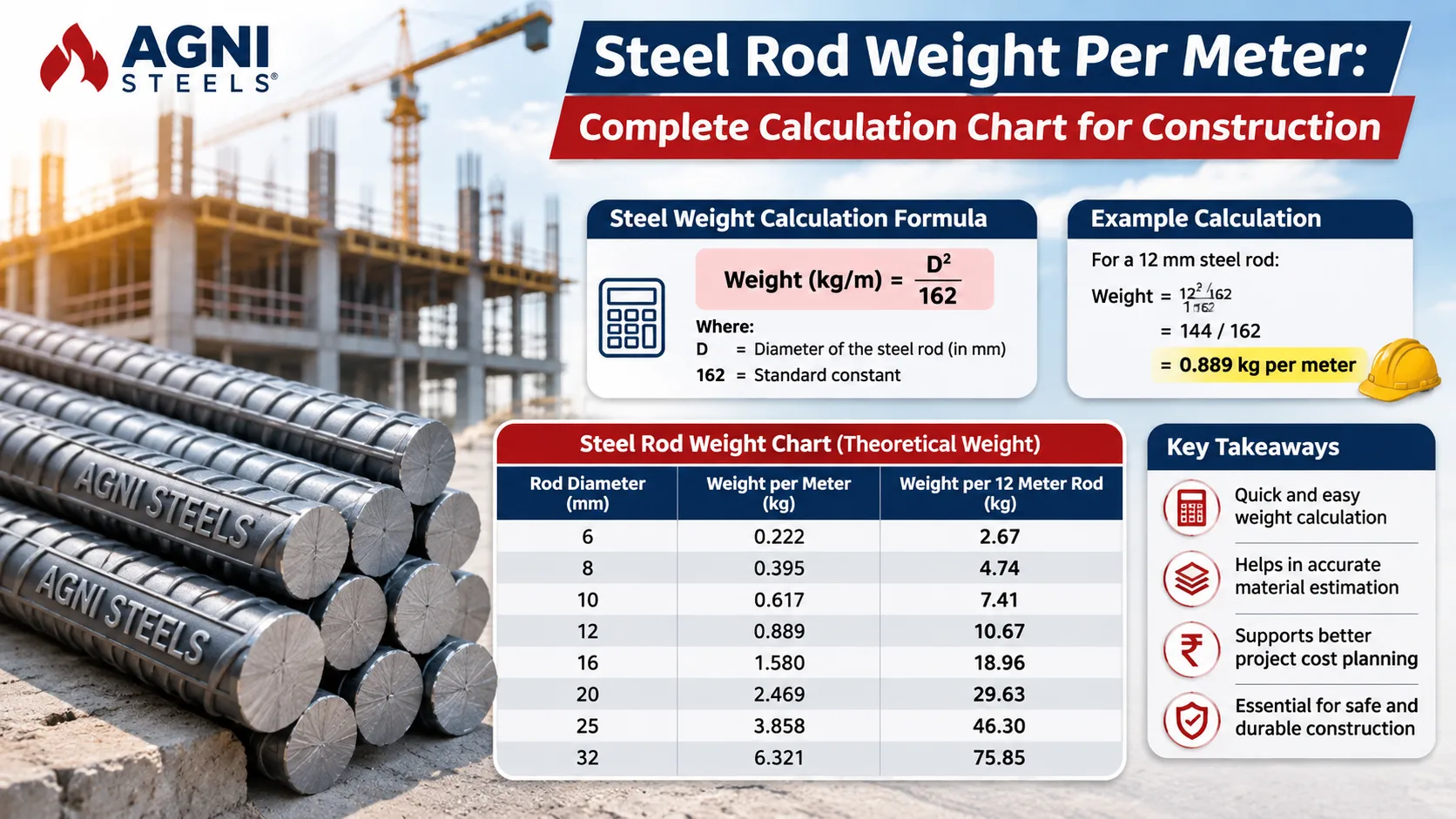
The standard formula for calculating the theoretical weight of a round steel reinforcement bar is:
Steel Weight = D² × L / 162
Where:
- D = Diameter of the steel bar in millimeters
- L = Length of the steel bar in meters
- 162 = Approximate conversion constant
To calculate the total weight of multiple bars:
Total Steel Weight = D² × L × N / 162
Where N represents the number of bars.
Example of Steel Quantity Calculation
Suppose a construction project requires:
- Bar diameter: 12 mm
- Length of each bar: 12 meters
- Total number of bars: 100
Using the formula:
Total Weight = 12² × 12 × 100 / 162
= 172,800 / 162
Total steel weight = 1,066.67 kg approximately.
Therefore, the project requires approximately 1.067 tonnes of 12 mm steel bars for this particular quantity.
Steel Weight Chart for Common TMT Bar Sizes
The following chart helps estimate the theoretical weight of different reinforcement bar sizes.
| Bar Diameter | Weight Per Metre | Weight Per 12 Metres |
|---|---|---|
| 6 mm | 0.222 kg | 2.67 kg |
| 8 mm | 0.395 kg | 4.74 kg |
| 10 mm | 0.617 kg | 7.41 kg |
| 12 mm | 0.889 kg | 10.67 kg |
| 16 mm | 1.580 kg | 18.96 kg |
| 20 mm | 2.469 kg | 29.63 kg |
| 25 mm | 3.858 kg | 46.30 kg |
| 32 mm | 6.321 kg | 75.85 kg |
These values are theoretical estimates. Actual steel weights may vary within applicable manufacturing tolerances.
How to Estimate Steel Requirements for Different Construction Components
Steel requirements vary depending on the structural component and engineering design.
1. Steel Quantity for Slabs
Slabs generally contain reinforcement bars arranged in one or two directions. The number of bars depends on slab dimensions and the spacing specified in the structural drawings.
For a preliminary estimate:
Number of bars = (Available width / Bar spacing) + 1
Total length = Number of bars × Length of each bar.
The same process is followed for the perpendicular reinforcement direction.
The calculated total length is then converted into weight using the steel weight formula.
2. Steel Quantity for Beams
Beam reinforcement typically includes top bars, bottom bars, and stirrups.
The total quantity depends on beam length, reinforcement diameter, anchorage, lap lengths, stirrup spacing, and structural detailing.
Each reinforcement type should be calculated separately before combining the total quantity.
3. Steel Quantity for Columns
Columns generally include longitudinal reinforcement and transverse ties.
The number of main bars, their lengths, and the quantity of ties must be determined using the approved structural design.
4. Steel Quantity for Foundations
Foundation reinforcement depends on footing dimensions, soil conditions, structural loads, and engineering specifications.
A reinforcement schedule or bar bending schedule is useful for calculating the required steel quantities.
What Is a Bar Bending Schedule?
A Bar Bending Schedule (BBS) is a document that provides detailed information about reinforcement bars used in a construction project.
It generally includes:
- Bar identification number
- Bar diameter
- Number of bars
- Cutting length
- Shape and bending details
- Total reinforcement length
- Estimated steel weight
A properly prepared BBS helps improve quantity estimation and reduce avoidable cutting and fabrication errors.
Factors That Affect Steel Quantity Estimation
Several factors influence the amount of steel required.
Structural design: Reinforcement requirements are based on engineering calculations and approved drawings.
Building dimensions: Larger structural elements may require more reinforcement.
Number of floors: The building configuration and applied loads influence structural reinforcement requirements.
Bar spacing: Reinforcement spacing directly affects the number of bars required.
Lap length and anchorage: These details increase the actual cutting lengths of reinforcement bars.
Cutting and bending: Fabrication requirements can influence procurement quantities and material utilization.
Common Mistakes in Steel Quantity Calculation
- Using incorrect bar diameters.
- Forgetting additional reinforcement at supports.
- Ignoring lap and anchorage lengths.
- Mixing different bar diameters in one calculation.
- Estimating steel requirements without structural drawings.
- Treating theoretical weight as actual delivered weight.
To avoid these mistakes, use approved structural drawings and a properly prepared reinforcement schedule.
Benefits of Using a Steel Quantity Calculator
A steel quantity calculator offers several practical benefits:
- Helps estimate reinforcement material requirements.
- Makes construction budgeting easier.
- Supports purchase order preparation.
- Improves steel inventory management.
- Helps compare estimated and delivered quantities.
- Saves time during preliminary material estimation.
Why Choose Quality TMT Steel for Construction?
Accurate quantity estimation is important, but selecting suitable reinforcement steel is equally essential.
Before purchasing TMT bars, check the required grade, applicable BIS standards, manufacturer specifications, and product documentation.
Agni Steels provides TMT steel solutions for different construction requirements. Choosing suitable reinforcement materials according to structural specifications helps support reliable construction.
Conclusion
A steel quantity calculator makes reinforcement steel estimation easier for builders, engineers, and contractors. By using the formula D² × L × N / 162, you can estimate the theoretical weight of steel bars based on their diameter, length, and quantity.
For accurate construction procurement, always refer to approved structural drawings and reinforcement schedules.
Plan your steel requirements carefully and choose suitable TMT steel solutions from Agni Steels.