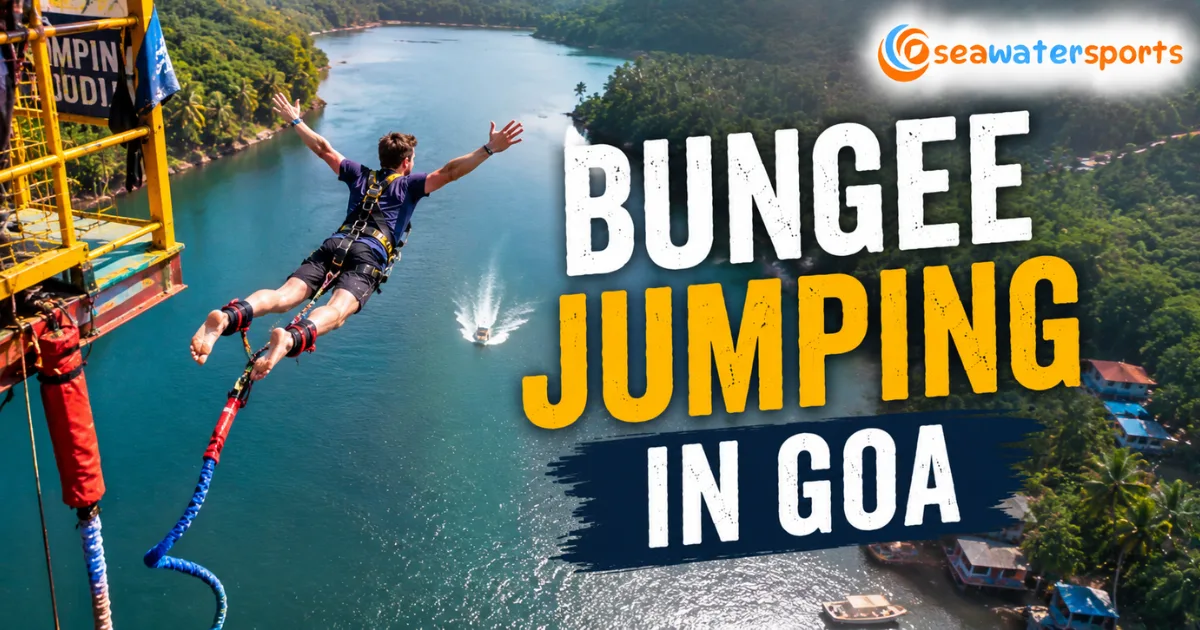
Harness points checked. Cord attachment verified. Weight confirmation, confirmed against the cord specification. Secondary backup clipped and tensioned. Carabiner locks are double-checked by a second crew member.
Only then does the countdown begin.
This meticulous safety process is what transforms bungee jumping from a leap of faith into a professionally managed adventure activity. Every detail is inspected to ensure maximum safety, allowing participants to focus on the thrill of the experience rather than the risks.
With Sea Water Sports, adventure enthusiasts can enjoy bungee jumping and other adrenaline-filled activities under strict safety protocols and expert supervision. From equipment inspections to trained crew support, Sea Water Sports prioritises safety at every stage, ensuring that your unforgettable moment of freefall is backed by world-class operational standards and professional guidance.
That sequence, dry, technical, methodical, is precisely what stands between a transcendent experience and a preventable accident. And if you're planning a Bungee Jumping in Goa experience, understanding what that checklist actually covers is not just interesting background knowledge. It's the framework that tells you whether the operator you've chosen is worth trusting with your bodyweight at height.
This piece breaks down the technical specifications that define professional bungee operations, the equipment standards, the jumpmaster qualifications, the cord engineering, and the physical constraints that govern who can jump safely and who cannot.
The Elastic Cord — Engineering Beneath the Experience
The bungee cord is not a glorified rubber band. It is a precision-engineered component with specific load ratings, elongation tolerances, and fatigue thresholds — and understanding its basic mechanics explains why the weight limits exist and why they are non-negotiable.
Core construction:
- Professional bungee cords are built from natural latex rubber strands bundled in parallel
- Each strand contributes a calculable load capacity to the overall cord assembly
- The outer sheath — typically braided nylon or polyester — provides abrasion resistance without contributing to the elastic function
- Cord diameter and strand count are specified to the platform height and the operator's declared weight range
Key performance parameters:
- Maximum elongation: 3x to 4x resting length
Load capacity (per cord): Rated for a minimum of 2x maximum jumper weight
- Fatigue threshold: Mandatory retirement after a specified jump count
- Temperature sensitivity: Performance degrades below 10°C and above 40°C
- UV degradation: Regular inspection intervals; replacement on visible surface cracking
Why does the elongation ratio matter?
A cord rated to 3x elongation on a 40-metre platform means the cord fully extends at approximately 120 metres of total travel, which is far beyond the platform height. The cord is engineered to reach full extension well before the jumper approaches ground or water level, with a defined safety margin built into that calculation.
Sea Water Sports uses cord assemblies that are inspected before every operational day and retired on a schedule that prioritises safety margin over cost efficiency. Any visible surface degradation triggers immediate replacement regardless of jump count.
Jumpmaster Qualifications — What Does Certification Actually Mean?
The jumpmaster is the most important technical variable in any bungee operation. Equipment can be perfect and still produce an incident if the person operating it lacks the training to read an anomaly before it becomes a problem.
International certification standards for professional jumpmasters typically require:
- Minimum supervised jump count before independent operation (varies by certifying body — typically 200–500 assisted jumps)
- Formal training in cord load calculation — the ability to match cord specification to jumper weight in real time
- Harness fitting and inspection certification — understanding of correct tension, contact points, and failure indicators
- Emergency response training — rescue protocol for mid-cord incidents, including retrieval from full extension
- Regular recertification cycles — typically annual, with practical assessment components
What does a qualified jumpmaster do that an unqualified one doesn't?
- Independently calculates cord selection against your confirmed weight — not estimated, confirmed
- Physically inspects every attachment point before and after every jump
- Identifies and refuses borderline participants — weight at the edge of cord specification, visible anxiety responses that indicate involuntary muscle tension (which affects landing dynamics), jewellery or clothing that could interfere with harness function
- Communicates the jump sequence and body position requirements clearly enough that the participant can execute them correctly
The last point matters more than most people realise. A jumper who crosses their arms incorrectly, tenses their neck, or bends at the waist during free-fall experiences a meaningfully different cord dynamic than one who jumps cleanly. The jumpmaster's briefing is a technical instruction, not a pep talk.
Physical Constraints — The Honest FAQ
What is the weight limit for bungee jumping in Goa?
The standard operational weight range for professional bungee jumping in Goa is 40kg minimum to 110kg maximum. Some operators extend to 120 kg with specific cord configurations, but this requires explicit confirmation at booking, not at the platform.
Why is there a minimum weight?
Below approximately 40kg, the cord's rebound dynamics become unpredictable. The cord is engineered for a load range, and insufficient weight means the cord cannot reach its designed elongation characteristics, resulting in erratic oscillation that the harness system is not designed to manage safely.
Why is there a maximum weight?
Above the cord's rated maximum, the safety margin between full extension and ground clearance narrows to an unacceptable level. The cord specification is not a guideline — it is a load engineering parameter with real physical consequences at the boundary.
Are there height restrictions?
Most operators set a minimum height of approximately 140 cm. This is primarily a harness fit issue — standard harness configurations require a minimum torso and leg length to distribute load correctly across the body.
What medical conditions disqualify participation?
The disqualifying conditions list maintained by responsible operators includes the following:
- Cardiovascular conditions, including hypertension, arrhythmia, and recent cardiac events
- Epilepsy or seizure disorders — the free-fall and rebound cycle can trigger episodes
- Spinal injuries or active back conditions — the cord deceleration force loads the spine significantly
- Recent surgery — particularly abdominal, orthopaedic, or cardiovascular
- Pregnancy at any stage
- Active vertigo conditions — distinct from fear of heights, which is manageable; clinical vertigo is not
- Severe osteoporosis — the rebound dynamics create compressive loading that the condition cannot safely absorb
Equipment Inspection Protocol — What Happens Before You Jump?
A professional operation runs a defined inspection sequence before the first jump of the day and between every participant. Here's what that looks like at a sea water sports-managed facility:
Pre-operational daily inspection:
- Full cord visual inspection under tension — looking for surface cracking, strand separation, or sheath damage
- Carabiner and swivel function test — every locking mechanism opened, closed, and load-tested
- Harness inventory — every harness is inspected for webbing integrity, buckle function, and stitching condition
- Platform structure check — anchor points, platform surface, and barrier integrity
- Jump count log review — any cord approaching retirement threshold flagged for replacement
Per-participant check sequence:
- Weight confirmation on calibrated scale — not estimated from clothing or appearance
- Cord selection confirmed against weight
- Harness fitted and tensioned to specification — not comfort preference
- All attachment points verified by the jumpmaster and seconded by a crew member
- Participant briefing completed and comprehension confirmed — the jumpmaster does not proceed until the participant can correctly describe the jump position
This sequence is not negotiable at any point in the day. The first jumper of the morning and the last jumper of the afternoon receive identical protocols.
How does bungee safety compare across Goa's adventure activities?
For context, it's worth understanding where bungee sits in the broader Adventure Activities in Goa safety framework.
- Bungee Jumping in Goa: Cord failure, harness fit, equipment certification, weight compliance
- Scuba Diving in Goa: Decompression and equipment, divemaster ratio, equipment service records
- ATV Ride in Goa: Terrain, speed, collision, Guide-led format, protective equipment
- Water Sports in Goa: Sea conditions, equipment, operator weather monitoring, life jacket compliance
Each activity has a distinct risk profile and a distinct set of controls. Bungee jumping's controls are heavily front-loaded; the safety work happens before the jump, not during it. That's why the pre-jump protocol is so rigorous and why operators who abbreviate it are cutting the most important part of the entire operation.
The Questions Worth Asking Before You Book?
A technically competent operator will answer all of these without hesitation:
- What is the cord specification and rated weight range for your platform?
- How many jumps has the current cord assembly completed, and what is your retirement threshold?
- What certification does your jumpmaster hold, and when was it last renewed?
- What is your disqualification protocol for borderline participants?
- What emergency response equipment is on-site, and what is the response protocol?
If any of these questions produce evasion, vagueness, or impatience — walk away. The experience is worth having. It is only worth having safely.
Sea Water Sports answers all of them. That's the standard against which every bungee operator in Goa should be measured.
Bungee jumping is not inherently dangerous. It is a mechanically well-understood activity with a robust international safety framework built up over decades of operational experience. The incidents that occur globally, not just in Goa, almost universally trace back to deviation from that framework.
The cord specifications exist because engineers calculated them. Weight limits exist because physics demands them. The jumpmaster protocols exist because experience proved their necessity.
Follow the framework. Choose an operator who takes it seriously. Then step off the platform and let the engineering do exactly what it was designed to do.