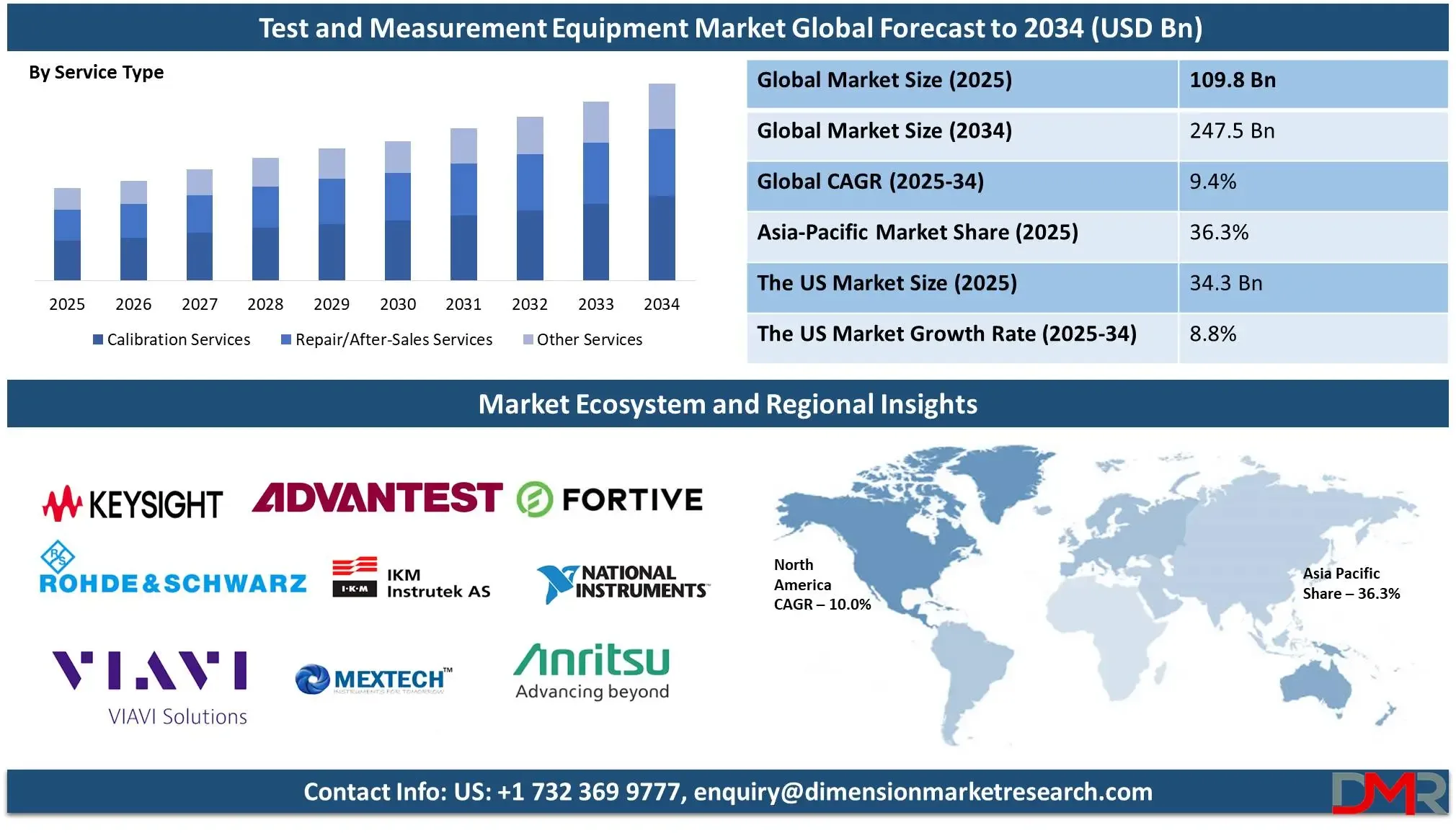
According to Dimension Market Research, the Test and Measurement Equipment Market is expanding as manufacturers, technology companies, laboratories, and industrial organizations require increasingly accurate methods to test complex products and systems. The market is valued at USD 109.8 billion in 2025 and is projected to reach USD 247.5 billion by 2035, registering a 9.4% CAGR during the forecast period. (dimensionmarketresearch.com)
Test and measurement equipment supports product development, manufacturing quality, regulatory compliance, safety verification, performance analysis, calibration, and maintenance. The industry includes general-purpose and mechanical testing equipment as well as calibration, repair, and after-sales services. Key technologies include oscilloscopes, multimeters, signal generators, spectrum analyzers, logic analyzers, network analyzers, power meters, automated test equipment, machine vision, and machine-condition monitoring systems.
Demand is being strengthened by the rapid development of semiconductors, 5G communication, electric vehicles, autonomous driving, connected devices, industrial automation, healthcare technologies, renewable energy, and advanced manufacturing. As product designs become more compact and technologically sophisticated, testing requirements are moving toward higher speeds, greater automation, better connectivity, and software-based analysis.
Testing Becomes a Competitive Advantage
Product testing is no longer limited to final quality inspection.
Manufacturers increasingly test products throughout the design, prototyping, production, assembly, and post-production stages.
Early detection of defects can reduce costly rework and improve product reliability.
For technology companies, accurate test results can also shorten product-development cycles and help engineers optimize designs before commercialization.
As competition increases across electronics, automotive, telecommunications, and industrial markets, efficient testing can become a competitive advantage.
Companies are therefore investing in measurement systems that can deliver accurate results while reducing test time and manual effort.
Semiconductor Complexity Drives Advanced Testing
Semiconductors are among the most demanding applications for test and measurement equipment.
Modern chips contain billions of transistors and operate at increasingly high frequencies while supporting sophisticated processing functions.
Manufacturers must verify electrical characteristics, power consumption, thermal behavior, signal integrity, reliability, and performance.
Automated test equipment can test semiconductor devices at high volumes while maintaining consistent procedures.
Advanced measurement tools are also used during semiconductor research and development to identify design issues before mass production.
The growth of AI processors, automotive chips, communications components, and high-performance computing is therefore supporting long-term demand for semiconductor testing technologies.
Automated Test Equipment Gains Importance
Automated Test Equipment is becoming increasingly important as manufacturers seek faster and more consistent production testing.
Automated systems can execute predefined test sequences, collect data, compare results against specifications, and generate reports.
This reduces manual intervention and can improve test repeatability.
Automation is particularly useful in high-volume production environments, where thousands or millions of units may need to be evaluated.
The increasing integration of software and robotics is also helping test systems become more flexible.
General-Purpose Equipment Maintains Market Leadership
General-purpose test equipment is expected to represent approximately 60.0% of market share in 2025, according to DMR. (dimensionmarketresearch.com)
General-purpose systems remain popular because a single instrument can support multiple applications.
Common products include oscilloscopes, digital multimeters, signal generators, spectrum analyzers, logic analyzers, network analyzers, and power meters.
These instruments are widely used by engineers, technicians, researchers, manufacturers, laboratories, universities, and service organizations.
Software connectivity and modular capabilities are further increasing the usefulness of general-purpose platforms.
Electric Vehicles Create New Testing Requirements
Electric vehicles are transforming automotive testing.
Unlike conventional vehicles, EVs contain high-voltage batteries, electric motors, inverters, power converters, sophisticated thermal-management systems, and advanced electronic controls.
These components require extensive testing for performance, safety, efficiency, durability, and reliability.
Battery testing is especially important.
Testing systems can evaluate battery capacity, charging behavior, thermal performance, degradation, power output, and lifecycle characteristics.
As EV production increases, demand for battery analyzers, power electronics testing, thermal testing, and automated automotive test systems is expected to grow.
Autonomous Vehicles Expand Sensor Testing
Autonomous and advanced driver-assistance systems rely on multiple sensors and electronic systems.
Radar, LiDAR, cameras, ultrasonic sensors, positioning systems, and electronic control units must work together accurately.
Test and measurement equipment can simulate operating conditions and verify sensor responses.
Engineers can evaluate detection accuracy, timing, signal quality, interference, and system performance.
The growing complexity of autonomous vehicles is increasing the need for integrated hardware and software testing environments.
5G Requires High-Frequency Measurement
5G communication networks operate across new frequency ranges and introduce higher bandwidth requirements.
Testing is required for mobile devices, base stations, antennas, radios, network infrastructure, and related components.
Engineers need to evaluate signal quality, spectrum usage, latency, throughput, interference, and other parameters.
High-frequency instruments and network emulators help recreate real-world conditions during development.
The continuing evolution of 5G technology is therefore supporting demand for advanced RF and microwave measurement solutions.
IoT Increases Device Testing Volumes
The Internet of Things is connecting products across manufacturing, healthcare, transportation, logistics, agriculture, homes, and commercial buildings.
Each connected device may need to pass multiple tests before deployment.
These tests can cover wireless performance, battery consumption, sensor accuracy, interoperability, connectivity, cybersecurity, and environmental durability.
As the number of connected devices increases, manufacturers need automated and scalable testing methods.
IoT growth is therefore expanding the addressable market for wireless and electronic test equipment.
Healthcare Remains a Major Application
DMR projects healthcare to account for approximately 25.0% of the market in 2025, making it the leading application segment. (dimensionmarketresearch.com)
Medical devices require reliable and accurate testing because equipment performance can directly affect clinical outcomes.
Test and measurement technologies are used for patient-monitoring devices, medical imaging systems, laboratory equipment, diagnostic products, wearable devices, and electronic medical systems.
Calibration is especially important in healthcare because measurement accuracy is essential.
The increasing adoption of connected medical devices and digital diagnostics is creating additional testing requirements.
Medical Devices Require Strict Validation
Medical-device manufacturers need to verify product performance at multiple stages.
Testing may evaluate electrical safety, sensor accuracy, mechanical durability, environmental resistance, connectivity, thermal behavior, and battery performance.
Wearable medical technologies add requirements for continuous sensing and wireless connectivity.
Manufacturers therefore increasingly use automated and digitally managed testing systems.
These systems can improve documentation and traceability while reducing manual testing requirements.
Aerospace Testing Demands High Accuracy
Aerospace and defense applications require highly reliable components because failures can have significant consequences.
Aircraft avionics, satellite systems, communications technologies, radar systems, navigation equipment, and electronic control systems all require rigorous testing.
Test equipment must often operate under demanding environmental and accuracy requirements.
According to DMR, aerospace and defense test-equipment demand is expected to expand at approximately a 4.5% CAGR, supported by developments in avionics, radar, and communications technology. (dimensionmarketresearch.com)
Calibration and documentation are particularly important in this sector.
Automotive Electronics Increase Measurement Demand
Modern vehicles are effectively becoming software-defined electronic platforms.
Electronic control units, sensors, battery-management systems, infotainment systems, ADAS technologies, and communication modules all require testing.
Automotive manufacturers are therefore integrating more electronic testing into production processes.
DMR expects automotive testing demand to grow at approximately a 5.8% CAGR, supported by electric and autonomous vehicle development. (dimensionmarketresearch.com)
This is increasing demand for automated testing and high-speed electronic measurement.
Machine Vision Improves Automated Inspection
Machine vision is becoming an important part of production testing.
Cameras and image-processing systems can inspect products for defects, alignment errors, dimensional variations, missing components, and surface imperfections.
Unlike manual inspection, machine vision can operate continuously on high-speed production lines.
Artificial intelligence can further improve image classification and defect-recognition capabilities.
This makes machine vision increasingly valuable for manufacturers seeking consistent quality control.
Mechanical Testing Supports Industrial Manufacturing
Although electronics is a major source of innovation, mechanical test equipment remains important.
Manufacturers use mechanical testing to evaluate material strength, fatigue, vibration, deformation, hardness, and durability.
Industries such as automotive, aerospace, construction, machinery, energy, and consumer products depend on these tests.
As advanced materials and lightweight structures become more common, accurate mechanical characterization becomes increasingly important.
Calibration Services Create Recurring Business
Calibration services are projected to represent approximately 50.0% of the service segment in 2025, according to DMR. (dimensionmarketresearch.com)
Calibration ensures that instruments maintain accurate measurement performance.
Industries with strict quality standards require regular calibration to maintain confidence in measurement results.
Calibration services can include instrument verification, adjustment, certification, documentation, and traceability.
The growing installed base of sophisticated testing equipment is therefore creating recurring service opportunities.
Repair and Maintenance Extend Equipment Lifecycles
High-performance test instruments can represent substantial investments.
Companies therefore seek repair and maintenance services to extend their useful life.
Services can involve hardware repair, replacement components, software updates, preventive maintenance, and technical support.
Manufacturers that provide strong after-sales service can create recurring revenue while strengthening customer relationships.
This is particularly important in aerospace, semiconductor, telecom, healthcare, and research environments where equipment reliability is essential.
AI Changes Test Data Analysis
Artificial intelligence is becoming increasingly relevant to measurement and testing workflows.
Traditional testing can generate large quantities of data that require manual review.
AI and machine learning can analyze this information to detect anomalies, classify defects, optimize test sequences, and identify patterns.
Potential applications include:
- Automated defect detection
- Predictive equipment maintenance
- Test parameter optimization
- Failure-pattern analysis
- Adaptive testing
- Automated reporting
The integration of AI can make testing faster and more responsive.
Request a Free Sample Report:
https://dimensionmarketresearch.com/request-sample/test-and-measurement-equipment-market/
Predictive Maintenance Expands Machine Testing
Industrial users increasingly monitor equipment condition rather than waiting for failures.
Sensors can measure vibration, temperature, pressure, current, acoustic signals, and other parameters.
Measurement systems can analyze these signals to identify changes in equipment behavior.
Predictive analytics can then help maintenance teams determine when servicing may be required.
This approach can reduce unexpected downtime and improve asset utilization.
Cloud-Based Test Management Gains Momentum
Cloud platforms are changing how test information is stored and shared.
Test data can be centrally managed and accessed by authorized engineering, quality, manufacturing, and service teams.
Cloud systems can also help organizations standardize testing procedures across multiple facilities.
This is particularly valuable for global manufacturers where products are developed and produced at several locations.
Modular Test Systems Increase Flexibility
Modular testing allows users to configure systems around specific applications.
Instead of replacing the entire platform when requirements change, organizations can upgrade selected modules.
This can reduce equipment costs and improve flexibility.
Modular systems are particularly useful in R&D environments where technologies and testing requirements evolve rapidly.
The approach also supports automated production environments with changing product configurations.
Wireless and RF Testing Expand
Connected products require increasingly sophisticated wireless validation.
Testing can evaluate radio-frequency performance, antenna behavior, signal integrity, interference, throughput, and connectivity.
Wireless testing is important across smartphones, IoT devices, automotive systems, industrial equipment, and healthcare technologies.
As new wireless standards develop, instrument providers must continually upgrade measurement capabilities.
Renewable Energy Requires Testing and Monitoring
Solar power systems, wind turbines, battery storage, and smart-grid technologies all depend on electrical and electronic components.
These systems require testing for voltage, current, efficiency, power quality, safety, and reliability.
Inverters and power converters are particularly important because they connect renewable generation to electrical networks.
Test equipment can help engineers evaluate system performance before and after deployment.
The expansion of renewable energy therefore creates another important opportunity for advanced measurement technologies.
Industrial Automation Supports Connected Testing
Factories are increasingly using robotics, sensors, machine vision, programmable controllers, and automated production equipment.
Test systems can connect directly with manufacturing execution systems and production-control platforms.
This allows testing to become part of the production workflow rather than a separate manual step.
Data can be captured automatically and linked to product serial numbers or production records.
This improves traceability and helps manufacturers identify quality trends.
Cybersecurity Becomes Relevant to Test Systems
Modern test equipment is increasingly connected to networks and cloud platforms.
This connectivity creates new cybersecurity considerations.
Organizations need to protect test data, instrument configurations, product information, and communication interfaces.
Secure authentication, network controls, encrypted communication, access management, and software updates are increasingly important.
As testing becomes more connected, cybersecurity will become another consideration in instrument procurement.
Asia-Pacific Leads Market Development
Asia-Pacific is projected to account for approximately 36.3% of global Test and Measurement Equipment Market revenue in 2025.
The region's leadership is supported by electronics manufacturing, semiconductor production, automotive manufacturing, telecommunications infrastructure, and industrial automation.
China, Japan, South Korea, India, and other Asian markets have substantial manufacturing and technology ecosystems.
The expansion of local production capacity continues to create demand for testing and calibration services.
China Remains an Electronics Testing Hub
China's electronics, telecommunications, semiconductor, and automotive industries create major demand for test equipment.
High-volume manufacturing requires automated testing that can operate continuously.
Research and development facilities also require advanced measurement instruments for new products and technologies.
The combination of manufacturing scale and technological investment makes China an important market for both general-purpose and specialized test equipment.
North America Supports High-End Testing Demand
The U.S. market is projected to reach USD 34.3 billion in 2025 and USD 73.4 billion by 2035, expanding at an 8.8% CAGR. (dimensionmarketresearch.com)
The market benefits from advanced aerospace, defense, healthcare, telecommunications, semiconductor, automotive, and technology industries.
High research and development spending supports demand for sophisticated instruments.
The U.S. is also an important center for innovation in wireless testing, semiconductor measurement, automated testing, and AI-enabled instrumentation.
Europe Emphasizes Precision and Compliance
European manufacturers operate across automotive, aerospace, healthcare, industrial, electronics, and energy sectors.
Strict quality requirements increase the importance of calibrated and traceable measurements.
Industrial digitalization is also encouraging the adoption of automated and connected test systems.
The integration of renewable energy and smart-grid technologies creates additional opportunities for electrical measurement and testing.
High Acquisition Costs Remain a Barrier
Advanced testing instruments can be expensive.
High-end oscilloscopes, RF analyzers, automated testing systems, imaging platforms, and specialized equipment can require substantial capital expenditure.
Organizations must also budget for calibration, maintenance, software, and trained personnel.
This can be challenging for smaller manufacturers and research organizations.
Equipment leasing, contract testing, shared laboratories, and cloud-based services can offer alternative approaches.
Skilled Technical Personnel Are Important
Advanced instruments require trained professionals who understand both measurement principles and application-specific requirements.
As technology becomes more sophisticated, users need expertise in software, automation, data analytics, electronics, and instrumentation.
The industry therefore has a growing need for technical training and application support.
Manufacturers that provide education, remote support, and application engineering can strengthen customer relationships.
Competitive Landscape
The Test and Measurement Equipment Market includes global measurement companies, specialized instrument manufacturers, and technology providers.
Prominent companies identified by Dimension Market Research include Keysight Technologies, Fortive, AMETEK Inc., Rohde & Schwarz, National Instruments Corp., Teledyne Technologies, VIAVI Solutions Inc., Anritsu, Yokogawa Electric Corporation, Advantest Corporation, and EXFO Inc.
Companies compete through measurement accuracy, bandwidth, speed, automation, software integration, modularity, connectivity, application support, and after-sales services.
The competitive environment is increasingly moving toward integrated hardware, software, analytics, and lifecycle-service offerings.
Recent Technology Activity
Test-equipment providers continue to develop solutions for emerging communication and electronics technologies.
DMR reports that Keysight Technologies introduced an advanced 5G network emulator in March 2024, enabling engineers to simulate network scenarios such as mobility, interference, and handover.
In February 2024, Anritsu Corporation launched a 5G mmWave test solution addressing the higher-frequency requirements of next-generation wireless testing. (dimensionmarketresearch.com)
These developments demonstrate how the industry is evolving alongside advanced communication technologies.
Future Trends in Test and Measurement
The future of the market will be shaped by the convergence of physical instruments and digital intelligence.
AI and machine learning can automate data interpretation.
Cloud platforms can centralize test information.
Automated test systems can increase production throughput.
Modular equipment can improve flexibility.
Machine vision can automate visual inspection.
Connected instruments can provide remote access and diagnostics.
High-frequency testing will continue to expand with advanced wireless technologies.
These trends are changing the role of test equipment from measurement hardware into a broader digital quality-management platform.
Market Outlook
The Test and Measurement Equipment Market is expected to maintain strong growth as product complexity and quality requirements increase across electronics, automotive, healthcare, aerospace, telecommunications, semiconductors, energy, and industrial manufacturing.
Dimension Market Research projects the market to grow from USD 109.8 billion in 2025 to USD 247.5 billion by 2035 at a 9.4% CAGR. (dimensionmarketresearch.com)
General-purpose test equipment is expected to remain the largest product category, while calibration services provide an important recurring revenue stream.
Healthcare remains a major application, while Asia-Pacific continues to represent the largest regional market.
The strongest future opportunities are expected to come from semiconductor production, 5G infrastructure, electric vehicles, autonomous systems, IoT, industrial automation, renewable energy, and connected healthcare technologies.
At the same time, AI, cloud connectivity, predictive maintenance, machine vision, and automated test systems will continue to improve testing efficiency.
As manufacturers seek faster development cycles, lower defect rates, better product traceability, and greater operational reliability, test and measurement equipment will remain a critical component of modern product development and manufacturing.
Buy / Checkout Test and Measurement Equipment Market Report:
https://dimensionmarketresearch.com/checkout/test-and-measurement-equipment-market/