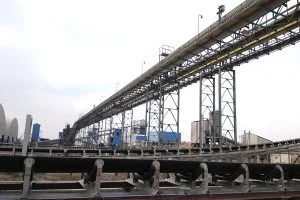
Belt conveyors don't get much attention until something goes wrong. But walk through any working cement plant, coal handling facility, or sugar mill and you'll find it everywhere — moving tonnes of material hour after hour, shift after shift.
That reliability is exactly the point. Operations that run on bulk materials can't afford gaps in their handling chain. When a conveyor stops or a chute gets blocked, the problem doesn't stay in one spot. Material starts piling up behind it, and everything ahead of it runs dry. One stoppage can throw off the entire production line within minutes. That's precisely why a well-built belt conveyor matters. It keeps things moving so the rest of the operation never has to slow down for it.
This guide is for anyone who needs to understand how these systems actually work. Whether you are evaluating options for a new plant, specifying a replacement system, or simply trying to make a more informed decision about a supplier. No jargon for its own sake — just the things worth knowing about how these systems work, where they're used, and what makes the difference between equipment that holds up and equipment that doesn't.
What Is a Belt Conveyor?
One pulley drives the belt forward, the other simply holds the other end in place. Material is loaded on at one end, carried along, and discharged at the other. Beneath the belt, rollers spaced at intervals take the weight of the load and stop the belt from sagging between support points.
Start with the belt itself — the choice of material is driven entirely by what the conveyor will handle. For heavy, abrasive materials like ore, coal, crushed stone — rubber is the practical choice. It absorbs impact and resists the kind of surface wear that would destroy a lighter belt within months. For indoor duties or applications where cleanliness matters, PVC is the more sensible option. Woven fabric belts have their place too, mainly where the belt needs to flex around tighter paths or where the carrying surface has to meet particular process demands.
Beyond the belt, every other component has to be sized and specified to match — idler spacing, pulley dimensions, drive power, take-up travel, chute design. None of these decisions exist in isolation. A mismatch anywhere in the system shows up quickly: premature belt wear, material spillage, unexpected stops. When everything is properly matched to the material and the application, there's nothing dramatic to report. The conveyor runs, the material moves, and the operation stays on schedule.
Key Components of a Belt Conveyor System
Understanding what goes into a well-engineered belt conveyor helps you evaluate quality and anticipate maintenance needs. Here are the core components:
1. Drive Pulley
One pulley in the system is connected to the motor.This is the one that actually pulls the belt forward. The size of the motor, the type of gearbox, and the rubber coating on the pulley face all make a difference to how the conveyor handles heavy loads day after day. Get these right and the drive runs efficiently for years.
2. Tail Pulley
At the far end of the conveyor, the tail pulley is where the belt curves back and travels underneath to complete its loop. It has no motor and does not drive. Its only job is to keep the belt on the right path. Small as that sounds, its position has to be accurate. A pulley that drifts even slightly out of place will cause the belt to pull to one side, wear unevenly, and eventually force an unplanned stoppage. Most people only notice it when that happens.
3. Idler Rollers
Underneath the belt, from one end to the other, there are rows of rollers keeping the belt supported off the frame. The rollers along the top run carry the full weight of the material being transported. The ones along the bottom simply stop the empty belt from sagging on its way back. At the point where material drops onto the belt, a heavier set of impact rollers takes the force of that landing — protecting the belt from the kind of repeated stress that would otherwise shorten its life considerably.
4. Take-Up Unit
Any belt will stretch over time — it's unavoidable. Left unchecked, a stretched belt loses grip on the drive pulley and starts to sag between rollers. The take-up unit corrects this by maintaining the right amount of tension in the belt at all times. On a long conveyor, a gravity-based system handles this on its own without anyone needing to adjust it. On a shorter one, turning a screw to take up the slack is usually all it takes.
5. Belt Cleaners
When material reaches the discharge end and falls off the belt, not all of it goes cleanly. A thin layer sticks to the belt surface and rides back along the return side, eventually dropping off and piling up around rollers and the frame below. Belt cleaners are scraper blades mounted right at the discharge point that remove this leftover material on every pass. Without them, that build-up quietly causes wear and misalignment that takes real time to sort out.
6. Structural Frame
The steel frame holds everything together — the pulleys, rollers, drive system, and the belt itself all sit on it.The frame has to handle the full weight of bulk material moving across it continuously, absorb the vibration that the drive system produces, and stay firm through years of heat, dust, and moisture. Any weakness in the frame eventually affects every part mounted on it.A properly built frame keeps the whole system stable, aligned, and dependable throughout its working life.
7. Skirt Boards and Chutes
When material is loaded onto a moving belt, it rarely lands in a neat, centred pile. Skirt boards run along both sides of the loading zone, acting as barriers that keep the material on the belt while it settles into position. The chute sitting above controls the way material falls — directing it onto the belt rather than letting it scatter, and softening the landing enough to protect the belt surface from unnecessary impact.
What to Look for in a Belt Conveyor Manufacturer
Buying a belt conveyor is not the same as buying a commodity. The specification, design, and quality of manufacture have a direct and lasting impact on uptime, maintenance costs, and operational risk. Here's what separates a reliable supplier from an unreliable one:
Engineering Depth
When evaluating a manufacturer, the real question is whether they can genuinely engineer a solution around your specific needs — your material type, your site conditions, and how much output you require — or whether they're simply picking the closest option from a shelf and calling it a day.Before you commit to a purchase, get clear answers to these questions.
In-House Manufacturing
A manufacturer who handles design, fabrication, and quality checks all within their own facility takes complete ownership of the final product.When critical components are outsourced, quality becomes inconsistent. Every external supplier has their own processes and their own standards, and pulling all those parts together into one reliable system is harder than it sounds. Keeping production in-house removes that uncertainty. The manufacturer controls every stage, maintains consistent standards throughout, and delivers a finished system they can fully stand behind.
Track Record in Your Industry
A manufacturer who has spent years solving real problems in these industries knows what works under tough conditions and what tends to fail. They have gone through trial and error, adjusted their designs based on what they have seen in the field, and built that knowledge into how they engineer every system. When you choose a manufacturer with that kind of background, you are getting more than a conveyor — you are getting the benefit of everything they have learned along the way.
After-Sales Support
A conveyor that fails without accessible support creates an expensive problem very quickly. Look for manufacturers with national service coverage and a real commitment to post-commissioning support — not just a warranty period.
International Standards Compliance
Conveyors operating in heavy industry need to meet recognized safety and quality standards. Compliance isn't just paperwork — it's the baseline for equipment that's safe for workers and viable for international projects.
Why Methods India Stands Out in Belt Conveyor Manufacturing
For operations that can't afford downtime, the choice of conveyor manufacturer matters as much as the conveyor specification. Methods India has been engineering and manufacturing belt conveyor systems in India for over four decades, serving industries from cement and mining to power generation, steel, sugar, and ports.
What distinguishes their approach is that every system is engineered from the ground up for the specific customer of material, site, throughput, and constraints rather than adapted from a standard configuration. With in-house design, fabrication, and commissioning capabilities under one roof, and a national after-sales network, Methods India offers a complete conveyor solution backed by real engineering experience.
Their portfolio spans troughed, inclined, shuttle, portable, reversible, and cross country belt conveyors, as well as enclosed pipe conveyor systems for dust-sensitive applications.For detailed specifications, industry case studies, and to discuss your specific material handling requirements, visit the Methods India Belt Conveyors page.
Conclusion
A properly designed and well-built conveyor moves material steadily, shift after shift, without drawing attention to itself. It is only when something goes wrong that people realize how much the rest of the operation depended on it.
That is why the choice of manufacturer matters more than most buyers initially think. The right manufacturer will take the time to understand your industry, build the system around your specific site and material, and remain a dependable point of contact well after the conveyor is commissioned. Whether your operation runs on cement, coal, steel, sugar, or any other bulk material, a good belt conveyor does not just support your production — it keeps the whole operation moving.