
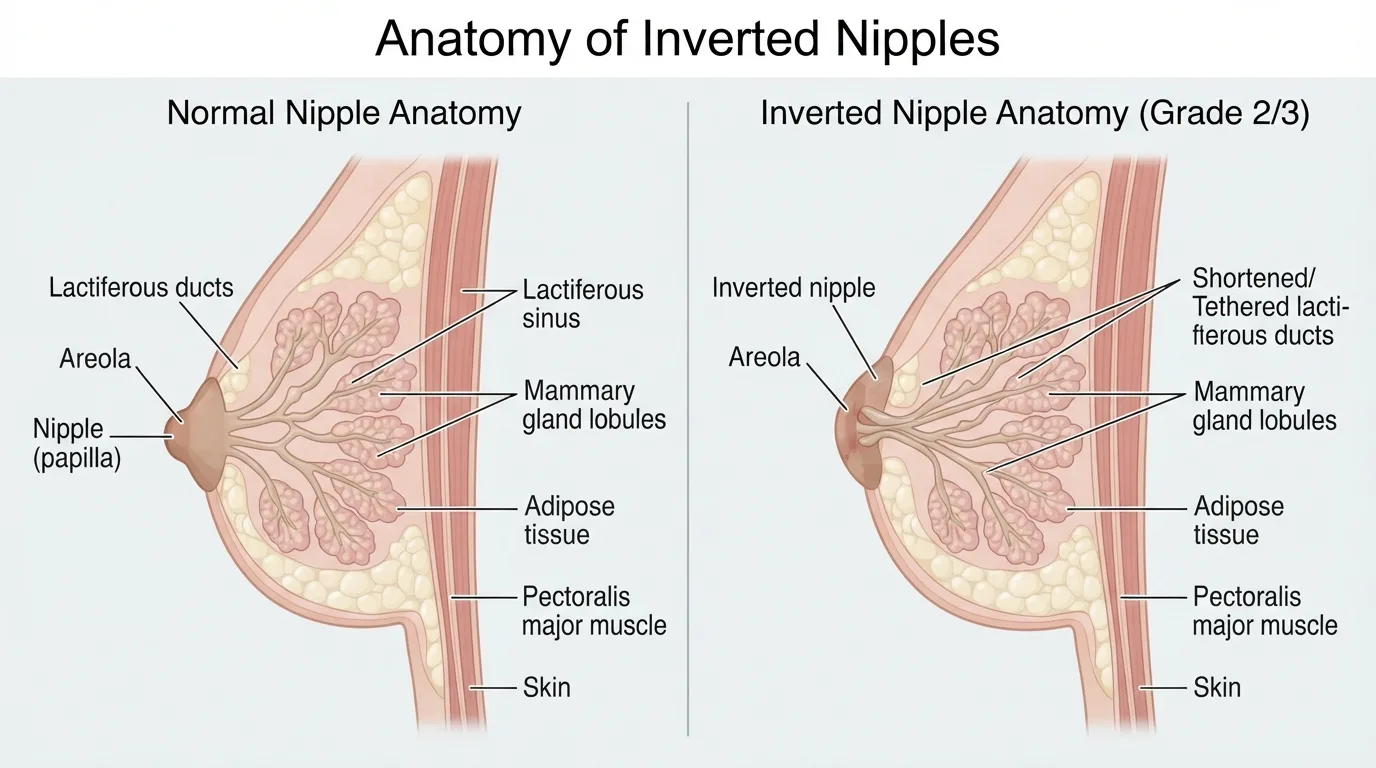
For many people, a part of their body that feels different can become a source of quiet anxiety. An inverted nipple, where the nipple points inward instead of outward, is a surprisingly common condition, affecting around 10% to 20% of people . For the vast majority, it is simply a benign variation of anatomy, something they have had since birth or puberty. However, for a significant number, it can present challenges—from difficulty breastfeeding to a lingering self-consciousness that affects confidence in intimate moments or even the simple choice of clothing .
Whether you have always had inverted nipples or have noticed a recent change, understanding this condition is the first step towards finding the right solution. At our clinic in Kirkella, on the outskirts of Hull, East Yorkshire, we have been helping patients from across the UK navigate these concerns for over 23 years. Our Consultant Plastic Surgeon, Ms. Nabiha Rehman (MBBS, FRCS(Ed)), brings a wealth of experience to this delicate area of surgery. This guide will walk you through everything you need to know—from the causes and the crucial distinction between congenital and acquired inversion, to the treatment options available.
What Are Inverted Nipples and How Are They Classified?
An inverted nipple is one that lies flat against the areola or retracts inward into the breast tissue, rather than protruding . While many people may use "inverted" and "retracted" interchangeably, the condition is often classified into three distinct grades, which helps determine the most appropriate treatment .
Grade 1: This is the mildest form of inversion. The nipple can easily be pulled out using finger pressure around the areola and will usually maintain its projection. The milk ducts are generally not compromised, and breastfeeding is often possible . Some people find their nipples protrude on their own when stimulated or in cold temperatures .
Grade 2: The nipple can be pulled out but retracts back in when the pressure is released . There is a moderate degree of fibrosis (thickening tissue), and breastfeeding may be more difficult or even impossible .
Grade 3: This is the most severe type. The nipple is deeply inverted and cannot be pulled out physically. The milk ducts are often constricted, and breastfeeding is not possible . This grade may also be associated with issues like poor hygiene, rashes, or infections .
Understanding your grade is crucial, as it influences the surgical approach and the likelihood of preserving breastfeeding potential.
What Causes Inverted Nipples?
The causes of inverted nipples fall into two broad categories: congenital (present at birth) and acquired (developing later in life). Distinguishing between the two is a vital part of the diagnostic process .
Congenital Inversion: This is the most common cause, often affecting both breasts. It usually results from short, tight milk ducts or fibrous tissue tethering the nipple inward . This condition is simply a structural variation, not a sign of illness . If a person has had inverted nipples since adolescence, it is almost certainly congenital .
Acquired Inversion: This develops later in life and can be caused by a wider range of factors. A sudden inversion in one nipple, particularly if accompanied by other symptoms, should always be evaluated by a medical professional to rule out underlying conditions .
Common causes of acquired inversion include:
- Infection and Inflammation: Conditions like mastitis or mammary duct ectasia can cause scarring and pull the nipple inward .
- Trauma or Surgery: Scar tissue from past surgeries or injuries can tether the nipple .
- Aging: As we age, the milk ducts can shorten, leading to inversion, especially around menopause .
- Rapid Weight Loss: Losing a significant amount of weight can reduce the fatty tissue behind the nipple, causing it to sink inwards .
- Breast Cancer: While rare, a newly inverted nipple can be a sign of breast cancer. The risk is higher if the inversion is new, on one side only, and accompanied by a lump, discharge, or skin dimpling .
Is a Sudden Change in Nipple Shape a Cause for Concern?
This is a question that understandably causes anxiety. The answer is: it depends. Most inverted nipples are not cancer. However, a new, one-sided inversion needs medical attention .
The key is to be vigilant for any changes. If you notice any of the following signs, you should see a doctor promptly:
- A nipple that has only recently become inverted, especially if it is on one breast .
- A lump in the breast or armpit .
- Nipple discharge, particularly if it is bloody or a yellowish hue .
- Skin dimpling on the breast, resembling the texture of an orange peel .
- Redness, crusting, or eczema-like changes on the nipple or areola .
Your doctor will conduct a physical examination and may recommend imaging tests, such as a mammogram or ultrasound, to examine the breast tissue thoroughly . It is always better to be safe. As one expert notes, "If you have any of these symptoms, see your physician right away" .
What Are the Treatment Options for Inverted Nipples?
Treatment is not always necessary. For many, especially those with stable, congenital grade 1 inversion, reassurance alone may be all that is required . When treatment is desired, options range from non-surgical techniques to surgical correction.
Non-Surgical Methods: These are often explored for grades 1 and 2. They can include manual traction (gently pulling the nipple) or using suction devices, such as a syringe, to draw the nipple out . These methods can sometimes provide temporary eversion and can be helpful for breastfeeding. However, they are unlikely to provide a durable, permanent correction, especially for more severe grades .
Surgical Correction: For individuals seeking a lasting change, surgery is the most reliable option. The goal is to release the fibrous tethering bands and support the nipple in an everted position . The specific technique chosen will depend on the grade of inversion and the patient's priorities, particularly regarding future breastfeeding.
What Does Inverted Nipple Correction Surgery Involve?
Surgical techniques for inverted nipple correction are generally delicate procedures performed under local anaesthesia, often on an outpatient basis . The procedure usually takes about an hour .
There are two main surgical approaches:
1. Duct-Preserving Techniques: These aim to release the tethering tissue while preserving the milk ducts. This is a major consideration for patients who may wish to breastfeed in the future. A simple method to release the fibrous bands through a small incision at the base of the nipple can be used, often with internal sutures to hold the nipple outwards . A more advanced technique involves a dissecting microscope to meticulously identify and preserve the ducts while cutting the surrounding fibrous tissue .
2. Duct-Dividing Techniques: These provide a more durable correction by dividing the constricting milk ducts . Various methods, such as multiple Z-plasties or internal suturing to fill the defect, have been described . These techniques typically have lower recurrence rates but significantly reduce the chance of breastfeeding .
In some cases, particularly for severe inversions or recurrences, surgeons may even use a small cartilage graft from the ear to create a more durable platform beneath the nipple .
What Should You Expect During Recovery?
Recovery from inverted nipple correction is usually straightforward. Patients can expect some swelling and tenderness in the immediate postoperative period, which typically resolves with simple pain relief . Stitches are often removed within 5-7 days .
The "overcorrected" position of the nipple is maintained with special dressings or traction sutures for a period to prevent retraction . Most patients can return to their daily routine about a day after the procedure, but strenuous activity should be avoided for a few weeks . It is essential to avoid digital manipulation until the area is fully healed .
Frequently Asked Questions About Inverted Nipples
Q: What is the difference between congenital and acquired inverted nipples?
A: Congenital inversion is present from birth or develops during puberty and usually affects both breasts. It is a benign anatomical variation caused by short ducts. Acquired inversion develops later in life and can be caused by infection, trauma, aging, or, rarely, breast cancer. A sudden, one-sided inversion needs to be checked by a doctor .
Q: Can I breastfeed after inverted nipple correction?
A: The answer depends on the surgical technique used. Duct-preserving techniques aim to protect breastfeeding potential, but they can have a higher risk of recurrence. Duct-dividing techniques are more durable but significantly reduce the likelihood of breastfeeding. No surgeon can guarantee the ability to breastfeed .
Q: Will the inversion come back?
A: Recurrence is the most significant complication of this surgery, with the greatest risk seen 6 to 12 months postoperatively . The risk is higher with duct-preserving techniques, which are often chosen to protect breastfeeding potential . A second correction is possible if recurrence occurs.
Q: Does the procedure leave scars?
A: Yes, small scars are inevitable with any surgery . However, incisions are usually made within the natural contours of the nipple-areola complex to minimize their visibility .
Q: How do I know if my inverted nipple is a sign of cancer?
A: While most inverted nipples are not cancerous, a new, one-sided inversion, especially if accompanied by a lump, bloody discharge, or skin changes, should be evaluated by a doctor . A medical examination and imaging tests like a mammogram or ultrasound can help determine the cause .
Customer Testimonials
The decision to have this procedure is a deeply personal one. We have been privileged to help many patients feel more confident in their own skin.
- "I had been embarrassed about my inverted nipples for as long as I could remember. It affected how I felt in intimate situations. The team at Beautiful Beings Clinic understood completely. The surgery was quick and the recovery was easier than I thought. I finally feel confident and comfortable."
- "When my nipple suddenly changed, I was terrified it was cancer. The clinic got me in for a consultation immediately and put my mind at rest. It turned out to be benign, but I chose to have it corrected surgically. The result is so natural, and I have complete peace of mind now."