Automotive manufacturing is changing rapidly as vehicle manufacturers respond to increasing production complexity, shorter development cycles and growing demand for consistent quality. Automation has become an important part of this transformation, helping production facilities improve repeatability, efficiency and flexibility.
From robotic welding and material handling to automated assembly and inspection, modern automotive factories increasingly combine engineering, machinery, robotics and digital technologies to create more connected production environments.
Why Automation Matters in Automotive Production
Traditional manufacturing processes often depend heavily on manual operations. While skilled workers remain essential, repetitive production activities can benefit from automation.
Automated systems can perform defined tasks consistently across production cycles. This can be particularly valuable in high-volume automotive manufacturing, where small variations repeated across thousands of components can affect production quality and efficiency.
Automation can support manufacturers in areas such as:
- Repetitive assembly operations
- Material handling
- Welding and joining
- Component positioning
- Inspection
- Production-line monitoring
- Part transfer between manufacturing stations
The objective is not simply to replace manual work. Modern automotive automation is increasingly focused on combining human expertise with machines that can perform repetitive, precise or physically demanding operations.
Robotics in Automotive Manufacturing
Robotics has become one of the most visible elements of automotive factory automation.
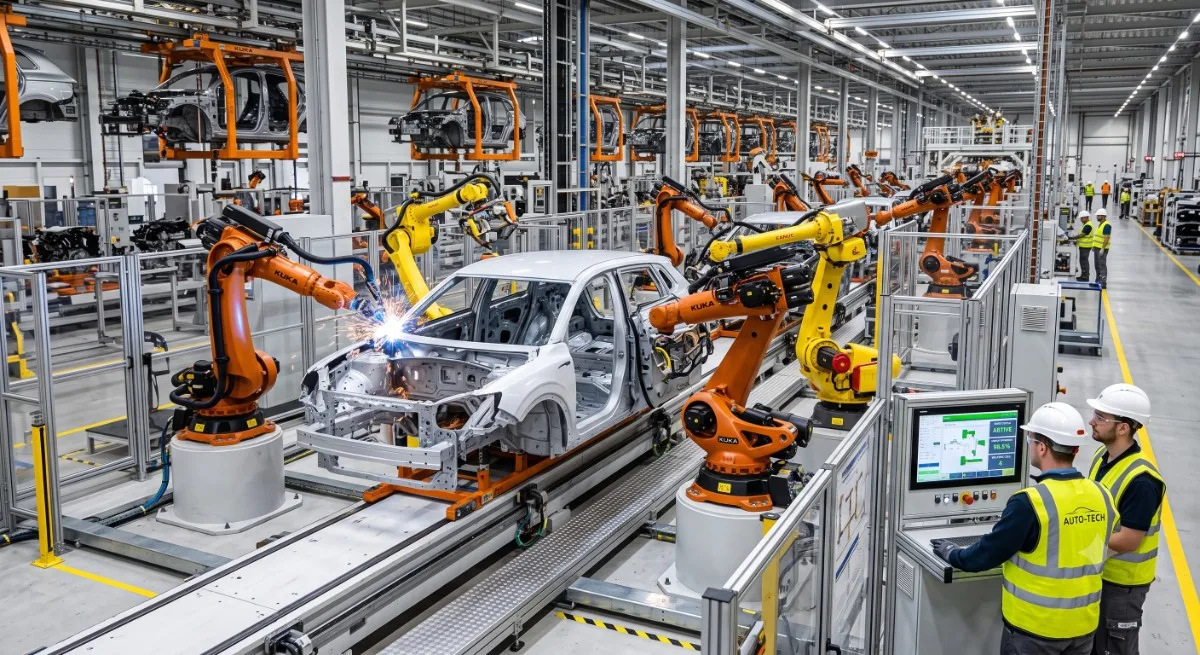
Industrial robots can be integrated into production systems for welding, handling, assembly and other manufacturing operations. In body shops, for example, robotic systems can help position components and perform repeatable joining operations.
Robotic automation can provide several advantages:
- Consistent cycle times
- Repeatable positioning
- Reduced variation
- Continuous operation
- Improved workplace ergonomics
- Greater production flexibility
However, the robot itself is only one part of an automated manufacturing system. Fixtures, tooling, controls, sensors and production software all need to work together for the process to perform reliably.
Automation in Body-in-White Production
Body-in-White manufacturing is an area where automation plays a particularly important role.
Vehicle body structures contain numerous components that must be positioned and joined accurately. Automated production systems can coordinate fixtures, robots and joining equipment to create repeatable assembly processes.
For example, robotic welding systems can perform multiple joining operations according to programmed paths, while automated handling equipment can transfer components between stations.
This integration helps manufacturers maintain dimensional consistency while supporting the production volumes required by modern automotive plants.
The Importance of Manufacturing Equipment
Automation is not limited to robotics.
The equipment surrounding a production process is equally important. Fixtures, tooling, conveyors, assembly machines, inspection systems and material-handling equipment all contribute to the overall manufacturing system.
A highly automated production line therefore requires careful engineering at the system level.
The design of manufacturing equipment needs to consider:
- Component geometry
- Production cycle time
- Accessibility
- Safety
- Maintenance
- Quality requirements
- Production volume
- Model variations
When these elements are properly integrated, automation can become part of a coordinated production strategy rather than a collection of individual machines.
Flexible Manufacturing for Multiple Vehicle Models
Automotive manufacturers increasingly need production systems capable of handling different vehicle models and variants.
A production line designed around a single configuration may become difficult to adapt when product requirements change. Flexible automation can help address this challenge.
Programmable robots, modular tooling and adaptable fixtures can allow production equipment to accommodate different components and manufacturing requirements.
This flexibility is particularly relevant as automotive manufacturers introduce new vehicle platforms and adapt production facilities for changing market demand.
Automation and Quality Control
Quality is another important reason for increasing automation in automotive manufacturing.
Automated processes can provide consistent positioning and repeatable operations. Sensors and inspection technologies can also be integrated into production systems to identify deviations during manufacturing.
Instead of discovering every problem at the end of the production process, manufacturers can increasingly monitor quality throughout different production stages.
Early detection can help reduce:
- Rework
- Scrap
- Production interruptions
- Assembly errors
- Downstream quality issues
This makes automation closely connected with modern quality-management strategies.
Automation and Electric Vehicle Production
The growth of electric vehicles is also influencing automotive manufacturing.
EV production introduces different vehicle architectures, component requirements and manufacturing processes. Production facilities therefore need equipment that can adapt to changing designs.
Automation can provide the flexibility required to support these evolving production environments.
As vehicle manufacturers continue introducing new platforms, automated manufacturing systems will need to accommodate different components, materials and assembly requirements.
The Role of Engineering in Factory Automation
Successful automotive automation requires more than purchasing robotic equipment.
Production systems need to be engineered around the specific requirements of the vehicle, components and manufacturing process.
This involves areas such as:
- Production-line design
- Tooling engineering
- Fixture development
- Robotic programming
- Process integration
- Quality engineering
- Equipment commissioning
- Production optimization
This engineering approach is particularly important for complex automotive manufacturing environments where multiple production technologies must operate together.
HIROTEC and Automotive Manufacturing Technology
HIROTEC operates in automotive manufacturing technology, providing engineering and manufacturing solutions for areas including automotive production, manufacturing equipment, body structures, exhaust production and related production technologies.
Its approach reflects the broader direction of the automotive industry: integrating engineering expertise, manufacturing equipment and automation to support efficient and adaptable vehicle production.
As automotive manufacturing becomes more complex, the ability to engineer complete production systems becomes increasingly important.
What Is Next for Automotive Automation?
The next stage of automotive manufacturing automation is likely to involve greater integration between machines, sensors, software and production data.
Manufacturing facilities are moving toward systems that can monitor processes, identify deviations and provide production information in real time.
Several developments are likely to remain important:
Greater flexibility: Production systems will need to accommodate multiple vehicle variants.
Connected equipment: Machines and production systems will increasingly exchange information.
Advanced inspection: Automated inspection can help identify quality issues earlier.
Smarter robotics: Robots will become more adaptable to changing production requirements.
Data-driven manufacturing: Production data can support maintenance, quality improvement and process optimization.
Conclusion
Automation has become an important part of modern automotive manufacturing, but its value extends beyond robotic equipment. The combination of robotics, fixtures, tooling, inspection systems, manufacturing machinery and engineering expertise creates the foundation for efficient vehicle production.
As automotive manufacturers respond to electrification, changing vehicle architectures and increasing production complexity, flexible and well-integrated automation systems will become increasingly important.
The future of automotive manufacturing will depend not only on individual machines, but on how effectively engineering, automation and manufacturing technologies work together.