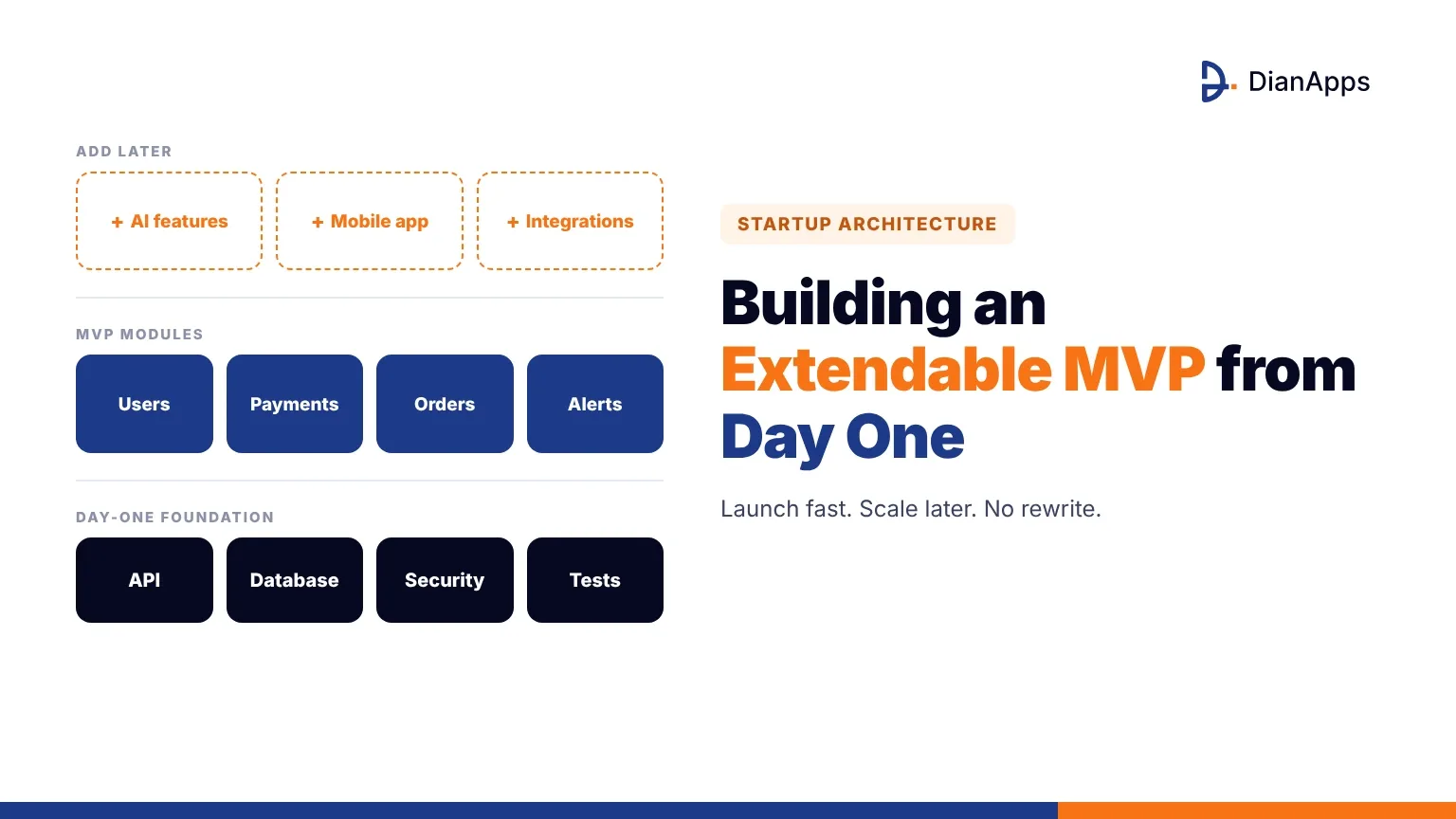
An extendable MVP is a first version of a product that has only a few features but is built on a clean, organised structure. This lets a startup launch quickly and then add new features, users and platforms later without rebuilding the product from scratch. For most startups, the best way to achieve this is a “modular monolith”: one app, neatly divided into separate parts, with a clean API, a well-planned database and basic security, testing and monitoring from day one.
Most founders know they should launch fast and test their idea with real users. Far fewer plan for what happens next. If the MVP works, a product that was rushed out can quickly become a problem. New features get slower to add, bugs appear in strange places, and the team ends up spending months rebuilding instead of growing.
The good news is that a fast launch and a strong product don’t have to be a trade-off.
Why Every Startup Needs an MVP
An MVP exists to test whether people really want your product before you spend too much money building it.
That matters because most startups fail for very simple reasons. In a CB Insights study of 111 failed startups, the two most common reasons were running out of cash or failing to raise more money (38%) and having no real market need (35%). A focused MVP tackles both. It tests demand early, while the costs are still low. If you’re new to the idea, it’s worth reading up on what an MVP is in app development and how it differs from a prototype.
But there is a third risk that founders often miss: the MVP works, and then can’t cope with its own success. An extendable MVP is built to avoid that.
Why So Many MVPs Have to Be Rebuilt
Many MVPs are rebuilt because they started life as quick prototypes that were never meant to last.
Shortcuts taken in the first few weeks slowly turn into problems. Every part of the code depends on every other part, so fixing one thing breaks another. There is no clean API, so adding a mobile app means copying the same logic twice. The database grows without a plan, prices and limits are written straight into the code, and there are no automated tests, so every update feels risky. Security shortcuts that seemed harmless during testing become serious once real customer data arrives.
Rebuilding can take months and cost more than the original product. For a young startup, that lost time can be fatal.
The Best Architecture for an MVP: A Modular Monolith
For most startups, the best architecture for an MVP is a modular monolith rather than microservices.
A modular monolith is a single application that is deployed as one piece but organised inside into clear sections, such as users, payments, orders and notifications. Each section looks after its own data and rules, and talks to the others through clear connections.
Microservices split a product into many small, separate services. Big technology companies use them, but for a small team they usually mean more servers to manage, harder bug fixing, higher cloud bills and slower progress.
A modular monolith gives startups the best of both. The team works in one codebase and launches quickly, but the product is already neatly divided. If one part later needs to grow on its own, such as payments or search, it can be moved into a separate service with little effort, because its boundaries are already clear.
The Foundations to Get Right From Day One
The smartest approach is to keep the features simple but get the hard-to-change foundations right from the start.
Build an API first. An API is the layer that lets apps and systems talk to your backend. Building a clean one from day one means you can add a mobile app, connect partners or build a new front end later without starting again.
Plan the database carefully. Your data structure is one of the hardest things to change once customers rely on it. Choose a reliable, widely used database, design it around your main business ideas and track every change properly.
Use trusted login and security tools. Use a proven sign-in service instead of building your own, protect sensitive data with encryption, and give each user only the access they need. Adding security later is much harder, especially in fintech and healthcare.
Use managed cloud services. Ready-made cloud services for databases, storage and email save time and let a small team focus on the product.
Keep settings out of the code. Store prices, limits and options in settings files, so you can change them without releasing a new version.
Use feature flags. Feature flags are on-off switches for features. They let you test something new with a small group of users and turn it off instantly if there’s a problem.
Add basic tests and automatic releases. You don’t need tests for everything, but you do need them for key journeys such as sign-up and payments.
Measure everything. An MVP is for learning, so add analytics to see how people use it and monitoring to spot errors early.
How to Keep an MVP Small but Ready to Grow
The biggest danger for an MVP isn’t weak technology. It’s building too much.
Research by Pendo found that 80% of features in a typical software product are rarely or never used. Every extra feature adds cost and complexity. To stay focused, start with one core problem and solve it well. Split features into “must have”, “nice to have” and “later”, and build only the first group. Use proven third-party tools for payments, messaging, maps and search rather than building your own. Leave room to add features later, but don’t build them until users ask for them.
Safe Shortcuts and Risky Ones
Some shortcuts save time at the MVP stage without causing long-term harm, and others almost always lead to a rebuild.
Safe shortcuts include doing some admin tasks by hand instead of building dashboards, using a simple design system, launching on one platform first, keeping reports basic and running in a single cloud region.
Risky shortcuts include skipping the API, ignoring security, changing the database without tracking it, leaving payments untested, building your own login system and mixing business logic into the screens users see.
How to Choose an MVP Tech Stack
The best tech stack for an MVP is a proven one that your team can hire for and support for years.
Ask a few simple questions. Can we easily find developers for it? Does it have a large community and long-term support? Does it suit our product? For mobile apps, cross-platform tools such as React Native and Flutter let one team launch on iPhone and Android at the same time, while fully native apps suit products that rely heavily on phone features. It also helps to choose tools that connect easily to AI services, since many new products now include features such as chat assistants or smart recommendations.
New and fashionable tools can be tempting, but a reliable, well-known stack is usually the fastest route to a product that works.
How an Extendable MVP Grows With the Business
An extendable MVP grows in stages instead of needing a fresh start.
First, the startup launches and learns from real users. Next, it strengthens the product by adding tests, improving speed and fixing the most important weak spots. Then it expands with new features, platforms and integrations that customers actually want. Finally, as usage grows, the busiest parts are moved into their own services and the infrastructure is scaled up. Because the structure was clean from the start, each stage builds on the one before.
Many founders don’t have a full technical team at the beginning. Experienced MVP development services can help scope the right features, choose a suitable tech stack and set up a clean, modular architecture, so the first version launches quickly and is ready to grow.
The Bottom Line
An MVP should be small in features, not small in quality.
Startups that grow smoothly build a simple product on strong foundations: a modular structure, a clean API, a well-planned database, solid security, basic testing and clear tracking of how people use the product. Keep the features tight, protect the parts that are hard to change, and keep everything else simple. Then, when your idea finds its market, your product will be ready to grow with it.