
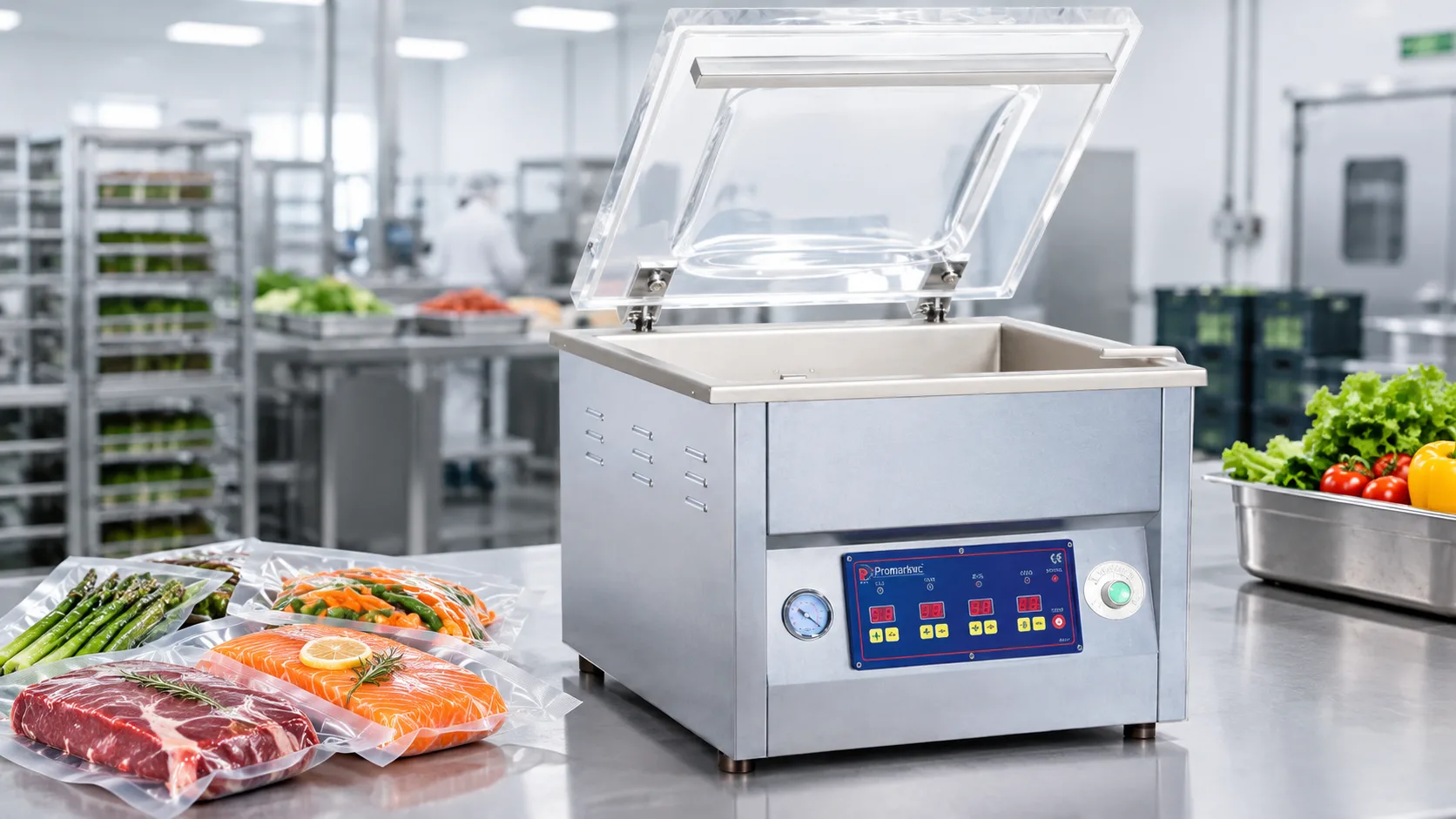
From independent butchers and seafood processors to catering companies and farm shops, operators across the UK are scrutinising their packaging infrastructure with a new urgency and finding that the equipment they've always relied on may not be meeting the needs they assumed it was.
Food businesses are accustomed to navigating pressure from multiple directions simultaneously. What's changed in recent years is the degree to which operators are examining their internal systems portion discipline, stock rotation, preparation workflows for the losses that have always existed but were easier to absorb when ingredient costs and energy bills left more room for manoeuvre.
Packaging sits squarely within that examination. Not the boxes or the branding, but the more functional question of how products are protected between the point of production and the point of sale or service. For a growing number of UK food businesses, this has brought the chamber vacuum sealer into focus.
A Problem That Costs More Than It Appears
The scale of food waste across the UK's commercial food sector is not an abstract concern. Research from WRAP the waste reduction organisation that works with government, industry, and businesses has consistently found that the hospitality and food service sector alone discards around 1.1 million tonnes of food every year, at an estimated cost to the sector of £3.2 billion annually. That translates to roughly £10,000 per outlet per year, on average. Around 18 per cent of all food purchased by these businesses ends up in the bin, and WRAP's research indicates that three-quarters of that discarded food was still edible at the point of disposal.
These are sector-wide figures that encompass restaurants, contract caterers, and large-scale food service operations. Independent operators butchers, fishmongers, deli owners, farm shops, prepared-meal producers each face a version of the same problem at smaller scale and with less operational buffer. Spoilage before a product reaches the customer, products packaged inconsistently and degrading unevenly in chilled storage, ingredients prepped in advance and deteriorating before service: the losses are real, and they accumulate.
Vacuum packaging doesn't resolve stock management failures or poor ordering discipline. What it does address, in practical terms, is the loss of product that was properly bought, properly handled, and properly prepared but not adequately protected after that point.
Chamber Vacuum Sealers Versus External Models
There is a meaningful difference between the suction-based external vacuum sealers sold for light commercial or domestic use and the chamber vacuum sealers designed for professional food production environments. Understanding that difference matters before any purchasing decision is made.
External vacuum sealers work by extracting air from the bag through a nozzle or external mechanism. The process is relatively straightforward for dry products, but creates problems with anything that contains liquid, marinade, or high moisture content. The suction mechanism pulls liquid out of the bag along with the air, compromising both the seal and the product. It also places limits on the bag formats that can be used effectively.
A chamber vacuum sealer operates on an entirely different principle. Both the bag and the product are placed inside an enclosed stainless steel chamber. The machine evacuates air from the entire interior of the chamber simultaneously. Because the air pressure inside and outside the bag reduces at the same rate, liquids remain undisturbed and in place throughout the process. Once the correct vacuum level is reached, the sealing bar closes across the bag opening and creates a heat seal. Air is then gradually reintroduced into the chamber, and the external pressure compresses the bag evenly and firmly around the product.
The practical implications of this are significant. A fishmonger sealing fresh salmon portions with a citrus marinade, a butcher packing marinated steaks for retail, a caterer preparing sous vide portions, a seafood processor handling high-moisture shellfish all of these applications create difficulties for suction sealers that chamber machines handle consistently. The sealed result is also typically more uniform, which matters both for appearance and for reliable shelf-life extension.
Where It Makes Operational Sense for UK Food Businesses
The range of applications where chamber vacuum packaging delivers practical benefit across the UK food sector is broader than many operators initially consider.
In independent butchery, professional vacuum sealing supports both retail presentation and extended shelf life without reliance on additives. Products sealed and labelled in quieter periods can ease counter pressure during busy trading hours. For butchers supplying hospitality businesses or farm shops alongside their own counter trade, consistent packaging also signals product quality to wholesale customers.
Farm shops and artisan producers often handle high-value, seasonally constrained products estate-raised meats, aged cheeses, cured or smoked goods where any loss to premature spoilage is proportionally costly. Reliable packaging is part of protecting the premium position these businesses occupy.
For meal-preparation companies and catering operations, vacuum sealing integrates with cook-chill and sous vide production processes in ways that go beyond mere freshness extension. The sealed bag is integral to the cooking method, portion control, and the logistics of preparing product for distribution or delayed service. Getting the seal right, consistently, is operationally non-negotiable in that context.
Seafood businesses at any scale processing fresh day-boat catch, producing smoked or cured fish for wholesale, supplying restaurants with portioned fillets deal with a product category that is particularly susceptible to premature spoilage and particularly challenging to package adequately with suction-based equipment. Chamber sealing handles the moisture and the variety of product formats more reliably.
Evaluating Equipment: What to Look For
The decision to invest in a chamber vacuum sealer involves several practical considerations that are worth working through in detail rather than defaulting to the nearest available model within a given budget.
Chamber dimensions determine which products can actually be processed. A machine too small for the portion sizes or bag lengths a business regularly works with creates bottlenecks that undermine the investment. Pump capacity typically expressed in cubic metres per hour affects both the depth of vacuum achievable and how quickly the machine completes each cycle. Higher-volume operations benefit from faster cycle times; lower-volume businesses may not need the largest available pump specification.
The sealing bar configuration is relevant for businesses that use longer bags, want to seal multiple bags simultaneously, or require a specific seal width for their product format. Stainless steel construction throughout the machine including the chamber itself is an appropriate expectation for any equipment that will be in daily use in a food production environment and subject to regular cleaning.
Ease of maintenance should be evaluated practically, not just on paper. Routine tasks pump oil changes, filter replacement, chamber cleaning need to be straightforward enough that they happen reliably on schedule rather than getting deferred. The availability of technical support and spare parts from the supplier is a longer-term consideration that deserves equal attention to the upfront specification.
Businesses evaluating professional vacuum packaging equipment would do well to assess whether the supplier they're considering has practical experience across the types of products and production scales relevant to their operation, rather than simply offering a product catalogue. Companies such as Promarksvac, which supplies a range of commercial and industrial vacuum packaging machinery including single and double chamber models, thermoforming systems, and belt-type configurations, are among the manufacturers operating in this space. In each case, the key evaluation questions are the same: does the supplier understand the operational context, can they specify the right configuration for your volume and product range, and will they be available if problems arise after installation?
Protecting What's Already Been Invested In
The independent food sector in the UK and this applies across butchers, fishmongers, farm shops, delis, independent caterers, and small food producers has in many cases been slower to adopt chamber vacuum technology than food manufacturers operating at scale. The initial investment, typically ranging from several hundred to several thousand pounds depending on specification, can feel substantial relative to a small-business budget. The technical distinctions between machine types are also rarely explained in terms that connect clearly to the operational problems a business is actually trying to solve.
The case for professional vacuum packaging doesn't rest on transformation. It rests on the more mundane observation that once a product has been bought, prepared, and handled correctly, protecting it adequately through to the point of use is a basic operational requirement. Equipment that can't do that reliably isn't a neutral choice; it's a steady, quiet drain on margin, stock, and effort that tends to go unacknowledged until someone starts adding up what it costs.