Enterprises rushing to adopt AI inside their voice, video, and messaging platforms often make the same mistake. They spend months choosing an AI vendor or model and only weeks preparing for the actual adoption. In real-time communications, that ratio is where most initiatives quietly stall.
Success does not come from having the smartest model. It comes from making sure that AI can survive inside a live call, on a real network, under real compliance rules, without breaking the customer experience your business depends on.
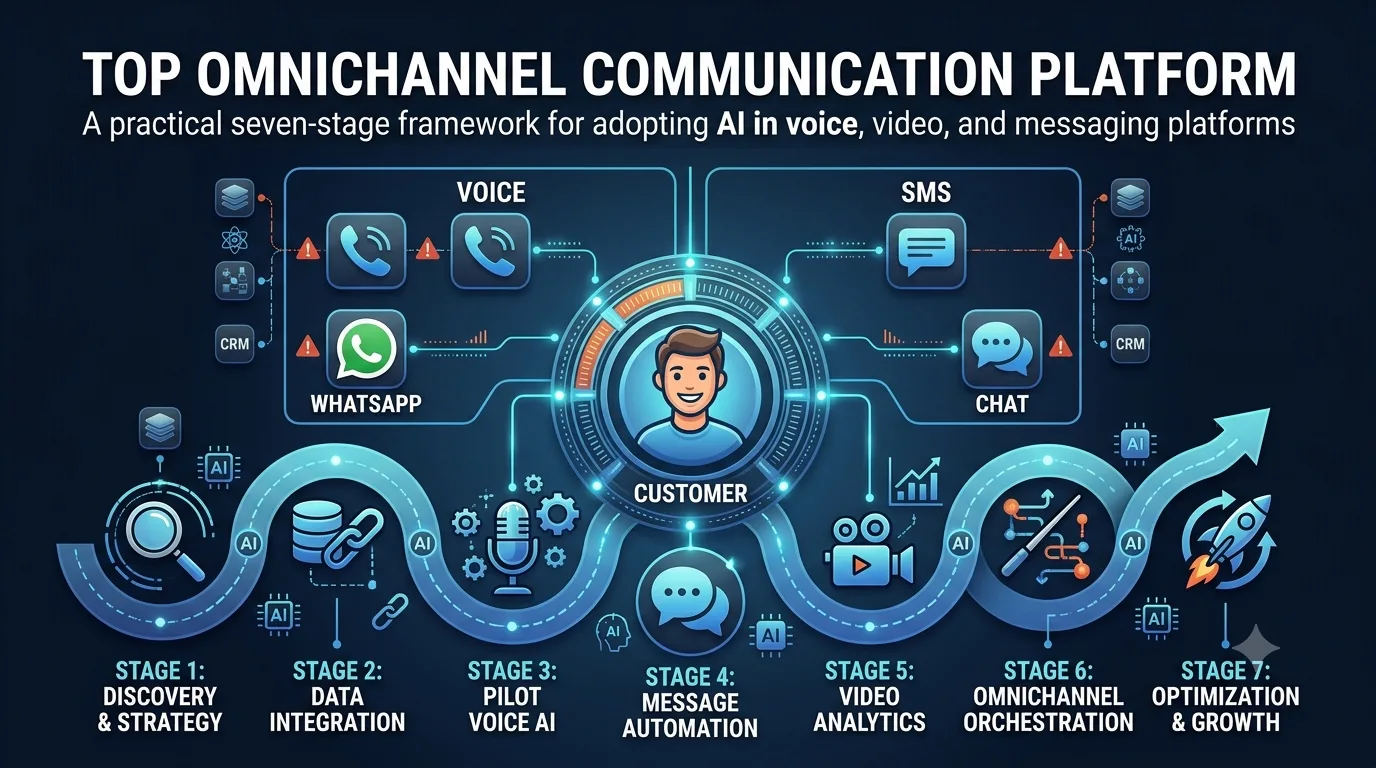
This article lays out a practical seven-stage framework for adopting AI in real-time communications, along with the questions leaders and engineering teams should be answering at each step.
Why real-time communications is a special case for AI adoption | Top Omnichannel Communication Platform
Standard AI adoption playbooks were written for batch workloads and forgiving timing. A live phone or video interaction gives you neither. Every second of delay is heard by a customer. Every regulation applies from the first call. Every integration has to work in the moment.
Five realities shape adoption in this environment:
Latency is a product feature. Slow speech recognition, slow model responses, or slow synthesis all show up to the customer as an AI that sounds broken. Infrastructure decides everything. Your session border controllers, codecs, media path, and network health set the ceiling for what AI can do. Compliance is not optional. Recording, consent, retention, data residency, and telecom rules apply the moment AI touches a conversation. Integrations are the workflow. Without connectivity to CRM, ticketing, and knowledge systems, AI is a demo, not a solution. And operations never sleep. Real deployments need dashboards, runbooks, and clear ownership around the clock.
If any of these does not have an owner in your adoption plan, it is not a plan. It is a wishlist.
The seven-stage framework for AI adoption in RTC
Stage 1: Discovery and Platform Selection
Before choosing an AI vendor or model, map your customer journeys and communication workflows. Look for calls and messages where AI can create real value: routing, self-service, agent assistance, quality monitoring, IVR modernization. Rank them by business impact and how automatable they are. The output of this stage is a shortlist of use cases you actually believe in and a small set of platforms or model families that could support them.
Stage 2: Readiness Assessment
Walk your infrastructure end to end. Is your session border controller ready for the additional media legs an AI agent will add? Are your codecs consistent enough for reliable speech recognition? Do your APIs surface the right customer context the moment a call arrives, not five turns in? Where does personal data live and who is allowed to send it to a model? What is your current latency budget and how much of it is still available? Gaps found here are cheap to fix. Gaps found later, in production, are not.
Stage 3: Pilot and Bridge Engineering
A pilot is not a demo. It is AI wired into one real workflow, running on one queue, for one intent, with real customers. The engineering effort is the bridge: media handoff from the SIP layer to the AI runtime, streaming recognition and generation with the ability to interrupt, a context service that pulls customer data on call arrival, a clean handoff path back to a human when confidence drops, and structured logging for every turn. If you cannot answer what happens when the AI is wrong, you do not have a pilot yet.
Stage 4: Production Hardening
Proving value is not proving readiness. This is where load and soak testing happen at expected and peak concurrency. This is where you inject failures deliberately to see how the system responds to model timeouts, upstream API errors, and provider outages. This is where you design graceful fallbacks to an IVR or a human so a customer never sits in silence. And this is where observability matters as much as accuracy: per-turn latency, recognition confidence, model cost, and handoff rate should all be visible.
Stage 5: Compliance Implementation
Design compliance in from the start rather than pasting it on at the end. Consent capture, AI-specific disclosures, retention rules for transcripts and model logs, redaction of personal information before it hits any third-party API, access controls, audit trails, and alignment with each region you operate in. For many enterprises, compliance is what actually decides whether production launches.
Stage 6: Managed AgentOps
Once live, the AI is a running system, and running systems need care. Continuously evaluate on real, redacted traffic. Version your prompts, models, and policies with rollback ready. Monitor drift. Refresh knowledge sources on a defined cadence. Keep a consistent disclosure architecture so the AI's identity stays clear from touchpoint to touchpoint. Most stories of AI initiatives that quietly become forgotten start here, not at launch.
Stage 7: Care Center Transformation
As individual deployments mature, they start to compound. Voice automation, agent assistance, quality management, analytics, and knowledge systems become one connected system rather than six separate projects. That is the point at which adoption stops feeling like a project and starts feeling like how your care operation works.
Build, buy, or hybrid
The build vs buy question is the one every leader asks, and the honest answer is usually somewhere in the middle. Buying lets you move faster but gives you less control over data flow and how the AI actually behaves. Building gives you flexibility and ownership but asks more of your engineering team and takes longer to reach production. Most successful real-time communications teams pick a hybrid path: buy the pieces where speed matters, such as foundation models and hosted recognition and speech synthesis, and build the pieces where the product differentiates, such as call flow logic, integrations, disclosure design, and the data plane between them. The point is not to pick a side. It is to find the balance between speed, control, and long-term business value that fits your situation.
A short implementation loop
Inside every stage, the same short loop tends to work. Define the business outcome as a measurable metric. Pick one high-value use case, small enough to ship and big enough to matter. Assess technical readiness honestly. Validate with a real pilot on real traffic. Then keep optimizing, because deployment day is the start of the work, not the end of it.
The takeaway
The organizations getting real results from AI in real-time communications are not the ones adopting fastest. They are the ones adopting most deliberately. They have a roadmap. They know their own infrastructure well enough to say where it will break under load. They have an operating model that survives the second month after launch.
A framework will not guarantee any of that. It will just make the expensive mistakes harder to make by accident. Wherever your team currently is on this path, pick the stage that matches where you actually are, and be honest about the ones you skipped. The rest is work.
Originally published on the Ecosmob blog: https://www.ecosmob.com/blog/ai-adoption-framework-real-time-communications/