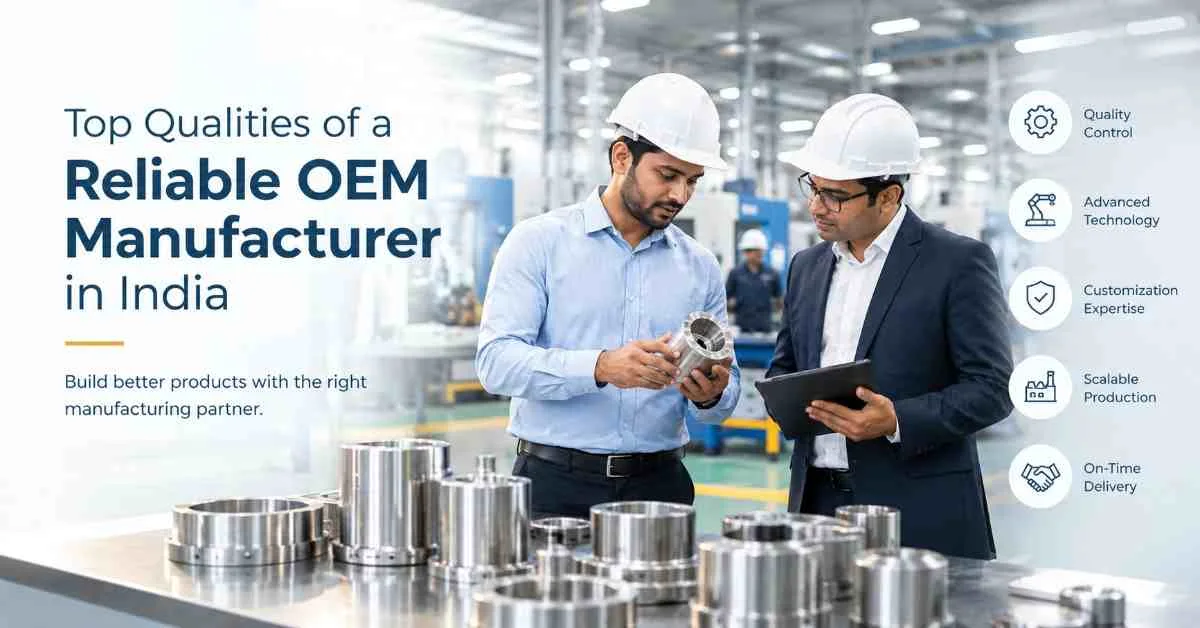
For businesses looking to outsource product manufacturing or components, choosing the right OEM manufacturer in India is an important decision. The right manufacturing partner can help maintain consistent quality, manage production costs, meet delivery schedules, and support business growth.
However, not every OEM manufacturer offers the same level of manufacturing capability, quality control, customization, or technical support. Before entering into a long-term partnership, businesses should carefully evaluate what an OEM manufacturer can actually deliver.
From production infrastructure and material expertise to quality systems and scalability, here are the key qualities to look for in a reliable OEM manufacturer in India.
1. Strong Manufacturing Capabilities
A reliable OEM manufacturer should have the infrastructure and technical capabilities needed to manufacture products according to the customer's requirements.
This includes having appropriate machinery, production lines, skilled workers, quality inspection systems, and manufacturing processes.
Depending on the product, businesses may need capabilities such as:
- Sheet metal fabrication
- Precision forming
- Welding and assembly
- CNC machining
- Wire forming
- Surface finishing
- Tool and die development
- Product assembly
Before selecting an OEM partner, check whether its manufacturing capabilities match your product specifications and expected production volumes.
2. Consistent Quality Control
Quality is one of the most important factors when choosing an OEM manufacturing company. A component that does not meet specifications can affect the performance, safety, appearance, and reliability of the final product.
A dependable OEM manufacturer should have defined quality control processes at different stages of production.
These may include:
- Raw material inspection
- In-process quality checks
- Dimensional inspection
- Product testing
- Final inspection
- Traceability and documentation
For businesses manufacturing consumer products, appliances, industrial equipment, or other products where consistency matters, strong quality systems are essential.
3. Ability to Handle Custom Requirements
OEM manufacturing is not limited to producing standard products. Many businesses require components designed specifically for their products.
A reliable OEM manufacturer should be able to work with:
- Technical drawings
- CAD files
- Product specifications
- Material requirements
- Dimensional tolerances
- Surface finish requirements
- Custom designs
The manufacturer should also be able to communicate with the customer's technical and product development teams to understand requirements and make necessary adjustments during development.
This capability becomes particularly valuable when developing new products or modifying existing components.
4. Expertise in Materials and Manufacturing Processes
Material knowledge plays an important role in OEM production.
For example, stainless steel is widely used for components and products where durability, corrosion resistance, hygiene, and appearance are important. However, selecting the right grade and manufacturing process depends on the intended application.
An experienced stainless steel OEM manufacturer should understand factors such as:
- Stainless steel grades
- Material thickness
- Forming requirements
- Welding methods
- Surface finishes
- Corrosion resistance
- Product application
Strong material and process knowledge helps manufacturers produce components that meet both functional and aesthetic requirements.
5. Modern Technology and Production Equipment
Technology can have a direct impact on manufacturing accuracy, consistency, productivity, and production costs.
When evaluating an OEM manufacturer, businesses should consider the type of machinery and technology used across the production process.
Modern manufacturing equipment can help with:
- Consistent production
- Accurate dimensions
- Repeatable results
- Faster production
- Complex component manufacturing
- Reduced production errors
Technology alone, however, is not enough. It should be supported by skilled professionals and well-defined production processes.
6. Sufficient Production Capacity
An OEM partner may perform well with small orders but struggle when production volumes increase. This can create delays and supply problems for growing businesses.
Before selecting an OEM manufacturer, understand its production capacity and ability to scale.
Ask questions such as:
- What is the current production capacity?
- Can production volumes be increased when required?
- What is the expected lead time for larger orders?
- Does the manufacturer have multiple production facilities?
- How are peak production requirements managed?
A manufacturer with scalable production capabilities can become a long-term partner rather than simply fulfilling one-time orders.
7. Relevant Industry Experience
Experience matters because different industries have different manufacturing and quality requirements.
For example, a company manufacturing home appliance components may require different expertise from a manufacturer producing industrial or mobility components.
Look for an OEM manufacturer with experience relevant to your product category.
Industry experience can help with:
- Understanding technical specifications
- Selecting suitable materials
- Identifying production challenges
- Maintaining quality standards
- Improving product design for manufacturing
- Managing industry-specific requirements
A manufacturer that understands your industry can often contribute more than simply producing according to a drawing.
8. Certifications and Quality Standards
Certifications can provide additional confidence in an OEM manufacturer's quality management systems and manufacturing practices.
Depending on the industry and product, businesses may look for relevant certifications and compliance standards covering areas such as:
- Quality management
- Environmental management
- Occupational health and safety
- Industry-specific manufacturing requirements
- Product testing and compliance
However, certifications should not be the only factor in the decision. Businesses should also evaluate the manufacturer's actual processes, facilities, experience, and quality performance.
9. Reliable Delivery and Supply Chain Management
Even a high-quality product can create problems if it is delivered late.
OEM manufacturers need to manage raw materials, production schedules, quality checks, packaging, and dispatch efficiently to meet agreed timelines.
A reliable partner should provide:
- Clear production timelines
- Realistic delivery commitments
- Regular order updates
- Consistent production planning
- Efficient logistics coordination
Reliable delivery becomes especially important for businesses operating on tight production schedules.
10. Clear Communication and Long-Term Support
A successful OEM partnership requires more than manufacturing capability. Communication between the manufacturer and customer needs to remain clear throughout product development and production.
A good OEM manufacturer should be responsive when discussing:
- Product specifications
- Design changes
- Production schedules
- Quality concerns
- Material requirements
- Order volumes
- Delivery timelines
The best OEM relationships are built as long-term partnerships, where the manufacturer understands the customer's products and continuously supports their evolving requirements.
How to Evaluate an OEM Manufacturer in India
Before selecting an OEM manufacturing partner, businesses should conduct a detailed evaluation rather than making a decision based only on price.
Consider these factors:
- Manufacturing infrastructure
- Product customization capabilities
- Quality control systems
- Material expertise
- Production technology
- Manufacturing capacity
- Industry experience
- Certifications
- Delivery performance
- Communication and technical support
It is also useful to review samples, visit manufacturing facilities where possible, understand the production process, and discuss quality expectations before finalizing a long-term agreement.
Why Choosing the Right OEM Manufacturer Matters
The right OEM manufacturer can become an extension of your own production and product development team.
A capable partner can help businesses:
- Reduce the need for in-house manufacturing infrastructure
- Access specialized manufacturing expertise
- Maintain consistent product quality
- Scale production as demand grows
- Develop customized components
- Improve production efficiency
- Meet market and customer requirements
For companies sourcing stainless steel products and components, selecting an experienced manufacturer with strong fabrication, quality control, and customization capabilities can be particularly valuable.
How Jindal Lifestyle Supports OEM Manufacturing in India
Jindal Lifestyle provides OEM manufacturing solutions for businesses looking for customized products and components. Its capabilities cover areas including home appliances, cookware and cutlery, and other product categories.
With expertise in stainless steel manufacturing and product development, Jindal Lifestyle works with businesses to meet specific product and manufacturing requirements.
For companies searching for an OEM manufacturer in India, factors such as manufacturing infrastructure, customization capabilities, quality systems, material expertise, and production capacity should be considered before selecting a partner.
Conclusion
Finding a reliable OEM manufacturer in India requires looking beyond manufacturing costs. Quality control, customization, technology, production capacity, material expertise, certifications, industry experience, and delivery reliability all play an important role in choosing the right partner.
For businesses planning long-term production partnerships, the ideal OEM manufacturer should be capable of meeting current requirements while also supporting future product development and increasing production volumes.
A thorough evaluation at the beginning can help businesses build a reliable supply chain and establish an OEM partnership that supports consistent product quality and long-term growth.
Frequently Asked Questions
1. What should I look for in an OEM manufacturer in India?
Look for manufacturing capabilities, quality control systems, customization expertise, production capacity, material knowledge, relevant certifications, industry experience, and reliable delivery.
2. How do I choose a reliable OEM manufacturer?
Compare manufacturers based on their infrastructure, product quality, technical capabilities, experience, production capacity, certifications, delivery record, and ability to meet customized requirements.
3. Why is quality control important in OEM manufacturing?
Strong quality control helps ensure that components and products consistently meet the required specifications, dimensions, performance, and safety requirements.
4. Can an OEM manufacturer produce customized products?
Yes. Many OEM manufacturers produce customized products and components based on technical drawings, specifications, material requirements, dimensions, and design requirements.
5. Why choose an OEM manufacturer in India?
Indian OEM manufacturers can provide businesses with access to manufacturing expertise, production capabilities, skilled manpower, customization, and scalable production for domestic and international markets.