Modern buildings in the UAE are designed to withstand demanding environmental conditions while providing occupants with comfort, safety, and long-term durability. From high-rise towers in Dubai to commercial developments in Abu Dhabi and residential buildings across the Emirates, the building envelope plays a critical role in protecting interiors from external weather conditions. One of the most important ways to evaluate this protection is through a water penetration test.
Water intrusion may initially appear as a minor issue, such as a damp patch, staining around a window, or moisture near a curtain wall. However, uncontrolled water ingress can eventually affect sealants, insulation, finishes, internal spaces, and other building components. For developers, consultants, contractors, facility managers, and property owners, identifying vulnerabilities at an early stage can prevent expensive repairs and support the long-term performance of the building.
Cornerstone Middle East provides building performance and façade-related services in the UAE, including site hose testing, spray rack testing, water infiltration studies, curtain wall testing, and enclosure integrity assessments. Its published service information highlights the use of visual examination, moisture measurement, infrared thermography, controlled water testing, and building-envelope evaluation to investigate moisture-related problems.
What Is a Water Penetration Test?
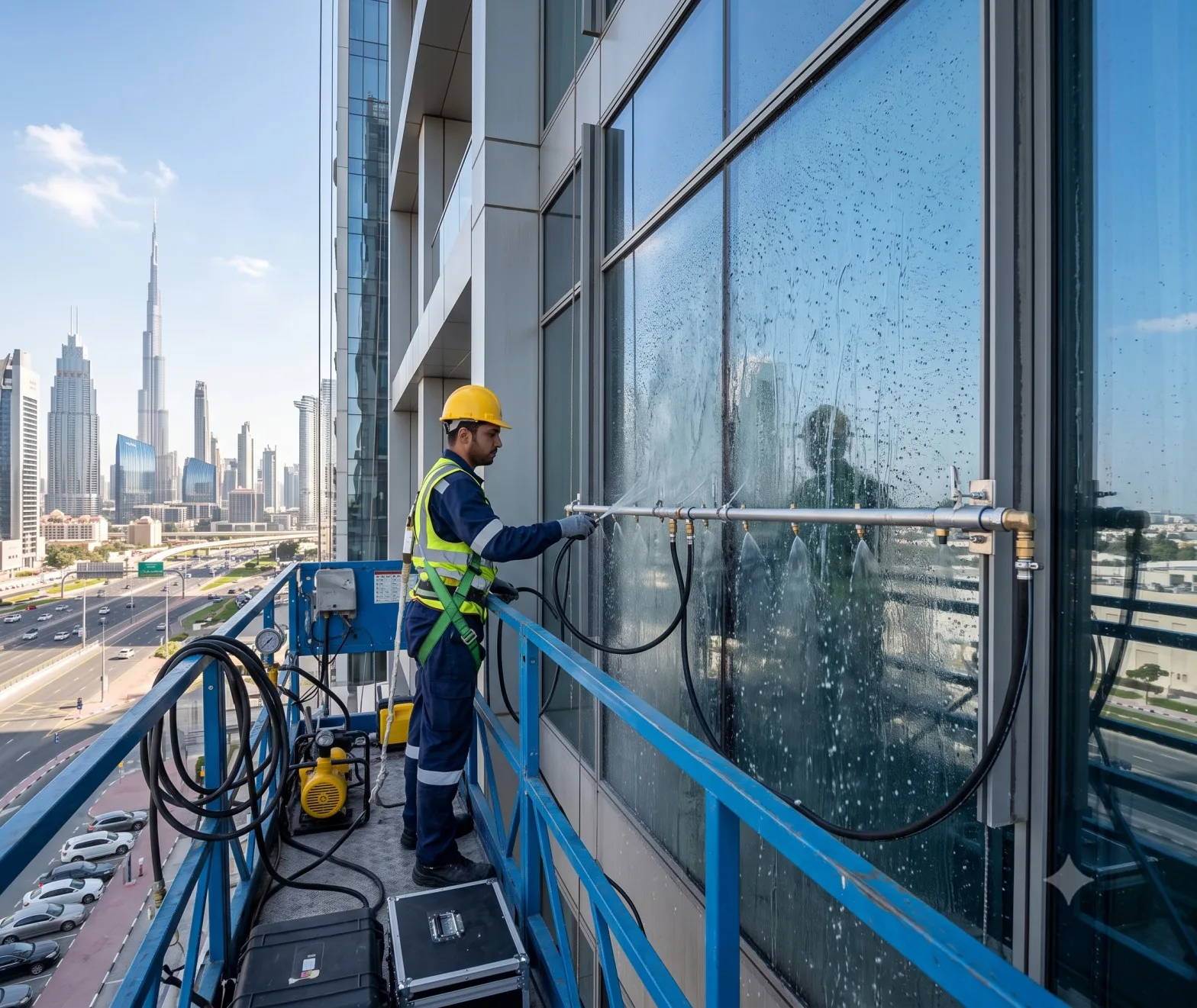
A water penetration test is a controlled assessment used to determine whether water can enter a building through vulnerable parts of its external envelope. Depending on the building component and project requirements, water may be applied through calibrated hoses, spray systems, or other controlled methods while inspectors observe the interior and exterior for signs of leakage.
The objective is not simply to determine whether water is present. A properly planned assessment aims to identify the location, pathway, and potential cause of water ingress. This can involve examining joints, seals, glazing systems, curtain walls, windows, doors, cladding interfaces, and other areas exposed to rain.
For field assessments, different standards can apply depending on the system being evaluated. ASTM E1105, for example, covers field determination of resistance to water penetration for installed exterior windows, skylights, doors, and curtain walls under water application combined with a static air-pressure difference.
Why Is Water Penetration Testing Important in the UAE?
The UAE has a predominantly hot and dry climate, but buildings still need to be prepared for periods of rainfall, humidity, wind-driven rain, and changing environmental conditions. High-rise buildings and glazed façades can be particularly dependent on correctly installed seals, joints, drainage paths, and façade interfaces.
Water infiltration can become more complicated when the source of a leak is not located directly above the visible internal damage. Water may travel through concealed paths within a façade or building envelope before appearing at an interior location. This is why visual inspection alone may not always be sufficient.
A structured water assessment can help building professionals:
- Identify vulnerable areas before they develop into major defects.
- Verify whether façade and waterproofing installations are performing as intended.
- Locate potential leakage points in windows, doors, curtain walls, and joints.
- Support corrective maintenance and repair decisions.
- Reduce the risk of repeated water-related complaints.
- Provide documented evidence of observed performance and deficiencies.
Cornerstone Middle East states that its water infiltration studies are intended to identify water-entry points and assess vulnerabilities affecting building durability, indoor air quality, and occupant comfort.
Which Building Components Can Be Assessed?
Water resistance assessments can be relevant to many components of a building envelope. The appropriate method depends on the construction type, project specifications, accessibility, and the purpose of the assessment.
Common areas include:
Curtain Walls
Curtain wall systems are extensively used in UAE commercial and high-rise buildings. Their performance depends on glazing, frames, gaskets, sealants, drainage paths, joints, and connections between the façade and adjacent construction.
Cornerstone Middle East lists water penetration assessment as part of its curtain wall testing services, alongside structural performance, air infiltration, thermal transmittance, and impact resistance assessments.
Windows and Doors
Poorly sealed window and door interfaces can become potential entry points for rainwater. Testing can help determine whether installation details, seals, joints, and surrounding interfaces are performing adequately.
Storefronts and Sloped Glazing
Commercial properties frequently incorporate storefront systems and glazed entrances. AAMA 501.2 is one of the field-check procedures referenced by Cornerstone Middle East for installed storefronts, curtain walls, and sloped glazing systems.
Building Envelope Interfaces
Water can enter through transitions between different materials or construction systems. These may include façade-to-roof connections, cladding joints, window interfaces, penetrations, and other areas where multiple building components meet.
How Does the Testing Process Work?
A professional assessment normally begins before water is introduced to the building. The inspection team first needs to understand the building configuration, suspected problem areas, applicable project requirements, and relevant construction details.
Cornerstone Middle East describes a process that can include site evaluation, hose testing, leak identification, reporting, and consultation. Its water infiltration study service also identifies visual examination, moisture meter analysis, infrared thermography, water testing, and building-envelope evaluation as components of its diagnostic approach.
The process generally involves several stages.
Initial Site Inspection
The inspection begins with an examination of the affected area and surrounding building envelope. Professionals look for visible cracks, failed sealants, damaged finishes, gaps, staining, deterioration, or other indications that may help explain the moisture problem.
The inspection should consider both the internal symptoms and the external façade because the visible location of water damage may not correspond to the actual point where water entered.
Selection of the Appropriate Method
Not every façade requires the same assessment method. A controlled hose test may be appropriate for diagnosing specific areas, while a spray rack or pressure-based procedure may be more suitable for other applications.
The selected method should reflect the building component, project specification, applicable standard, and reason for the assessment.
Controlled Water Application
During a water assessment, water is applied to the relevant exterior area under controlled conditions. Site hose testing, for example, uses a calibrated hose to simulate rainfall and investigate vulnerable sections of the façade. Cornerstone Middle East describes its site hose testing as an approach for evaluating façade water resistance and identifying areas susceptible to water ingress.
Monitoring and Leak Identification
Inspectors monitor the tested area and relevant internal spaces for evidence of water entry. Observations may include visible moisture, dripping, dampness, staining, or other indications of leakage.
In some situations, additional diagnostic equipment can provide useful information. Moisture meters can help quantify moisture levels, while infrared thermography may assist in identifying temperature differences associated with potential moisture accumulation.
Documentation and Reporting
A professional report is an important part of the process. The report should clearly document the areas examined, methodology, observations, identified deficiencies, and recommendations.
Detailed reporting enables developers, contractors, consultants, and facility managers to make informed decisions about repairs and follow-up assessments. Cornerstone Middle East specifically highlights comprehensive reporting containing findings, analysis, and recommendations as part of its service approach.
Standards Used for Water Resistance Assessment
Standards provide consistent procedures for evaluating façade and building-envelope performance. The correct standard depends on the component and testing objective rather than applying one method universally.
Cornerstone Middle East references several international standards and industry guidelines for its water-related façade assessments, including ASTM E331, ASTM E1105, AAMA 501.2, EN 13051, ISO 7892, NHBC standards, and CWCT standards.
Some commonly referenced standards include:
- ASTM E331, which addresses water penetration of exterior windows, skylights, doors, and curtain walls under a uniform static air-pressure difference.
- ASTM E1105, which provides a field procedure for installed exterior windows, skylights, doors, and curtain walls using water application with uniform or cyclic static air-pressure difference.
- AAMA 501.2, which provides a field water-leakage check for installed storefronts, curtain walls, and sloped glazing systems.
- CWCT procedures, which are used within building-envelope performance assessment for relevant façade systems.
ASTM itself describes E1105 as a field method for evaluating installed exterior windows, curtain walls, skylights, and doors and notes that the procedure can also be used to investigate joints between assemblies and adjacent construction.
Common Causes of Water Ingress
A failed assessment does not necessarily mean that the entire façade system is defective. Water entry may be associated with a localized installation or maintenance issue.
Common contributing factors can include deteriorated sealants, improperly sealed joints, damaged gaskets, inadequate drainage, installation defects, cracks, defective interfaces, or deterioration caused by environmental exposure.
In existing buildings, maintenance history is also important. Sealants and other weather-resistant components can deteriorate over time, potentially reducing the ability of the façade to resist water.
This is why professional diagnosis is more valuable than simply sealing the visible symptom. If the underlying water pathway is not understood, a repair may temporarily hide the problem without eliminating its cause.
When Should a Water Penetration Test Be Conducted?
A water penetration test can be useful at several stages of a building's lifecycle.
For new construction, assessment can support quality assurance and help identify installation problems before a building is handed over. For renovation projects, testing can help establish whether façade modifications or replacement components are performing properly.
Existing buildings experiencing unexplained dampness, recurring leaks, façade deterioration, or moisture-related complaints may also benefit from a structured investigation.
It is particularly useful when:
- Water leakage repeatedly occurs after rainfall.
- Moisture appears around windows or curtain walls.
- Sealants or façade joints show visible deterioration.
- A newly installed façade requires performance verification.
- Building occupants report dampness or musty conditions.
- Previous repair work has failed to resolve recurring leakage.
Benefits Beyond Leak Detection
The value of professional water assessment extends beyond finding an immediate leak. Early identification of vulnerabilities can help property owners plan corrective work before moisture causes more extensive deterioration.
Water infiltration can contribute to damage involving finishes, insulation, sealants, and other building materials. Cornerstone Middle East notes that water infiltration studies can help protect structural elements, address moisture-related indoor air-quality concerns, prevent costly damage, and improve occupant comfort.
For facility managers, documented inspection findings can also support maintenance planning. Instead of responding only when occupants report a problem, building teams can use inspection information to prioritize areas that require repair or further investigation.
Choosing the Right Testing Partner in the UAE
Selecting a qualified service provider is an important part of obtaining meaningful results. Building-envelope investigations require more than simply spraying water onto a façade. The team should understand the construction system, applicable testing standards, measurement techniques, safety requirements, and limitations of each method.
A credible provider should be able to explain why a particular procedure is appropriate and provide clear documentation of the findings.
Cornerstone Middle East presents itself as a multidisciplinary engineering consulting provider in Dubai, UAE, with services covering building performance, façade and building-envelope assessments, water infiltration studies, site hose testing, spray rack testing, and curtain wall testing.
Its published service information also emphasizes experienced professionals, specialized equipment, compliance with relevant standards, and detailed reporting.
Frequently Asked Questions
How often should a building be assessed for water resistance?
There is no universal testing frequency for every building. The appropriate schedule depends on the building type, façade system, environmental exposure, maintenance history, project requirements, and whether previous leakage has been identified. Buildings with recurring moisture problems may require targeted diagnostic assessments.
Is a water assessment necessary for new buildings?
It can be valuable during construction and before handover because identifying façade or installation deficiencies early can make corrective action easier. The specific procedure should be determined according to the project specification and applicable standards.
Can testing identify the exact source of every leak?
Testing can provide valuable evidence about potential entry points, but water can travel through concealed paths within building assemblies. In complex cases, multiple diagnostic techniques may be required. Cornerstone Middle East combines water testing with methods such as visual examination, moisture measurement, and infrared thermography for water-infiltration investigations.
What happens after a leakage problem is identified?
The next step is generally to determine the underlying cause and develop an appropriate remedial strategy. Depending on the findings, corrective work may involve sealant replacement, joint repairs, drainage improvements, façade repairs, or other measures. Follow-up assessment may then be appropriate to verify the effectiveness of the repair.
Conclusion
Reliable building-envelope performance is essential for the long-term durability and comfort of properties across the UAE. A professionally conducted water penetration test can help identify vulnerabilities in façades, windows, curtain walls, doors, glazing systems, and other building-envelope components before water-related defects become more expensive and disruptive.
The most effective approach combines appropriate testing methodology, experienced inspection personnel, calibrated equipment, applicable standards, careful observation, and comprehensive reporting. Rather than treating water leakage as an isolated maintenance problem, building owners and project teams should view it as a building-performance issue that requires systematic investigation.
With its focus on façade testing, water infiltration studies, site hose testing, spray rack testing, curtain wall assessment, and enclosure integrity services, Cornerstone Middle East offers a broad range of building-performance solutions for projects in the UAE and wider GCC region.
For developers, consultants, contractors, and facility managers seeking to improve façade reliability, early assessment can provide valuable technical insight, support informed maintenance decisions, and contribute to the long-term resilience of the building envelope.