Summary - Outbound voice call campaigns are proactive communication strategies where businesses contact customers using automated messages, AI voice bots, or live agents for marketing, reminders, alerts, and engagement. Successful campaigns depend on clear objectives, verified contact data, audience segmentation, optimized call timing, compliant practices, and continuous performance tracking. When executed correctly, outbound voice calls help businesses significantly improve lead conversion rates, customer engagement, retention, and response speed, especially in markets like India where voice communication still holds strong influence across urban and semi-urban audiences.
Even with the rise of WhatsApp marketing, email automation, and chat-based customer engagement tools, outbound voice call campaigns continue to hold a strong position in modern business communication.
Why? Because the voice still feels personal.
When a customer receives a voice call, it creates immediate attention compared to a message that can be ignored or lost in notifications. For industries like banking, healthcare, e-commerce, education, and real estate, outbound voice calls remain one of the most reliable ways to deliver time-sensitive information and drive real responses.
In India especially—where mobile usage is massive and communication preferences vary across regions—voice calls still outperform many digital channels when it comes to urgency-driven communication and trust-building.
But here’s the reality:
Not all outbound voice call campaigns succeed.
The difference between a high-performing campaign and a failed one lies in strategy, execution, and optimization—not just technology.
Let’s understand how to do it right.
What Are Outbound Voice Call Campaigns?
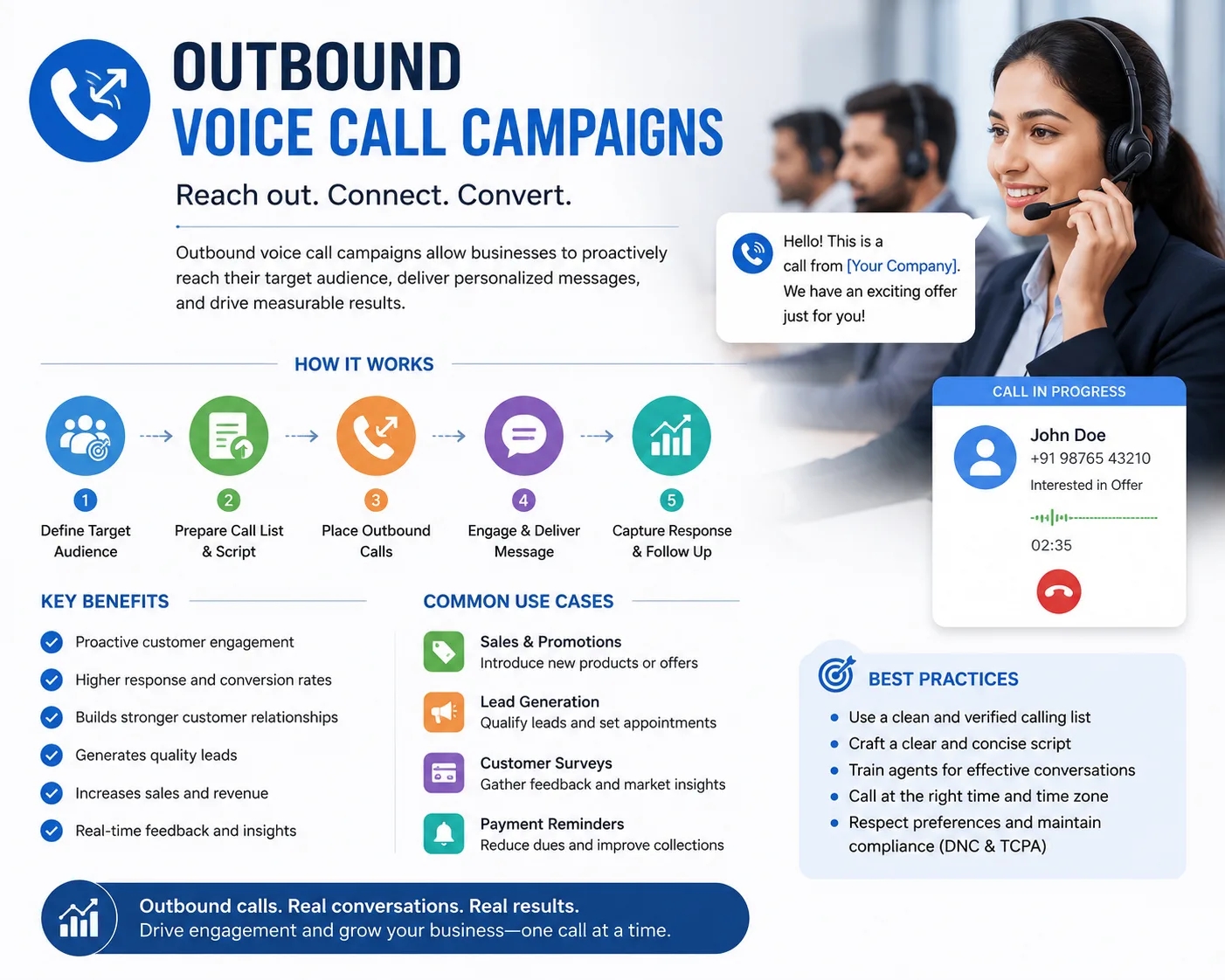
Outbound voice call campaigns refer to structured communication systems where businesses initiate calls to customers or prospects for specific purposes using Bulk Voice Calling Service Provider.
These calls can be:
- Pre-recorded voice messages
- AI-powered automated voice interactions
- Live agent conversations
They are commonly used for:
- Lead generation and follow-ups
- Promotional offers and announcements
- Payment reminders and billing alerts
- Appointment confirmations
- Customer feedback and surveys
For example, a Mumbai-based fintech company might use outbound voice calls to remind customers about EMI payments, while an edtech platform in Pune may use them to re-engage inactive students or promote new courses.
The goal is simple: deliver the right message to the right person at the right time through voice communication.
Why Are Outbound Voice Calls Still Effective in 2026?
Despite the dominance of digital messaging platforms, outbound voice calls continue to deliver strong results in many industries.
Here’s why they still work:
1. Higher Attention Rate
A ringing phone demands attention immediately. Unlike emails or WhatsApp messages, voice calls cannot be ignored silently.
2. Strong Urgency Impact
Voice communication is ideal for time-sensitive messages such as payment alerts, OTP confirmations, or delivery updates.
3. Builds Human Trust
Even automated voice messages feel more personal than text-based communication. Tone and clarity help build trust.
4. Strong Reach in Tier 2 & Tier 3 Cities
In many parts of India, voice calls are still the most reliable communication method compared to app-based messaging.
5. Works Across Age Groups
From young users to older demographics, voice remains universally understandable and accessible.
Because of these advantages, businesses across India continue to rely heavily on outbound voice call systems for customer communication.
Best Practices for Running Successful Outbound Voice Call Campaigns
1. Define Clear Campaign Objectives
Before launching any outbound voice campaign, you need clarity on what you are trying to achieve.
Ask yourself:- Are you generating new leads?
- Are you following up on existing leads?
- Are you reminding customers about payments or appointments?
- Are you trying to increase sales or engagement?
Each objective requires a different tone, script, and structure.
For example, a healthcare clinic in Mumbai sending appointment reminders should keep messages short and informative, while a real estate company running promotions may need more persuasive messaging.
Without clear goals, campaigns often become unfocused and ineffective.
2. Build and Maintain High-Quality Contact Lists
Your data is your foundation.
Even the best voice script will fail if you are calling the wrong audience.
Best practices include:- Using verified mobile numbers
- Collecting opt-in or permission-based leads
- Regularly cleaning outdated or inactive contacts
- Avoiding purchased low-quality databases
For instance, a real estate company using outdated leads may experience low pickup rates and high rejection rates, whereas CRM-integrated verified data often results in significantly better engagement.
Good data = better conversion.
3. Smart Audience Segmentation
Not all customers should receive the same message.
Segmentation helps personalize communication at scale.
You can segment based on:- Location (Mumbai, Delhi, Bangalore, etc.)
- Customer behavior (active, inactive, returning users)
- Purchase history
- Funnel stage (new lead vs warm lead vs customer)
For example, an edtech company in India may send different voice messages to first-time website visitors compared to students who previously enrolled in a course.
This makes communication more relevant—and relevance drives conversion.
4. Create High-Impact Voice Scripts
Your script is the heart of your campaign.
A good voice script should:- Introduce the brand clearly
- Deliver the message within the first few seconds
- Avoid unnecessary details
- Maintain a conversational tone
- End with a strong call-to-action
Example:
Instead of saying:
“We would like to inform you about our new service offerings…”
Say:
“Hi, this is ABC Company. We have a special offer for you today that can help you save on your next purchase.”
Short, direct, and action-oriented messaging consistently performs better.
5. Timing Matters More Than You Think
Even the best campaign fails if calls are made at the wrong time.
Ideal time slots:- 10:00 AM to 1:00 PM
- 4:00 PM to 7:00 PM
- Early mornings
- Late nights
- Busy working hours for professionals
In India, evening calls generally perform better for consumer-facing businesses, while mid-morning works well for B2B audiences.
6. Use AI Voice Automation for Scale
Modern outbound calling is no longer manual.
AI has transformed the entire system.
With AI voice technology, businesses can:- Handle thousands of calls simultaneously
- Deliver personalized messages
- Respond to basic queries automatically
- Integrate with CRM systems for automation
For example, an AI voice bot can remind customers about EMI payments and also answer simple queries like due dates or payment options—without human involvement.
This reduces cost and increases efficiency.
7. Ensure Full Regulatory Compliance
Compliance is critical for long-term success.
In India, businesses must follow:- TRAI regulations
- DND (Do Not Disturb) guidelines
- Consent-based calling rules
- Number blocking
- Customer complaints
- Legal risks
- Brand reputation damage
Always ensure your calls are permission-based and ethically executed.
8. Track and Analyze Performance Metrics
You cannot improve what you don’t measure.
Key performance indicators include:- Call pickup rate
- Conversion rate
- Drop-off rate
- Cost per lead
- Average call duration
For example, if your Mumbai campaign shows high pickup but low conversions, the issue is likely in the script or offer—not the audience.
Data helps you optimize continuously.
9. Continuously Optimize Scripts Based on Feedback
Successful businesses constantly refine their communication.
Improvements may include:- Shortening message length
- Adding local language elements
- Improving CTA clarity
- Making tone more conversational
For example, campaigns targeting Mumbai audiences often perform better when mixed with Hindi-English conversational tone rather than purely formal language.
10. Integrate Voice Calls with Multi-Channel Marketing
Outbound voice calls work best when combined with other channels.
A strong strategy includes:- Voice call → initial contact
- SMS → confirmation or reminder
- WhatsApp → detailed information
This creates a complete communication funnel.
For example:
A customer receives a voice reminder about a service → SMS confirmation → WhatsApp brochure or details.
This multi-touch approach significantly improves conversion rates.
Common Mistakes to Avoid in Outbound Voice Call Campaigns
Even well-planned outbound voice call campaigns can fail if key mistakes are ignored. Most failures come from poor execution, not technology.
1. Calling Without Customer Consent
Running campaigns without proper consent can lead to complaints, number blocking, and legal issues. It also damages brand trust. Always use opt-in or permission-based lists.
2. Over-Calling or Repeated Contacting
Calling the same user too frequently creates frustration and leads to blocking or spam reports. Balanced frequency is important to maintain trust.
3. Poor or Robotic Voice Scripts
Weak scripts reduce engagement. Avoid long, robotic messaging. Keep it natural, short, and clear with a strong CTA. Conversational tone performs better.
4. Ignoring Timing Strategy
Wrong timing leads to low pickup rates. For example, calling working professionals in Mumbai during office hours reduces response. Timing must match audience behavior.
5. Not Segmenting the Audience Properly
Sending the same message to all users reduces effectiveness. Segment users based on behavior, location, or funnel stage for better relevance.
6. Ignoring Performance Analytics
Without tracking metrics like pickup rate, conversion rate, and drop-offs, campaign improvement is not possible. Data-driven optimization is essential.
7. Not Integrating with Other Channels
Voice calls alone are not enough. Without SMS or WhatsApp follow-ups, many conversions are lost. Multi-channel communication improves results.
Industry Use Cases of Outbound Voice Call Campaigns
Outbound voice calls are widely used across industries where direct communication is important.
1. E-Commerce Industry
Used for order confirmations, delivery updates, cart reminders, and promotions. Helps improve trust and reduce support queries.
2. Banking and Financial Services
Used for EMI reminders, fraud alerts, due date notifications, and loan offers. Ensures timely communication and security alerts.
3. Education and EdTech
Used for admission follow-ups, fee reminders, course updates, and webinar invitations. Improves enrollment conversion rates.
4. Healthcare Industry
Used for appointment reminders, test updates, and health alerts. Helps reduce missed appointments and improves patient care.
5. Real Estate Industry
Used for lead follow-ups, site visit scheduling, and project updates. Helps convert inquiries into actual visits and sales.
6. Telecom and Service Providers
Used for plan renewals, service updates, offers, and feedback collection. Helps reduce churn and improve retention.
Frequently Asked Questions
What is an outbound voice call campaign in simple terms?
An outbound voice call campaign is a structured communication process where businesses call customers automatically or manually to deliver messages such as promotions, reminders, updates, or alerts.
Are outbound voice calls still effective in 2026?
Yes, outbound voice calls are still highly effective in 2026, especially in India. They generate higher attention rates compared to text messages and work well for urgent or time-sensitive communication.
What is the ideal duration of an outbound voice call?
The ideal outbound voice call duration is usually between 20 to 45 seconds. Short, clear, and action-focused messages perform best and improve engagement rates.
How do businesses benefit from outbound voice call campaigns?
Businesses benefit through improved lead conversion rates, faster customer response times, better engagement, and more efficient communication across marketing and support operations.
Which industries benefit the most from outbound voice calls?
Industries such as banking, healthcare, education, e-commerce, real estate, and telecom benefit the most because they rely on timely communication and customer engagement.
Turning Outbound Voice Calls into a Growth Engine
Outbound voice call campaigns are no longer just a basic communication tool—they have evolved into a strategic channel for driving real business growth. When executed with the right planning, they help businesses create timely, direct, and impactful conversations that customers actually respond to.
The real success lies in how well the campaign is structured. Clear objectives, clean and permission-based data, smart audience segmentation, well-crafted conversational scripts, and strict compliance together form the foundation of a high-performing system. When these elements are aligned, outbound voice calls can significantly improve engagement, boost lead conversions, and strengthen customer relationships.
With the growing use of AI voice automation and multi-channel integration, businesses now have even more opportunities to scale their calling campaigns efficiently while keeping communication personalized and relevant.
If you are looking to upgrade your customer communication strategy and implement a more effective outbound calling system, it’s the right time to take the next step.
Connect with WebXion to build smarter, scalable, and result-driven outbound voice call solutions tailored for your business growth.