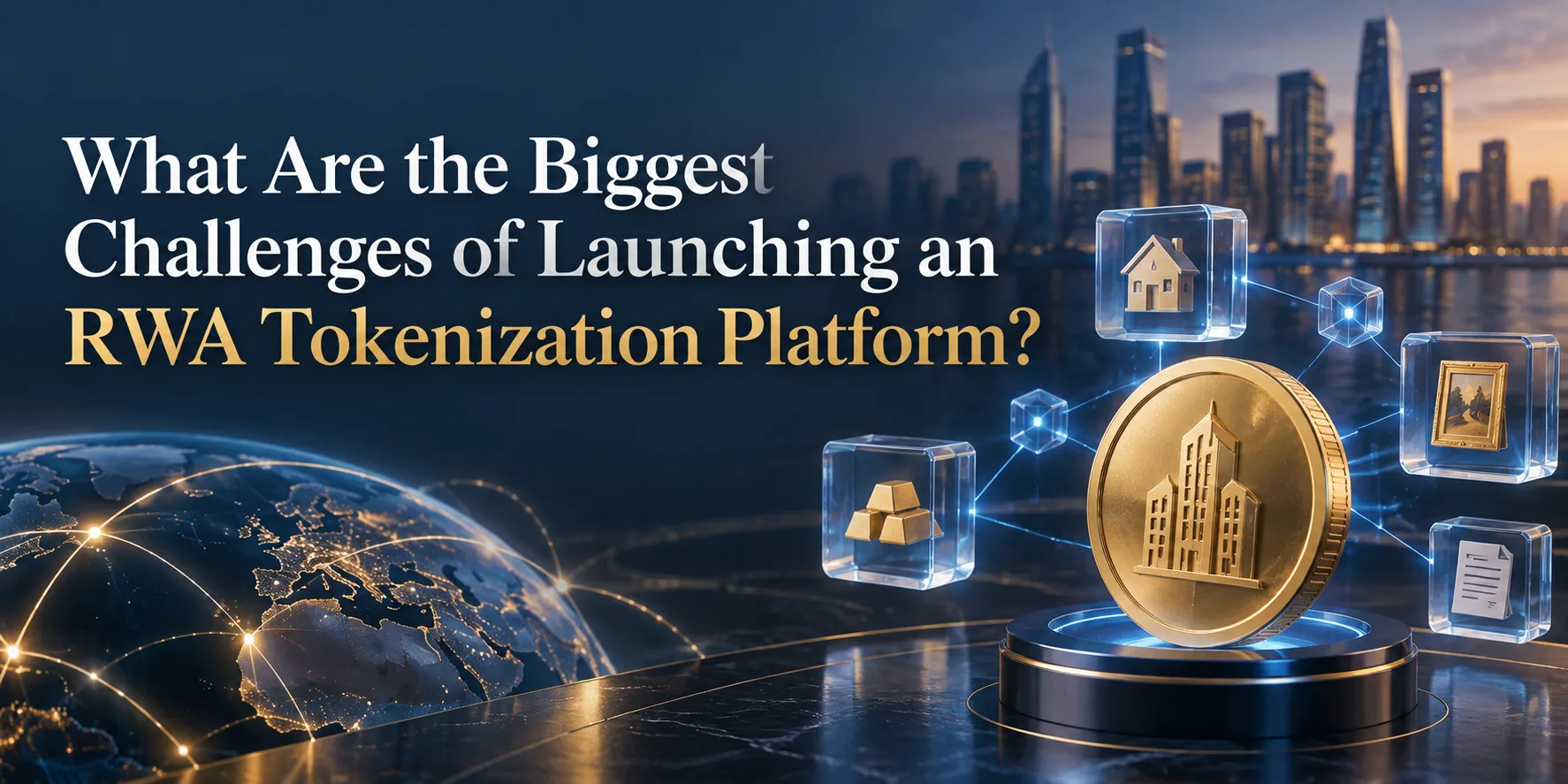
Real-world asset (RWA) tokenization is increasingly being viewed as one of the most important applications of blockchain technology beyond cryptocurrencies. The concept is straightforward: ownership rights or economic interests in assets such as real estate, private credit, bonds, commodities, funds, and other traditionally illiquid assets can be represented digitally on a blockchain. In practice, however, building a platform capable of doing this legally, securely, and at institutional scale is considerably more complicated than creating a token and deploying a smart contract.
The Bank for International Settlements (BIS) describes tokenization as a process that combines information about an asset with programmable rules governing ownership and transfers. It also emphasizes that the technology must overcome economic, legal, and technical challenges before its benefits can be realized at scale.
This explains why launching an RWA platform requires much more than blockchain development. The platform has to connect traditional asset ownership systems with blockchain infrastructure while preserving legal rights, regulatory compliance, investor protections, asset verification, custody, and operational resilience.
Below are the biggest challenges businesses need to address before launching an RWA tokenization platform.
1. Navigating Complex Regulatory Requirements
Regulatory compliance is arguably the biggest challenge because tokenized assets can fall under different legal classifications depending on the underlying asset, token structure, investor rights, jurisdiction, and distribution model.
For example, a token representing shares in a company may be treated as a security. A token representing an interest in a real-estate investment vehicle can similarly trigger securities regulations. Tokenization does not automatically change the legal nature of an asset. In a 2025 statement, the U.S. Securities and Exchange Commission emphasized that tokenized securities remain securities and therefore continue to be subject to applicable securities laws.
The SEC's January 2026 statement further distinguished between different tokenization models, including securities tokenized by issuers and securities tokenized by third parties.
Consequently, platform operators need to determine:
- What legal rights does each token represent?
- Is the token a security, fund interest, debt instrument, commodity interest, or another type of asset?
- Which investors are eligible?
- What KYC and AML procedures are required?
- Which jurisdictions can participate?
- What transfer restrictions must be programmed?
- Who legally owns the underlying asset?
- What happens if the platform becomes insolvent?
These questions must be answered before the technical architecture is finalized.
2. Establishing a Reliable Link Between Tokens and Real Assets
One of the fundamental challenges of RWA tokenization is ensuring that the digital token genuinely corresponds to the underlying physical or financial asset.
Creating a blockchain token is technically straightforward. Proving that the token represents a specific building, bond, commodity, loan, or other asset is much more difficult.
Consider real estate. A platform may issue 100,000 tokens representing economic interests in a property. But the blockchain itself cannot determine whether the property actually exists, whether the title is valid, whether the property has liens, or whether ownership has subsequently changed in an offline registry.
BIS has specifically highlighted this "on-ramp" problem. Traditional assets often remain recorded in separate systems, while tokenized representations exist on programmable platforms. Connecting these systems securely requires coordination between blockchain infrastructure and traditional registries and intermediaries.
This creates the need for independent asset verification, legal documentation, custodial arrangements, valuation processes, audits, and trusted data providers.
Without these controls, a platform can create a technically perfect token representing an asset whose legal or economic backing is uncertain.
3. Building Strong KYC, AML, and Investor Compliance Infrastructure
An RWA platform often operates much closer to traditional financial infrastructure than a typical cryptocurrency application.
If investors can purchase tokenized securities, real estate interests, private credit, or funds, the platform may need comprehensive identity verification and compliance processes.
These can include customer identification, sanctions screening, anti-money-laundering checks, accreditation or eligibility verification, transaction monitoring, suspicious-activity monitoring, and jurisdiction-based restrictions.
The difficulty increases when the platform serves users across multiple countries. Different jurisdictions can impose different requirements concerning investor eligibility, securities offerings, data privacy, custody, taxation, and reporting.
The blockchain may make transfers technically global, but that does not mean every token can legally be transferred to every wallet.
Therefore, compliance logic may need to be incorporated directly into the platform and smart contracts. Wallet addresses may have to be whitelisted, transfer restrictions may need to be enforced, and certain investors may need to be blocked from specific offerings.
4. Designing Secure and Flexible Smart Contracts
Smart contracts form the operational backbone of many tokenization platforms. They can control token issuance, ownership transfers, investor eligibility, distributions, redemptions, voting, and other asset-related functions.
However, smart contracts are also a major source of technical risk.
A programming error could potentially affect token ownership, distributions, transfer restrictions, or redemption mechanisms. Because blockchain transactions can be difficult or impossible to reverse, an error can have serious consequences.
For an RWA platform, smart-contract architecture may need to support:
- Controlled token issuance
- Whitelisted transfers
- Investor restrictions
- Corporate actions
- Dividend or income distributions
- Token burning and redemption
- Emergency controls
- Governance mechanisms
- Role-based permissions
- Compliance-related transfer restrictions
Security audits therefore become particularly important. A platform should generally combine secure development practices, independent contract auditing, penetration testing, access-control reviews, monitoring, and incident-response procedures.
The BIS has identified smart-contract vulnerabilities, private-key management, governance weaknesses, and the immutability of distributed-ledger transactions among the operational risks associated with tokenization.
5. Solving Custody and Asset Protection
Tokenization does not eliminate the need for custody. In many cases, it makes custody architecture even more important.
Suppose a platform tokenizes $50 million worth of real estate. Investors need confidence that the underlying property is actually held through an appropriate legal structure and that their token rights remain enforceable.
The platform therefore needs clearly defined relationships between the issuer, asset owner, custodian, transfer agent, trustee, special-purpose vehicle, investors, and technology provider.
Custody can become particularly complicated when tokenized assets are held across different legal jurisdictions. The platform must establish who controls the underlying asset, who maintains the authoritative ownership record, and what happens if one of the participating entities fails.
Recent SEC discussions around tokenized securities have similarly emphasized the importance of custody, authoritative ownership records, investor rights, and operational controls.
This means custody should be designed as part of the platform's core architecture rather than treated as an afterthought.
6. Maintaining Accurate Valuation and Reliable Off-Chain Data
Blockchain provides transparent transaction records, but it does not automatically provide accurate information about real-world assets.
A tokenized property still requires property valuation. A tokenized private loan still requires information about the borrower. A tokenized commodity still needs reliable pricing and verification.
This creates a dependency on oracles and external data providers.
For example, if an RWA platform uses an external valuation to calculate the value of a tokenized property, an inaccurate or manipulated data feed could affect investor decisions or automated smart-contract functions.
The problem becomes more serious when smart contracts automatically trigger events based on external information.
Consequently, platforms need robust oracle architecture, multiple data sources where appropriate, verification procedures, data freshness controls, and contingency mechanisms.
The Financial Stability Board has also highlighted risks involving asset valuation, opaque smart contracts, and reliance on unregulated or unreliable oracles as tokenization develops.
7. Achieving Real Secondary-Market Liquidity
One of the most attractive promises of RWA tokenization is improved liquidity. However, tokenization itself does not guarantee liquidity.
Creating 1 million tokens representing a property does not automatically create 1 million willing buyers.
Liquidity requires an active marketplace, sufficient investor demand, appropriate market-making mechanisms, transparent pricing, compliant transfer infrastructure, and clear redemption processes.
This is particularly challenging for unique assets such as commercial properties, private equity positions, infrastructure projects, or specialized debt instruments.
A platform therefore needs to think beyond primary issuance. It must consider how investors can potentially trade, redeem, or transfer their positions while remaining compliant with applicable restrictions.
This is one reason tokenization should be viewed as market infrastructure rather than simply a token-generation exercise.
8. Interoperability and Blockchain Selection
Another significant challenge is choosing the appropriate blockchain infrastructure.
An RWA platform may need to support institutional-grade security, transaction throughput, privacy, compliance controls, interoperability, and predictable costs. At the same time, investors may expect access through familiar wallets and marketplaces.
Choosing a public blockchain can provide broad accessibility, while permissioned networks can offer greater control over participants and transactions. Some platforms may ultimately need a hybrid architecture.
Interoperability creates another problem. If tokenized assets exist across multiple networks, moving assets and compliance information between ecosystems becomes more complicated.
The BIS has noted that tokenization can potentially create efficiencies by bringing assets, money, and transaction logic onto programmable platforms, but achieving these benefits requires sound infrastructure and governance.
Therefore, blockchain selection should be based on business and regulatory requirements rather than simply choosing the network with the lowest transaction fees.
9. Protecting the Platform Against Cybersecurity Threats
An RWA platform can become an attractive target for attackers because it potentially connects valuable real-world assets with blockchain-based financial infrastructure.
Threats can exist at several layers:
- Smart-contract vulnerabilities
- Private-key compromise
- Administrator account attacks
- Oracle manipulation
- API vulnerabilities
- Wallet attacks
- Identity and KYC database breaches
- Insider threats
- Front-end manipulation
- Cross-chain bridge vulnerabilities
The consequences can be significantly greater than those of a conventional application because the platform may control valuable financial assets.
Security therefore needs to cover both blockchain and traditional infrastructure. Multi-signature authorization, hardware security modules, role-based access control, continuous monitoring, encryption, penetration testing, disaster recovery, and incident-response procedures can all become important components of the architecture.
10. Managing Legal Rights and Investor Expectations
Perhaps the most overlooked challenge is making sure investors understand exactly what they are buying.
A token does not automatically equal direct ownership of the underlying asset.
Depending on the legal structure, an investor might own shares in a special-purpose vehicle, a beneficial interest, a debt claim, a contractual right to cash flows, or another economic interest connected to the asset.
These distinctions matter.
For example, owning a token connected to an apartment building may not give an investor the right to enter the property, make operational decisions, or directly transfer the property's legal title.
The platform must therefore clearly define token-holder rights, voting rights, distributions, redemption conditions, bankruptcy treatment, transfer restrictions, and dispute-resolution mechanisms.
The SEC has emphasized that the rights associated with a tokenized security can differ materially from the rights associated with the underlying security, making clear disclosure especially important.
11. Scaling Operations Beyond the Initial Launch
A proof of concept can tokenize one asset. Building an enterprise-grade platform capable of handling hundreds or thousands of assets is a completely different challenge.
As the number of assets increases, so does the complexity of onboarding, valuation, compliance, document management, investor servicing, distributions, reporting, corporate actions, and regulatory monitoring.
This means the platform needs scalable back-office infrastructure as much as it needs blockchain infrastructure.
Automation can help, but not everything should be automated. Some activities, such as legal verification, asset appraisal, compliance reviews, and exceptional corporate actions, may continue to require human oversight.
The strongest platforms will therefore combine programmable blockchain infrastructure with carefully designed human governance.
12. Balancing Innovation With Regulation and Trust
Ultimately, the biggest challenge of launching an RWA tokenization platform is not blockchain technology itself. It is building trust across multiple systems that were never originally designed to work together.
Real-world assets operate within legal, financial, physical, and institutional systems. Blockchain introduces a programmable digital ownership layer on top of those systems. The platform succeeds only when these layers remain synchronized.
This is why the BIS describes tokenization as a continuum in which the assets with the greatest potential benefits can also present some of the most difficult legal, economic, and technical challenges.
The evolution of tokenized government bonds provides a useful example. BIS reported that tokenized government bonds had reached about $8 billion in issuance by July 2025 and found evidence of lower bid-ask spreads in some cases, while also noting that regulatory and infrastructure challenges remain important to broader adoption.
The lesson is clear: successful tokenization requires more than putting an asset on-chain. It requires a complete ecosystem encompassing legal structures, compliance, custody, technology, liquidity, data, cybersecurity, and investor protection.
How Businesses Can Approach RWA Platform Development
Organizations planning an RWA platform should begin with the asset and legal structure rather than the blockchain.
The first stage should identify the asset class, target investors, jurisdictions, ownership structure, and regulatory classification. The next stage should define custody, compliance, token economics, transfer restrictions, valuation methodology, and redemption mechanisms.
Only after these foundations are established should the technical architecture be designed.
A well-engineered platform can then integrate token issuance, investor onboarding, KYC/AML, smart contracts, asset management, dashboards, wallet infrastructure, compliance controls, secondary-market functionality, reporting, and administrative tools Asset Tokenization Development Services.
The development process should also include extensive testing before production deployment. Smart contracts should undergo independent security reviews, while the broader platform should be assessed for API security, identity protection, access management, infrastructure resilience, and operational continuity.
The Future of RWA Tokenization Platforms
The long-term opportunity remains significant because tokenization can potentially make traditionally fragmented financial markets more programmable and efficient. Tokenized assets can support fractional ownership, automated distributions, faster settlement, programmable compliance, improved transparency, and new forms of collateralization.
However, adoption will depend on whether platforms can solve the fundamental problems surrounding legal enforceability, investor protection, custody, interoperability, liquidity, and operational risk.
The technology is already moving beyond experimentation. BIS notes that tokenization is increasingly being explored in financial markets, while regulatory authorities are actively developing frameworks for digital and tokenized assets.
The next generation of successful platforms is therefore unlikely to be defined simply by having advanced blockchain technology. Instead, competitive advantage will come from creating infrastructure that makes blockchain-based ownership compatible with established financial and legal systems.
Conclusion
Launching an RWA tokenization platform is a complex undertaking that combines blockchain development, financial infrastructure, legal structuring, compliance, cybersecurity, custody, data management, and investor protection. The biggest challenges include regulatory uncertainty, asset verification, smart-contract security, liquidity, custody, interoperability, valuation, and scalable operations. Businesses that approach tokenization as a complete financial infrastructure rather than simply a token-creation project will be better positioned for long-term success. For organizations seeking reliable blockchain expertise, Blockchain App Factory provides the best RWA tokenization development services, helping businesses build secure, scalable, and feature-rich solutions aligned with their tokenization goals.
FAQs
1. What is an RWA tokenization platform?
An RWA tokenization platform is a blockchain-based system that enables real-world assets such as real estate, bonds, commodities, funds, or private credit to be represented through digital tokens.
2. What is the biggest challenge in RWA tokenization?
Regulatory compliance is one of the biggest challenges because tokenized assets can be subject to securities, financial-services, AML, KYC, custody, and cross-border regulations.
3. Does tokenization automatically make an asset liquid?
No. Tokenization can make fractional ownership and digital transfers possible, but meaningful liquidity still requires buyers, sellers, compliant marketplaces, market infrastructure, and sufficient demand.
4. Why are smart contracts important for RWA platforms?
Smart contracts can automate token issuance, transfers, investor restrictions, distributions, redemptions, and other asset-management functions while enforcing predefined rules.
5. What role does technology play in RWA tokenization?
Technology provides the infrastructure for issuing, managing, transferring, monitoring, and reporting tokenized assets. RWA Tokenization Technology must work alongside legal, regulatory, custody, and financial infrastructure to create a reliable platform.