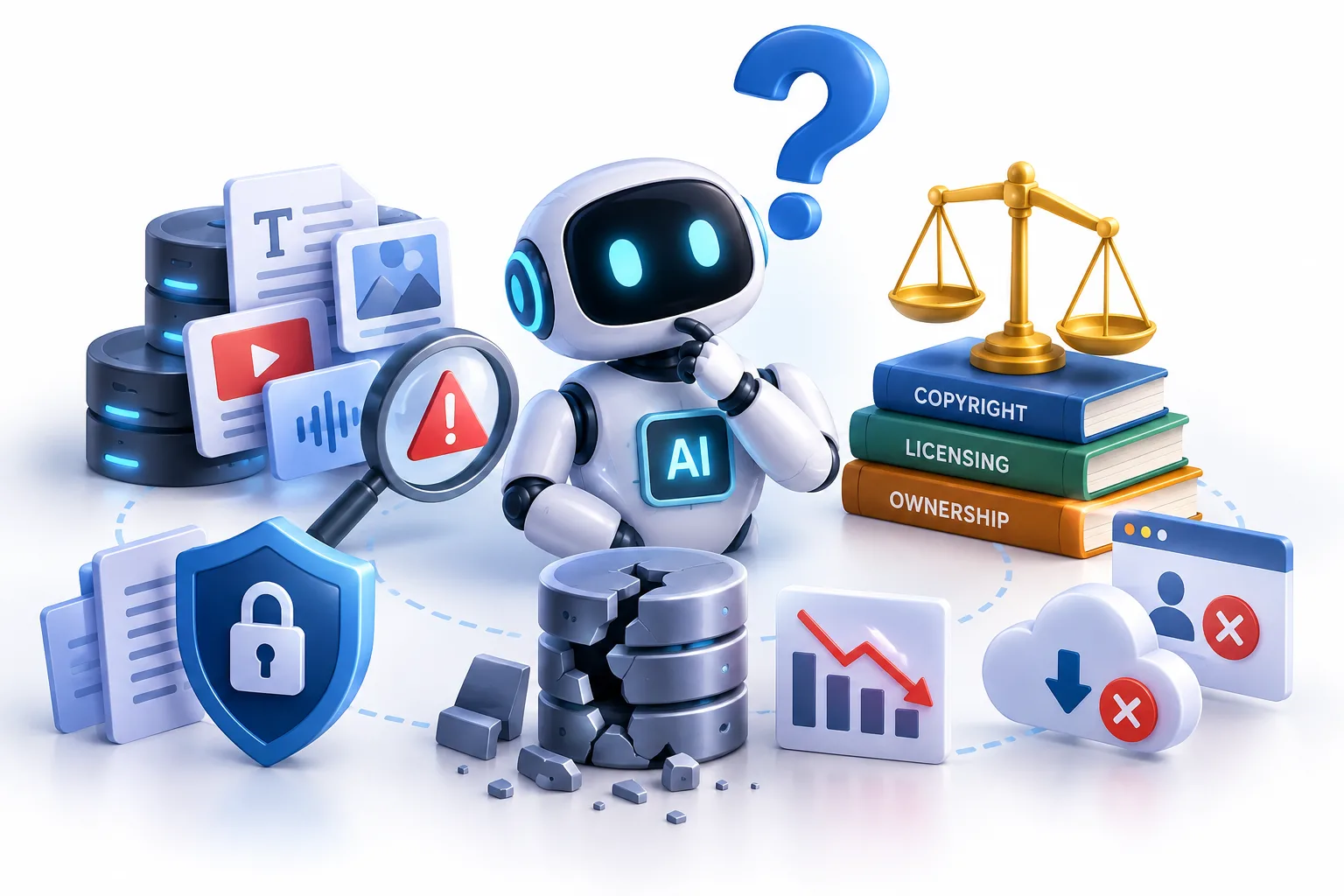
Generative AI has changed how businesses, developers, researchers, and everyday users create content, analyze information, and solve problems. From generating articles and images to writing code and summarizing documents, these systems depend heavily on data. The quality, quantity, and structure of that data directly influence how well an AI model performs.
However, using data for generative AI is not as simple as collecting large amounts of information and training a model. AI systems face several challenges related to data quality, privacy, copyright, bias, security, and availability. Understanding these challenges is important for developing AI systems that are useful, reliable, and responsible.
1. Poor-Quality and Inaccurate Data
One of the biggest challenges is data quality. Generative AI models learn patterns from their training data, so inaccurate, outdated, duplicated, or misleading information can affect their outputs.
For example, if a training dataset contains incorrect technical information, an AI system may learn those patterns and later produce unreliable answers. Large datasets can also contain spam, automatically generated content, broken text, and irrelevant information.
Data cleaning and validation therefore become essential parts of AI development. Organizations need processes for identifying low-quality information before it becomes part of a training or evaluation dataset.
2. Data Bias
Generative AI can reproduce biases present in its training data. Data collected from the internet and other sources may reflect social, cultural, geographic, or historical biases.
This can create problems when an AI system generates text, makes recommendations, or interprets information. The issue is not always caused by the AI model itself; sometimes the underlying data already contains uneven representation.
Reducing this problem requires diverse datasets, careful evaluation, and testing across different groups and situations.
3. Privacy and Sensitive Information
Training and operating AI systems can involve enormous amounts of information. Some datasets may contain personal or sensitive information that should not be exposed or used without appropriate authorization.
Privacy becomes particularly important when organizations use customer records, internal documents, conversations, or other private information. If such data is improperly collected, stored, or exposed, it can create serious privacy and security concerns.
Organizations need clear data-handling policies, access controls, anonymization techniques, and appropriate safeguards when working with sensitive information.
4. Copyright and Data Ownership
Another major challenge is determining whether data can legally and ethically be used for AI training.
Generative AI models may be trained using information collected from books, websites, articles, images, software, and other sources. However, not all publicly accessible content is automatically free to use for every purpose.
This creates difficult questions about copyright, licensing, ownership, and attribution. AI developers and organizations need to understand where their training data comes from and whether they have appropriate rights or permissions to use it.
5. Lack of High-Quality Specialized Data
More data does not always mean a better AI model. Generative AI systems often need high-quality, domain-specific information to perform well in specialized fields.
For example, a model designed for scientific research, legal analysis, engineering, or technical support may require carefully curated datasets rather than simply more general internet content.
Creating specialized datasets can be expensive and time-consuming because experts may need to review, label, organize, and validate the information.
6. Outdated Information
The real world constantly changes. New products are released, regulations change, scientific knowledge develops, and businesses update their policies.
If an AI system relies heavily on older training data, its responses may not reflect current information. This is particularly important for tasks where accuracy depends on recent developments.
Retrieval systems, regularly updated knowledge sources, and controlled data pipelines can help AI applications work with more current information.
7. Data Security
AI datasets themselves can become valuable targets for attackers. Unauthorized access to training data may expose confidential information, intellectual property, or personal records.
There is also a risk that malicious or manipulated data could be introduced into a dataset. If compromised information becomes part of an AI training process, it may affect the behavior of the resulting system.
Strong access controls, monitoring, dataset validation, and secure storage are therefore important components of responsible AI development.
8. Data Volume and Infrastructure
Modern generative AI models can require enormous datasets and significant computing resources. Collecting, storing, processing, and transferring this information can be expensive.
Organizations must manage storage capacity, processing pipelines, data formats, and computational requirements efficiently. Simply increasing dataset size can create additional infrastructure and quality-control problems.
How Can These Data Challenges Be Managed?
Organizations can reduce data-related problems by creating a structured data strategy. This can include:
- Cleaning and validating datasets before use
- Removing unnecessary or duplicate information
- Monitoring datasets for bias and quality problems
- Protecting sensitive information
- Documenting data sources and permissions
- Updating information when freshness matters
- Using human review for high-risk applications
- Testing AI outputs against trusted sources
A strong data governance process can help organizations understand what information enters an AI system, how it is processed, and where potential risks exist.
Conclusion
Generative AI depends on data, but the availability of massive datasets does not automatically guarantee accurate or trustworthy results. Poor-quality information, bias, privacy concerns, copyright issues, outdated knowledge, security threats, and limited specialized data can all affect AI systems.
The future of generative AI will therefore depend not only on larger models and more computing power, but also on better approaches to collecting, evaluating, protecting, and managing data. High-quality and responsibly managed data can help organizations build AI applications that are more reliable, useful, and appropriate for real-world applications.