Search has changed more in the last two years than it did in the previous decade. People are still searching, but the way results get generated, presented, and consumed looks fundamentally different from what marketers optimised for even recently. The brands staying visible across these shifts aren't the ones clinging to a single strategy. They're the ones that understand how SEO, AEO, GEO, and AIO fit together and build their content and technical work around all four rather than treating each one as a separate conversation.
Here's what each one actually means, how they differ, and why the real opportunity lies in the overlap between them.
Understanding the Four Disciplines and What Each One Does
Before we get into how they work together, it's worth being clear about what each term refers to, because people often use them interchangeably in ways that cause real confusion.
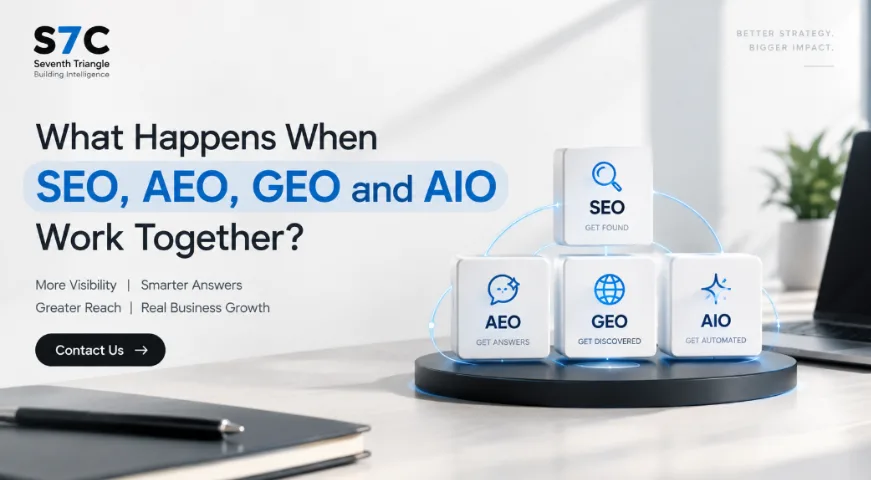
Search Engine Optimisation is the one most people know. It's about getting content to rank in traditional search results through a combination of technical health, keyword relevance, backlinks, and user experience signals. It remains foundational and isn't going away, but it's no longer the only game in town.
Answer Engine Optimisation is about getting content selected as the direct answer to a question rather than just ranking on a results page. When someone asks a voice assistant something or gets a featured snippet, AEO is the discipline behind appearing there. Search engine optimisation and answer engine optimisation share a lot of common ground, but AEO focuses on being the response rather than just being visible.
Generative Engine Optimisation is newer and addresses how content gets cited and used by AI-powered search tools that generate responses rather than returning links. Generative engine optimisation focuses on being the source that an AI cites when it builds an answer rather than just ranking for a query. This requires a different kind of content authority than traditional SEO rewards.
Artificial Intelligence Optimisation is the broadest of the four. Artificial intelligence optimisation looks at how content performs across AI-driven systems more generally, including recommendation engines, personalised search experiences, and platforms where AI decides what to surface rather than a traditional algorithm. AI search optimisation isn't about one platform. It's about structuring and presenting content in ways that AI systems can understand, evaluate, and trust.
SEO vs AEO vs GEO vs AIO: Where They Overlap and Why That Matters
Understanding the SEO vs AEO vs GEO vs AIO differences is useful, but treating them as entirely separate disciplines is a mistake. The brands getting the most from modern search are the ones that find the shared principles and build from there.
All four disciplines reward:
- Content that demonstrates genuine expertise and is clearly authoritative on its subject
- Clear, well-structured writing that makes it easy for both humans and machines to understand the point being made
- Specificity over generality because vague content doesn't rank, doesn't get cited, and doesn't get selected as an answer
- Technical health that ensures content is accessible, fast, and properly structured
- Trust signals including accurate information, consistent sourcing, and a clear point of view
The SEO, AEO, GEO, and AIO differences lie in where each one operates and what success looks like. Traditional SEO success is a ranking position. AEO success is being selected as a direct answer. GEO and AIO success is being cited or surfaced by generative and AI systems without a traditional ranking even being involved.
AEO and GEO Optimisation Strategies That Work Across All Four
Rather than building entirely separate strategies for each discipline, the most practical approach is to build content that serves all four simultaneously. Thinking about AEO and GEO optimisation strategies together actually makes the work simpler because the underlying requirements overlap significantly. Here's what that looks like in practice:
For SEO and AEO:
- Structure content around specific questions with clear, direct answers near the top
- Use structured data markup so search engines can understand the content's purpose
- Build topical authority by covering a subject comprehensively rather than in isolated pieces
For GEO and AIO:
- Write in a way that a generative AI search system could cite accurately and confidently
- Include specific facts, original perspectives, and clear attributions rather than generic claims
- Ensure the content on your site is consistent, accurate, and up to date because AI systems assess trustworthiness based on these signals
Generative AI search optimisation in particular rewards content that takes a clear position and supports it with genuine reasoning. AI-generated answers pull from sources that appear authoritative and specific, not sources that hedge everything and say nothing particular.
The future of search optimisation belongs to brands that treat these four disciplines as a connected system. SEO for AI-powered search engines isn't a replacement for traditional SEO. It's an extension of the same core principle: create content that genuinely serves the person looking for it, presented in a way that whatever system is doing the searching can understand and trust.
How Seventh Triangle Approaches Modern Search Optimisation
At Seventh Triangle, we work with brands that want visibility across all these channels, not optimising for one and hoping the others follow. The reality of modern search is that your content needs to perform in traditional results, get selected as direct answers, earn citations from generative systems, and hold up under AI evaluation simultaneously.
That requires a strategy that understands all four disciplines and builds content with all four in mind from the start rather than retrofitting each one separately.
Conclusion
SEO, AEO, GEO, and AIO aren't competing approaches. They're complementary disciplines that all reward the same underlying commitment to content that's authoritative, specific, well-structured, and genuinely useful. Brands that treat them as a unified strategy rather than separate silos build the kind of search visibility that holds up as the landscape shifts.
If your brand wants search visibility that works across all these channels, visit seventhtriangle.com and let's talk about what that looks like for your specific situation.