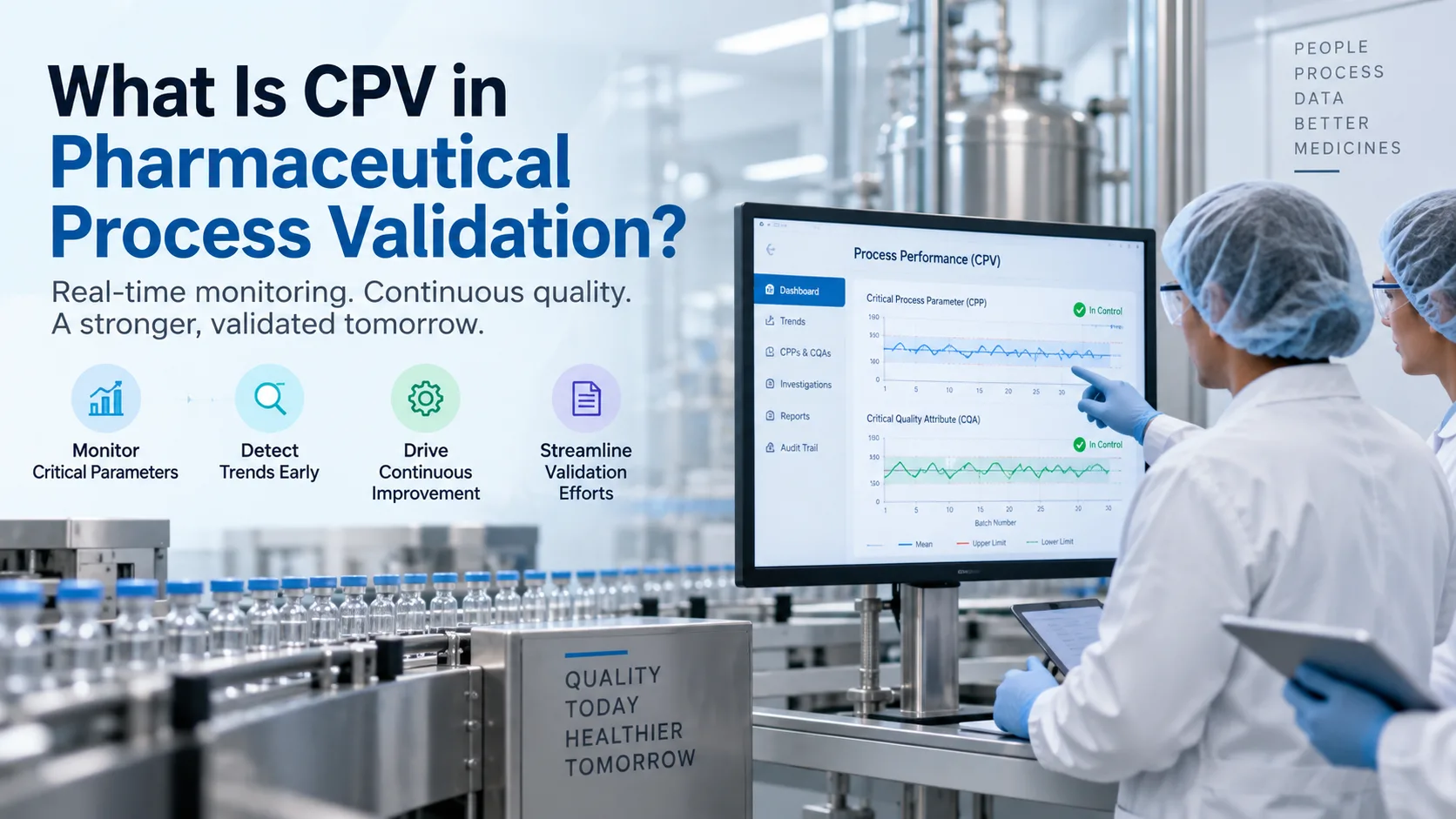
CPV software helps pharmaceutical manufacturers keep validated processes under control after commercial production begins. Instead of relying on scattered spreadsheets, periodic reviews, and delayed investigations, teams can use a connected system to monitor critical data, spot trends early, and support continuous quality improvement across the product lifecycle. For quality, manufacturing, validation, and regulatory teams, the value is practical: better visibility, stronger documentation, and faster decisions when process performance begins to shift.
What is CPV in pharmaceutical process validation?
CPV stands for Continued Process Verification, sometimes discussed by teams as continuous process verification. It is the ongoing Stage 3 activity within pharmaceutical process validation, where manufacturers confirm that a process remains in a state of control during routine production. In simple terms, if you are asking “what is process validation in pharma,” the lifecycle answer is this: design the process, qualify it, then continuously verify that it keeps performing as intended.
In the process validation in pharmaceutical industry lifecycle, CPV focuses on Critical Process Parameters, often called CPPs, and Critical Quality Attributes, or CQAs. CPPs are process variables that can affect product quality, while CQAs are the measurable product characteristics that must stay within acceptable limits. CPV software gives teams a structured way to collect, analyze, review, and report this information over time.
This matters because a validated process is not something to “set and forget.” Raw materials, equipment behavior, operators, environmental conditions, and production scale can all introduce variation. CPV helps teams recognize whether that variation is normal, drifting, or potentially harmful to product quality.

CPV turns validation from an event into a lifecycle discipline
Traditional validation work can feel project-based: complete the protocol, approve the report, archive the evidence, and move on. Modern pharmaceutical process validation is broader than that. It expects manufacturers to understand process behavior over the full lifecycle and use that knowledge to maintain control.
CPV software supports this shift by creating a single environment for monitoring, trending, and documenting process performance. Instead of waiting for an annual product quality review to reveal a pattern, teams can observe performance batch by batch, campaign by campaign, or site by site. That makes validation more active, more data-driven, and more useful to day-to-day operations.
A strong CPV program also connects validation to quality risk management. Not every parameter deserves the same level of attention. Software can help teams prioritize the parameters and attributes that matter most, apply appropriate statistical methods, and escalate signals when the data suggests that action is needed.
The core benefits of CPV software in pharma
The biggest benefit of CPV software is not simply that it stores data. Its real value comes from turning production and quality data into usable process intelligence. When configured well, it helps teams move from reactive quality control to proactive process understanding.
Key benefits include:
- Earlier detection of process drift: Statistical trend analysis can reveal subtle movement before a deviation or out-of-specification result occurs.
- Stronger compliance support: Structured workflows, audit trails, review records, and controlled reports help demonstrate that the process is being monitored throughout its lifecycle.
- Less manual data handling: Automated data capture reduces repetitive spreadsheet work and limits transcription errors.
- More consistent investigations: When deviations happen, teams can review related process trends, batches, parameters, and quality outcomes from a more complete data set.
- Better cross-functional decisions: Manufacturing, QA, validation, engineering, and data teams can work from the same information rather than separate local files.
- Support for continuous quality improvement: Long-term trends make it easier to identify recurring variation, evaluate corrective actions, and refine control strategies.
These benefits are especially important in complex manufacturing environments where data may come from many sources. Without a CPV platform, teams often spend more time finding, cleaning, and reconciling data than interpreting it.
How does real-time process monitoring improve quality decisions?
Real-time process monitoring improves quality decisions by reducing the delay between process behavior and human response. When process data is collected automatically from systems such as PAT tools, SCADA platforms, MES applications, LIMS, or equipment historians, teams can evaluate conditions while they are still operationally relevant.
This does not mean every signal requires immediate intervention. In a regulated environment, alarms and alerts must be designed carefully so they support the approved control strategy rather than create noise. The goal is to identify meaningful trends, unusual patterns, or risk signals early enough for informed review.
For example, a parameter may still be within specification but trending toward a control limit across multiple batches. A manual review might miss that gradual movement until much later. CPV software can highlight the pattern, route it for assessment, and help the team decide whether a preventive action, maintenance check, material review, or deeper investigation is appropriate.
Real-time visibility also improves batch review conversations. Instead of asking only whether a batch passed, teams can ask better questions: Was the process stable? Did any parameters behave differently than expected? Are similar shifts appearing across products, lines, or sites?
Analytics make CPV more than a dashboard
Dashboards are useful, but CPV software becomes far more powerful when it includes statistical and analytical tools. Statistical Process Control, control charts, capability analysis, and trend rules can help distinguish routine variation from signals that deserve attention. These tools support consistent interpretation instead of relying only on individual reviewer judgment.
Advanced programs may also use multivariate data analysis to evaluate relationships across many variables at once. This is valuable because pharmaceutical processes rarely depend on a single parameter in isolation. Temperature, mixing time, pressure, material attributes, equipment state, and environmental factors can interact in ways that are difficult to see through one-variable-at-a-time review.
Predictive analytics can add another layer by helping teams estimate where a process is likely to move if current trends continue. In some development and technology transfer contexts, approaches such as simulation can help teams understand process variability and design space behavior. However, advanced analytics must be explainable, validated for their intended use, and governed through appropriate quality procedures.
A practical analytics strategy should answer four questions:
- What process risks are we trying to monitor? Start with the control strategy, not the software feature list.
- Which data sources are trustworthy? Poor data quality can make even advanced models misleading.
- Who reviews each signal? Alerts need ownership, timelines, and escalation rules.
- How will decisions be documented? The system should preserve the reasoning behind actions, not just the chart that triggered them.

Integration is where CPV software creates everyday value
A CPV system is most useful when it fits into the existing manufacturing and quality ecosystem. In many pharma companies, relevant data lives across MES, LIMS, ERP, QMS, SCADA, PAT, electronic batch records, and laboratory instruments. If those systems remain disconnected, CPV becomes another reporting burden rather than a source of clarity.
Good integration reduces friction. Automated data collection can pull approved values from source systems, associate them with the right batch or lot, and present them in a format reviewers can trust. Integration with QMS can also connect CPV signals to deviations, CAPAs, change controls, and complaints when appropriate.
This connection is important for audit readiness. Regulators and internal auditors may want to see not only that a trend was detected, but how it was assessed, what conclusion was reached, and whether any follow-up action was taken. CPV software can help preserve that chain of evidence in a more organized way than manually assembled files.
Integration also supports operational efficiency. When teams spend less time gathering data, they have more time to understand process behavior. That is where CPV begins to influence better maintenance planning, stronger training needs analysis, improved sampling strategies, and smarter process improvements.
What should teams consider before selecting CPV software?
Teams should select CPV software based on process risk, data complexity, compliance needs, usability, and integration requirements. The best system is not necessarily the one with the most advanced features; it is the one that helps qualified users make timely, defensible, and well-documented decisions.
Before choosing or implementing a platform, consider this checklist:
- Lifecycle fit: Can the system support Stage 3 CPV while connecting back to process knowledge from development, qualification, and technology transfer?
- Data connectivity: Does it integrate with the systems that hold batch, laboratory, equipment, and quality event data?
- Statistical capability: Does it support the methods your process and control strategy actually require?
- User experience: Can QA, manufacturing, validation, and technical teams interpret trends without unnecessary complexity?
- Governance controls: Are roles, permissions, audit trails, approvals, and report controls suitable for GMP use?
- Scalability: Can the approach expand across products, lines, sites, and future data sources?
- Validation effort: Can the software be validated for its intended use without creating an unsustainable maintenance burden?
Implementation should be phased. Start with high-risk or high-value processes, define meaningful CPPs and CQAs, confirm data integrity, and build standard review routines. As the team gains confidence, expand the program rather than trying to automate every possible metric from day one.
People and process still matter
CPV software cannot replace scientific judgment. It can organize evidence, reveal patterns, and standardize workflows, but people still need to interpret the data in context. A trend may be statistically interesting without being clinically or operationally meaningful, while a small change in the wrong parameter may deserve urgent attention.
That is why cross-functional collaboration is essential. Manufacturing understands routine process behavior. QA understands compliance expectations and quality risk. Validation brings lifecycle discipline. Data specialists help ensure that analytics are appropriate and reliable. When these groups work together, CPV becomes a shared decision system instead of a reporting tool owned by one department.
Training is equally important. Users should understand what the charts mean, how alerts are generated, when escalation is required, and how conclusions should be documented. Without that foundation, even a strong system can produce inconsistent reviews.
The takeaway for pharma manufacturers
CPV software helps pharma teams make pharmaceutical process validation more continuous, visible, and useful. By combining automated data collection, real-time process monitoring, statistical analysis, and quality system integration, it supports both compliance and better process understanding.
The strongest programs begin with clear risks, reliable data, practical governance, and people who know how to act on the information. When those pieces come together, CPV becomes more than a regulatory expectation. It becomes a foundation for continuous quality improvement and more confident manufacturing decisions.