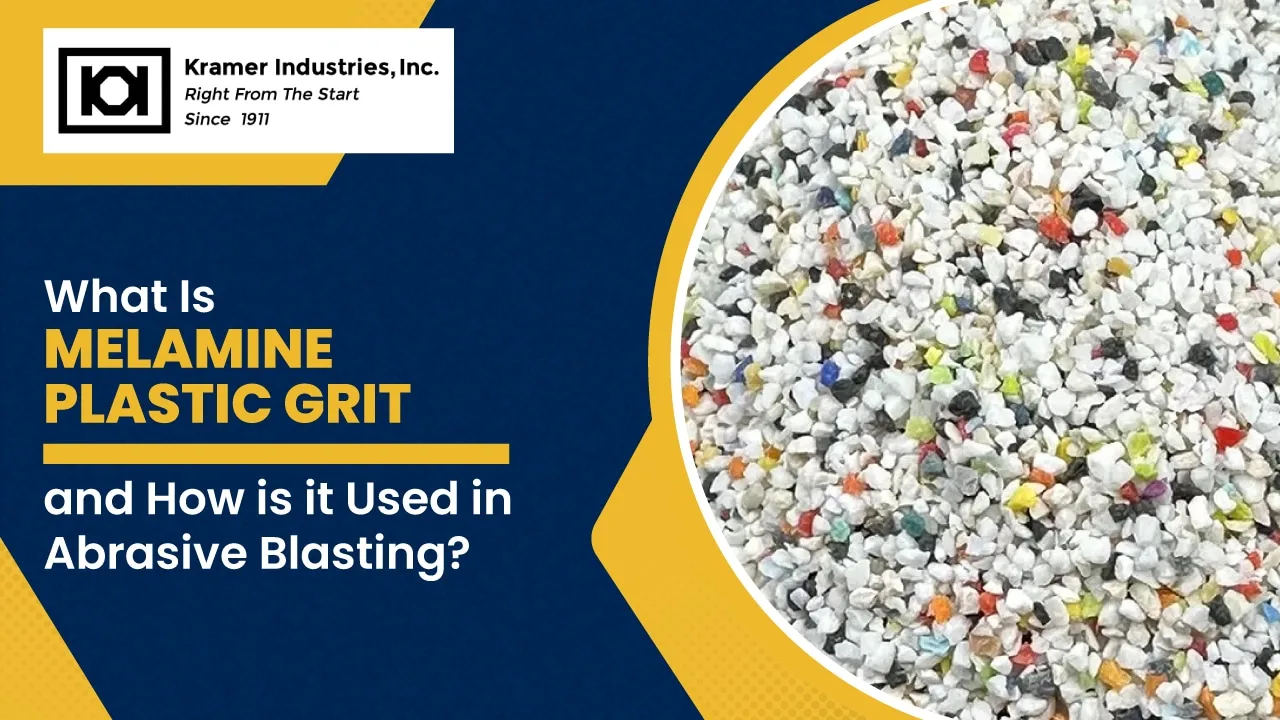
Abrasive blasting is often associated with aggressive surface preparation, such as removing rust, scale, or heavy coatings. However, some applications require a more controlled approach. When the underlying surface is valuable, dimensionally sensitive, or easily damaged, the goal is to remove unwanted material without unnecessarily affecting the substrate.
This is where melamine plastic grit can be a useful solution. Melamine plastic grit is a synthetic plastic blasting media designed for coating removal, cleaning, and surface preparation where effective cutting action and substrate protection are both important.
At Kramer Industries, we understand that selecting the right abrasive blasting media is essential for achieving consistent results while protecting the components being processed.
What Is Melamine Plastic Grit?
Melamine plastic grit is a synthetic abrasive blasting media manufactured from melamine resin. It belongs to the plastic blasting media family and provides relatively aggressive cutting action compared with softer plastic abrasives.
Unlike harder mineral abrasives such as aluminum oxide or silicon carbide, melamine plastic grit provides controlled abrasive action for removing coatings and contaminants while helping minimize unnecessary alteration of the underlying surface.
This makes melamine plastic grit particularly useful when paint, carbon, residue, or other unwanted material needs to be removed without significantly changing dimensions, edges, or the original surface condition.
Its performance depends on several factors, including:
- Particle size and shape
- Substrate material
- Type and thickness of coating
- Blasting pressure
- Nozzle configuration
- Exposure time
Selecting the appropriate combination helps balance stripping performance with substrate protection.
How Is Melamine Plastic Grit Used in Abrasive Blasting?
During abrasive blasting, compressed air propels melamine plastic grit through a nozzle toward the workpiece. The angular particles impact and abrade unwanted coatings, residues, and contaminants from the surface.
The objective is selective removal. The abrasive needs to provide enough cutting action to remove the unwanted material while limiting unnecessary erosion of the substrate.
This controlled action makes melamine plastic grit useful for applications where conventional mineral abrasives may be too aggressive. It can help reduce the risk of altering critical dimensions, damaging tooling, or creating additional finishing work.
Why Use Melamine Plastic Grit?
Melamine is generally one of the harder and more aggressive options within plastic blasting media. This makes it suitable when stronger cutting action is required while maintaining the controlled characteristics associated with plastic abrasives.
Key benefits include:
- Effective paint and coating removal
- Controlled cutting action
- Reduced risk of excessive substrate erosion
- Suitable for precision and sensitive components
- Useful for mold and tooling cleaning
- Effective removal of carbon and process residues
The primary advantage is control. Instead of selecting an abrasive based only on how quickly it removes material, manufacturers can balance stripping performance with the need to preserve the component underneath.
Common Applications for Melamine Plastic Grit
Melamine plastic grit is used in a variety of industrial abrasive blasting and cleaning applications.
Common uses include:
- Paint and coating removal
- Mold and tooling cleaning
- Deflashing
- Carbon and residue removal
- Cleaning aircraft components
- Processing selected aluminum and other soft-metal components
- Cleaning fiberglass components
- Surface preparation of selected manufactured parts
It can be particularly useful for molds, dies, and tooling that accumulate release agents, carbon, paint, or other residues during repeated production cycles. An overly aggressive abrasive can affect important surface details, while plastic media provides a more controlled cleaning approach.
Melamine Grit vs. Other Plastic Blasting Media
Different plastic abrasives provide different levels of hardness and cutting action. Melamine plastic grit is generally selected when more aggressive stripping is required within the plastic media category.
Softer plastic abrasives may be more appropriate for highly sensitive surfaces where minimizing surface impact is the primary concern. The appropriate choice depends on the substrate, coating, required stripping rate, and acceptable level of surface change.
When selecting plastic blasting media, consider:
- Substrate material and sensitivity
- Type of coating being removed
- Required stripping rate
- Desired surface condition
- Part geometry
- Blasting equipment and operating conditions
The most aggressive abrasive is not always the best choice. The right media should provide the required cleaning performance without creating unnecessary damage or rework.
How to Get Better Results With Melamine Plastic Grit
Abrasive selection is only one part of the blasting process. Operating conditions also influence coating removal and surface quality.
Important variables include:
- Blasting pressure
- Nozzle size and condition
- Nozzle distance
- Blast angle
- Media flow rate
- Particle size
- Exposure time
Increasing pressure may improve stripping speed, but excessive pressure can increase the risk of damaging sensitive surfaces. Similarly, larger particles may provide stronger cutting action but can produce different surface results.
For new applications, testing a representative area before full production can help establish the appropriate combination of media size, pressure, nozzle movement, and processing time.
When Should You Choose Melamine Plastic Grit?
Melamine plastic grit is a strong option when a coating or contaminant needs to be removed while the underlying component must remain as intact as possible.
It may be suitable when:
- Conventional mineral abrasives are too aggressive
- Paint or coatings need to be removed
- Molds or tooling require cleaning
- Components are dimensionally sensitive
- Soft-metal surfaces require controlled blasting
- Stronger cutting action is needed than softer plastic media can provide
The final media selection should always be based on the specific substrate, coating, blasting equipment, and desired result.
Conclusion
Melamine plastic grit provides a useful balance between effective cutting action and controlled surface treatment. Its relatively aggressive performance makes it suitable for coating removal, mold cleaning, deflashing, carbon removal, and other abrasive blasting applications where protecting the underlying substrate is important.
Successful results depend on more than choosing the right abrasive. Media size, blasting pressure, nozzle condition, distance, exposure time, and substrate characteristics all influence performance. Testing the process before full production can help establish consistent and repeatable results.
Kramer Industries provides melamine plastic abrasive grit and other blasting media to help manufacturers and finishing professionals select appropriate abrasive solutions for their surface preparation requirements.
Frequently Asked Questions
- What is melamine plastic grit used for?
Melamine plastic grit is used for paint and coating removal, mold cleaning, deflashing, carbon removal, and controlled surface preparation. It is particularly useful when effective stripping is required without unnecessarily damaging the underlying substrate.
- Is melamine plastic grit suitable for sensitive surfaces?
Melamine plastic grit can be suitable for selected sensitive applications because plastic media generally provides more controlled cutting than many mineral abrasives. The appropriate pressure, particle size, and blasting technique should be established through testing.
- How does melamine grit compare with other plastic blasting media?
Melamine plastic grit is generally one of the harder and more aggressive plastic blasting media options. Softer plastic abrasives may be better suited to highly sensitive surfaces, while melamine can be considered when stronger coating-removal performance is required.
- How do I choose the right plastic blasting media?
Choose plastic blasting media based on the substrate, coating, required stripping rate, desired surface condition, part geometry, and blasting equipment. Melamine is appropriate when stronger cutting action is required, while softer plastic media may be better for more sensitive applications.