Introduction
As organizations around the world continue to adopt cloud-based Enterprise Resource Planning (ERP) systems, Oracle Fusion Financials has become one of the most sought-after platforms for managing financial operations. Businesses need skilled professionals who can implement, configure, and support Oracle Cloud Financials to improve efficiency and streamline financial processes. This increasing demand has created excellent career opportunities for graduates, finance professionals, and career changers.
Enrolling in an Oracle Fusion Financials Course is an excellent way to gain the practical knowledge and hands-on experience required to enter this growing field. With the flexibility of Oracle Cloud Financials Training Online, learners can build job-ready skills while balancing their education or current employment. But what does the career journey look like after completing the course? Let's explore the typical career growth path in Oracle Fusion Financials.
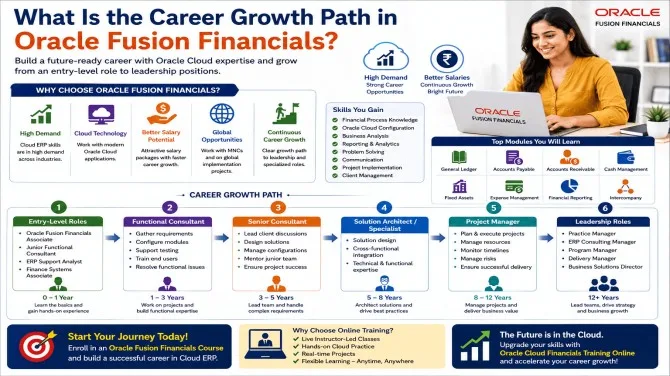
Step 1: Build a Strong Foundation
Every successful Oracle Fusion Financials professional begins by learning the fundamentals of Oracle Cloud ERP and enterprise financial management.
A comprehensive Oracle Fusion Financials Course introduces learners to essential financial modules, including:
- General Ledger (GL)
- Accounts Payable (AP)
- Accounts Receivable (AR)
- Cash Management
- Fixed Assets
- Expense Management
- Financial Reporting
Understanding these modules provides the foundation needed to work confidently with Oracle Cloud Financials in real business environments.
Step 2: Start in an Entry-Level Role
After completing Oracle Cloud Financials Training Online, most professionals begin their careers in entry-level positions where they gain practical experience with Oracle ERP systems.
Common entry-level roles include:
- Oracle Fusion Financials Associate
- Junior Functional Consultant
- ERP Support Analyst
- Oracle Support Executive
- Finance Systems Associate
These roles help freshers understand client requirements, financial workflows, system navigation, and daily business operations.
At this stage, professionals focus on learning, improving problem-solving skills, and gaining exposure to live Oracle Cloud environments.
Step 3: Become a Functional Consultant
With one to three years of practical experience, many professionals advance to the role of Functional Consultant.
Functional Consultants are responsible for:
- Gathering business requirements
- Configuring Oracle Cloud Financials modules
- Supporting implementation projects
- Conducting system testing
- Training end users
- Solving functional issues
Professionals who complete an Oracle Fusion Financials Course with hands-on project experience often transition into this role more quickly because they already understand real-world financial scenarios.
Step 4: Work on Oracle Implementation Projects
Implementation experience plays a major role in career growth.
Professionals participate in activities such as:
- Business process analysis
- Requirement gathering
- System configuration
- User Acceptance Testing (UAT)
- Data migration support
- Go-live activities
- Post-implementation support
Working on multiple implementation projects helps professionals build confidence, improve consulting skills, and expand their technical expertise.
This stage is often where careers begin to accelerate significantly.
Step 5: Move into Senior Consultant Roles
After gaining several years of experience, professionals can advance to Senior Oracle Fusion Financials Consultant positions.
Senior consultants typically:
- Lead client discussions
- Design financial solutions
- Mentor junior consultants
- Handle complex configurations
- Manage implementation activities
- Recommend process improvements
Professionals with extensive implementation experience and strong business knowledge are highly valued by consulting firms and multinational organizations.
Step 6: Specialize in Advanced Oracle Cloud Modules
One advantage of Oracle Cloud ERP is the opportunity to expand beyond core financial modules.
After completing Oracle Cloud Financials Training Online, professionals can specialize in related Oracle Cloud applications such as:
- Procurement
- Project Financial Management
- Enterprise Performance Management (EPM)
- Risk Management
- Revenue Management
- Oracle Cloud Administration
These advanced specializations increase professional value and create opportunities for larger implementation projects and higher-paying roles.
Step 7: Become a Solution Architect
Solution Architects are responsible for designing complete Oracle Cloud ERP solutions that align with an organization's business objectives.
Their responsibilities include:
- Enterprise solution design
- Cross-functional integration
- Technical and functional coordination
- Client presentations
- Architecture planning
- Implementation strategy
This position requires extensive Oracle Cloud knowledge, leadership skills, and experience across multiple ERP modules.
It is considered one of the most respected career paths in Oracle ERP consulting.
Step 8: Transition into Project Management
Experienced Oracle professionals often move into project management roles where they oversee complete ERP implementation projects.
Project Managers coordinate:
- Client communication
- Resource planning
- Budget management
- Timeline monitoring
- Risk management
- Team leadership
- Successful project delivery
Strong communication, leadership, and organizational skills become increasingly important at this stage of the career.
Step 9: Leadership and Consulting Roles
With extensive industry experience, Oracle professionals may advance into leadership positions such as:
- Oracle Practice Manager
- ERP Consulting Manager
- Program Manager
- Digital Transformation Consultant
- Delivery Manager
- Business Solutions Director
These professionals lead consulting teams, develop implementation strategies, manage client relationships, and contribute to organizational growth.
Leadership roles offer significant professional recognition and attractive compensation packages.
Skills That Support Career Growth
Career progression depends on more than technical knowledge alone. Professionals should continuously develop skills such as:
- Financial process expertise
- Oracle Cloud configuration
- Business analysis
- Communication
- Problem-solving
- Functional testing
- Documentation
- Client relationship management
- Leadership
Continuous learning helps professionals remain competitive as Oracle regularly introduces new cloud features and enhancements.
Benefits of Online Learning
One of the biggest advantages of Oracle Cloud Financials Training Online is flexibility.
Online programs offer:
- Live instructor-led classes
- Recorded sessions for revision
- Hands-on Oracle Cloud practice
- Real-time project exposure
- Interview preparation
- Placement assistance
These resources help learners prepare for each stage of their career while balancing personal and professional responsibilities.
Conclusion
The career growth path in Oracle Fusion Financials offers excellent opportunities for continuous learning, professional advancement, and long-term success. Starting with an Oracle Fusion Financials Course, learners develop the practical knowledge needed to secure entry-level ERP positions. As they gain experience, they can progress into Functional Consultant, Senior Consultant, Solution Architect, Project Manager, and leadership roles.
With the flexibility of Oracle Cloud Financials Training Online, professionals can continuously upgrade their skills and stay aligned with evolving industry demands. As Oracle Cloud ERP adoption continues to expand worldwide, a career in Oracle Fusion Financials offers strong job security, global opportunities, competitive salaries, and a clear path toward long-term professional growth.