India is one of the fastest-growing economies in the world, and at the heart of this growth lies a powerful, rapidly evolving logistics sector. From e-commerce giants delivering parcels to the remotest corners of the country to manufacturers shipping raw materials across states, logistics is the invisible backbone that keeps India's economy moving forward every single day.
As businesses scale and supply chains become increasingly complex, the need for smarter, more efficient logistics models has never been greater. One model that has truly revolutionised the way goods are moved across India is the Hub-and-Spoke Model — a system that has transformed logistics service India operations from fragmented, inefficient networks into streamlined, cost-effective, and highly reliable supply chains.
At Equity Logistics, we have built our entire logistics network around the hub-and-spoke philosophy, and the results speak for themselves. In this comprehensive guide, we will explain exactly what the hub-and-spoke model is, how it works in the Indian context, why it is the gold standard for modern logistics, and how it is reshaping the future of logistics service India for businesses of every size.
Understanding the Hub-and-Spoke Model — The Basics
Before diving into how the hub-and-spoke model works in India specifically, let's first understand what this model actually means.
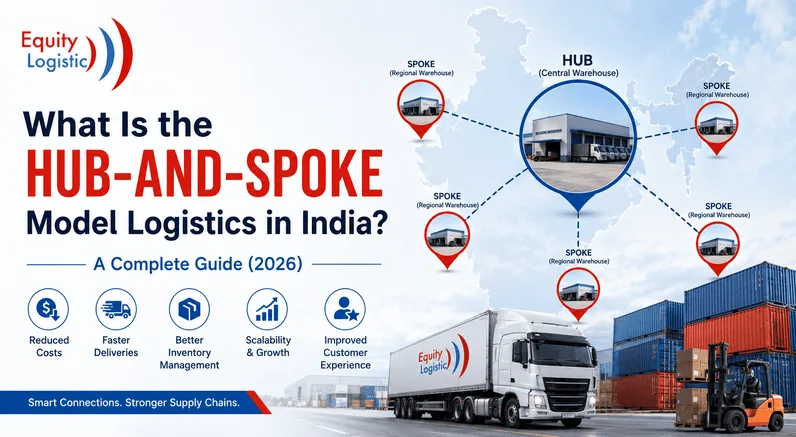
The hub-and-spoke model is a logistics and distribution network design in which goods are consolidated at central points — called hubs — and then distributed outward to smaller destinations — called spokes. Think of it like a bicycle wheel. The centre of the wheel is the hub, and the spokes radiate outward from the centre to the rim. In logistics terms, the hub is the central warehouse or distribution centre, and the spokes are the local delivery branches, regional offices, or end destinations connected to it.
Instead of transporting goods directly from every point of origin to every point of destination — which would require an enormous number of individual routes — the hub-and-spoke model consolidates shipments at the hub, sorts them efficiently, and then dispatches them to their final destinations via the spokes.
This approach dramatically reduces the number of routes required, lowers transportation costs, improves efficiency, and enables far better tracking and quality control throughout the logistics process.
At Equity Logistics, we have refined and perfected this model specifically for the unique challenges and opportunities of the Indian market, making us one of the most trusted names in logistics service India.
How the Hub-and-Spoke Model Works in India
India presents a unique set of logistics challenges that make the hub-and-spoke model not just useful but absolutely essential. With 28 states, 8 union territories, over 640 districts, and thousands of cities, towns, and villages spread across a vast and geographically diverse landscape, moving goods efficiently across this country requires careful planning and an intelligent network design.
Here is how the hub-and-spoke model works in the Indian logistics context, step by step:
Step 1 — Collection at Origin Spokes Goods are first collected from businesses, manufacturers, warehouses, or individual sellers at local collection points — the origin spokes. These are typically smaller regional offices or collection centres located across cities and towns.
Step 2 — Transportation to the Hub Once collected, goods are transported in consolidated loads from the origin spokes to the nearest regional hub. Because multiple shipments are consolidated together for this journey, transportation costs per unit drop significantly.
Step 3 — Sorting and Processing at the Hub At the hub — typically a large, strategically located central warehouse or distribution centre — goods are sorted, scanned, labelled, and reorganised by destination. Advanced technology, barcode scanning, and automated sorting systems ensure accuracy and speed at this stage.
Step 4 — Inter-Hub Transportation In large-scale logistics networks like the one operated by Equity Logistics, there may be multiple hubs across different regions of India — such as a North India hub, South India hub, East India hub, and West India hub. Goods destined for far regions are transported between these hubs via large-capacity trucks, trains, or air freight.
Step 5 — Delivery to Destination Spokes From the regional hub, sorted goods are dispatched to local delivery branches — the destination spokes — in the target area. These local branches handle the final mile delivery to businesses, retailers, or end customers.
Step 6 — Last Mile Delivery The final spoke in the chain handles the crucial last mile delivery — getting the parcel or shipment to its exact destination address. This is often the most challenging and expensive part of logistics, and the hub-and-spoke model helps optimise it by ensuring that local delivery vehicles are always operating with efficient, consolidated loads.
This end-to-end process is what makes Equity Logistics one of the most efficient and reliable logistics service India providers operating today.
Blog source- https://www.equitylogistic.com/blogs/details/what-is-the-hub-and-spoke-model-logistics-in-india