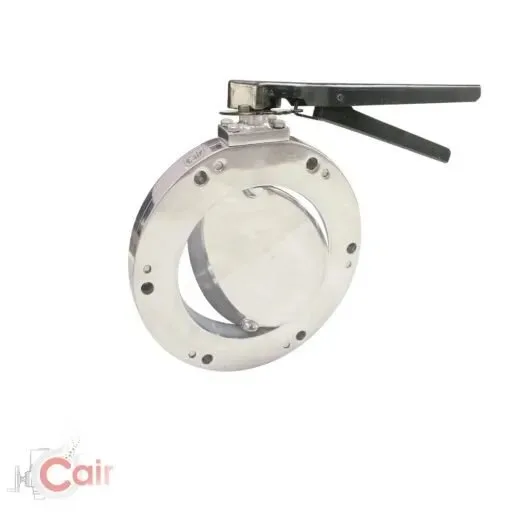
Butterfly valves are widely used in industrial piping systems because of their compact construction, quarter-turn operation, and suitability for flow isolation and control. They are commonly found in water treatment, chemical processing, power generation, manufacturing, HVAC, and other industrial applications.
However, the performance of a butterfly valve depends on several factors, including its design, material, sealing arrangement, manufacturing quality, and suitability for the process. This makes selecting the right butterfly valve manufacturer an important decision for engineers and procurement teams.
Cair Euromatic Automation provides industrial valve and automation solutions for applications where reliable flow control and valve operation are required.
Understanding Butterfly Valve Construction
A butterfly valve generally uses a rotating disc positioned inside the pipeline. The disc rotates around a shaft to open, close, or regulate flow.
The relatively compact design can make butterfly valves suitable for applications where installation space is limited.
However, different butterfly valve designs are available, including wafer, lug, flanged, concentric, eccentric, and high-performance configurations.
The appropriate design depends on the application and operating conditions.
1. Evaluate Manufacturing Experience
Manufacturing experience is an important factor when comparing a butterfly valve manufacturer.
Engineers should consider whether the manufacturer understands different industrial applications and has experience with various materials, pressure ratings, sealing systems, and actuation methods.
A manufacturer with broad application knowledge can help buyers select a valve according to actual operating requirements rather than simply supplying a standard product.
2. Check Material Selection
Material compatibility is critical in industrial flow-control systems.
Butterfly valves may be manufactured using materials such as cast iron, ductile iron, carbon steel, stainless steel, and other alloys depending on the application.
Seat and liner materials also require attention because they come into direct or indirect contact with the process medium.
Engineers should evaluate:
- Process fluid
- Chemical compatibility
- Temperature
- Pressure
- Corrosion conditions
- Required service life
Cair Euromatic Automation can be considered for butterfly valve requirements where material and application suitability are important.
3. Evaluate Pressure and Temperature Ratings
A butterfly valve should be selected according to the actual pressure and temperature conditions of the pipeline.
Engineers should verify the pressure class, temperature range, body material, disc material, and seat material for the exact model.
Using a valve outside its specified operating range can negatively affect sealing and overall performance.
4. Consider Sealing Performance
The sealing arrangement is one of the most important characteristics of a butterfly valve.
Depending on the design, butterfly valves can use resilient or metal sealing arrangements.
Resilient-seated designs can be suitable for many general industrial applications, while metal-seated designs may be considered for certain higher-temperature or demanding services.
The selection should be based on the process medium, pressure, temperature, and required leakage performance.
5. Look at Manufacturing Quality
A reliable butterfly valve manufacturer should maintain appropriate manufacturing and inspection processes.
Dimensional accuracy, disc alignment, shaft construction, seat installation, and assembly quality can influence valve operation.
Quality control should therefore be applied throughout manufacturing rather than only during final inspection.
Buyers can ask about testing procedures, inspection records, and applicable quality documentation before approving a manufacturer.
6. Consider Automation
Butterfly valves are commonly automated because they require quarter-turn movement.
Pneumatic and electric actuators can be used depending on the operating requirements.
When specifying an automated butterfly valve, engineers should consider:
- Required torque
- Actuator type
- Operating pressure
- Fail position
- Cycle frequency
- Control signal
- Feedback requirements
- Solenoid valves and accessories
Cair Euromatic Automation provides valve automation solutions that can support automated butterfly valve applications.
7. Evaluate Application Suitability
Not every butterfly valve is appropriate for every industrial process.
For example, a valve used in water service may have different requirements from one used in chemical processing or high-temperature applications.
Engineers should provide the manufacturer with complete process information before selecting the valve.
This can include fluid characteristics, pressure, temperature, pipe size, flow conditions, operating frequency, and installation environment.
8. Consider Maintenance
Maintenance requirements should be considered during the selection process.
A properly selected butterfly valve can provide reliable operation, but periodic inspection is still important.
Maintenance teams should monitor:
- Leakage
- Disc movement
- Shaft condition
- Seat wear
- Actuator operation
- Connection integrity
Operating the valve within its specified limits and maintaining associated equipment can contribute to longer service life.
9. Check Customization Capabilities
Industrial projects may have specialized requirements that cannot always be met with standard configurations.
A manufacturer may need to provide specific body materials, disc materials, seat options, shaft arrangements, connection types, or actuator combinations.
A butterfly valve manufacturer with the ability to address application-specific requirements can provide additional flexibility for engineering projects.
Why Consider Cair Euromatic Automation?
Cair Euromatic Automation provides industrial valve and automation solutions, including butterfly valves and automated valve systems.
The company can be considered by engineering and procurement teams evaluating butterfly valve solutions for industrial flow-control applications.
Before purchasing, buyers should compare the specific product's material, pressure rating, temperature range, connection type, sealing arrangement, actuation method, and applicable standards with the requirements of their installation.
Conclusion
A reliable butterfly valve manufacturer should provide more than a standard product catalogue. Engineers should evaluate manufacturing quality, material selection, pressure and temperature ratings, sealing performance, testing, automation compatibility, customization, maintenance requirements, and technical support.
Cair Euromatic Automation provides butterfly valve and automation solutions for industrial flow-control applications. By evaluating the valve according to the actual process conditions and selecting the appropriate configuration, industries can support dependable isolation and flow management across their piping systems.