Vaccination is usually seen as a straightforward process in which an individual gets a jab, and the immune system launches a response, protecting the person from illness. However, what takes place in the body is more complex than that. Understanding how pneumococcal vaccination works from the moment of injection to the establishment of long-term protection can demonstrate why the vaccine works so efficiently, why it is administered at specific ages, and why some people have to receive many doses of it throughout their lives.
Key Takeaways
- The pneumococcal vaccine works by presenting bacterial surface proteins to the immune system in a controlled manner, generating antibody memory without causing infection.
- Conjugation technology attaches bacterial polysaccharides to a carrier protein, dramatically improving the immune response, particularly in infants and older adults.
- Protection is serotype-specific, meaning the vaccine protects against the particular strains it covers but not against all circulating strains.
- The immune response triggered by vaccination is fundamentally different from the response to natural infection and is generally safer and more predictable.
What Streptococcus Pneumoniae Is and Why the Immune System Struggles With It
The bacterium Streptococcus pneumoniae frequently colonises the upper respiratory system of people without causing illness. However, in certain instances, it reaches sterile sites in the body, leading to diseases such as pneumonia, meningitis, bacteraemia, and ear infections. The bacterium has a polysaccharide capsule, an elaborate layer that prevents phagocytes from recognising the pathogen. The bacteria can evade the innate immune response because their outer capsule prevents the immune system from identifying them.
There are 90 different serotypes of Streptococcus pneumoniae identified, which differ significantly in their polysaccharide capsule structure.
What Happens at the Injection Site
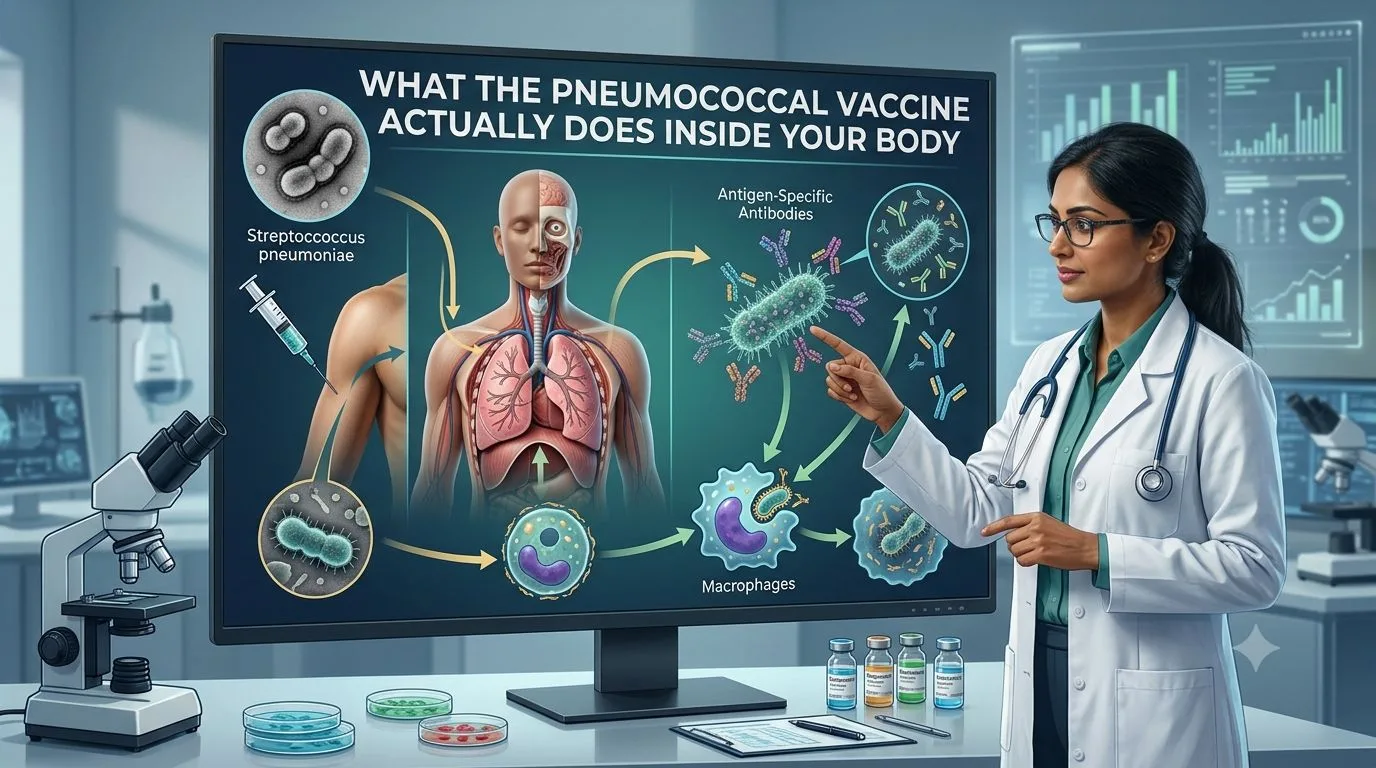
Once the vaccination procedure is complete, the first cells to interact with the vaccine components are antigen-presenting cells, especially dendritic cells. Dendritic cells take up and process the vaccine antigens, then travel to the nearest lymph node to initiate the adaptive immune response. Upon arrival at the lymph node, they present morsels of bacterial antigens to naive T-cells and B-cells.
The presentation then leads to B-cell activation. B-cells become activated, multiply, and transform into plasma cells that produce antibodies against the bacterial surface antigens in the vaccine. The antibodies attack the sugar capsule of the different serotypes of pneumococcus contained in the vaccine.
How the Pneumococcal Vaccine Specifically Works
This vaccine is based on the idea that antibodies directed against the microorganism's polysaccharide capsule can help the organism evade immunological elimination. When antibodies bind to the capsule of S. pneumoniae, the bacteria become coated in a process called opsonisation, allowing phagocytes to destroy the microbes effectively. Thus, this infection is perceived entirely differently by the immune system, which is at a disadvantage against encapsulated species of microorganisms.
However, polysaccharide antigens alone create a problem. They lead to the activation of B-cells without T-cells, causing a T-independent immune response that is inefficient at forming high-titer antibodies and does not allow for the development of immunological memory. Besides, polysaccharides alone will not work for infants, since they do not yet have a fully functional immune system.
How Conjugation Changes Everything
This limitation has been overcome with the application of conjugate technology in the current pneumococcal vaccines. The use of carrier proteins, most commonly CRM197, a non-toxic form of diphtheria toxin, helps convert T-independent antigens into T-dependent ones. This means that T helper cells are now involved in immune processes, leading to better antibody production, higher antibody quality, and, most importantly, lifelong memory B and T cells after immune responses to vaccine use.
Prevenar 13 is a thirteen-valent pneumococcal conjugate vaccine that protects against thirteen serotypes of Streptococcus pneumoniae using this conjugation technology. Some of the serotypes it protects against include serotypes 4, 6B, 9V, 14, 18C, 19F, and 23F, among others. It is delivered by intramuscular injection and can be taken at any age from infancy onwards.
What Immune Memory Means in Practice
The long-lived memory B cells produced by vaccination remain in the blood for years afterwards. When a real Streptococcus pneumoniae bacterium with the same serotype capsule is encountered, the memory B cells immediately recognise the polysaccharide antigens and respond much quicker than they did to the vaccine. Antibody levels increase within days rather than the weeks required during primary responses.
Protection against infection comes from this rapid secondary immune response. By the time a natural infection would have progressed to invasive disease in an unvaccinated person, the immune system in the vaccinated person has already generated a large antibody response against the bacterium.
What the Vaccine Protects Against and Its Limitations
Because the protection provided is serotype-specific, vaccines do not confer immunity against all circulating pneumococcal strains. Serotypes not included in the formulation can still cause disease in vaccinated individuals. This forms the basis for developing formulations that provide broader coverage by including additional serotypes. The slow transition from 13-valent to higher-valency vaccines indicates an effort to broaden protection and include strains that continue to emerge or gain prominence, following vaccination campaigns that have led to a decrease in the circulation of the most common serotypes.
Who Benefits Most and Why
The immune response elicited by pneumococcal vaccine depends on one’s age. Children under 2 years of age do not mount an adequate immune response to polysaccharide vaccines; thus, conjugate vaccines are the only effective option for this group. The elderly, aged more than 65 years, have reduced immune responses due to immunosenescence. The same applies to those suffering from asplenia, chronic lung disease, chronic renal failure, diabetes, and people under immunosuppressive therapy, who are highly prone to invasive pneumococcal infections.
Reactions That Indicate the Vaccine Is Working
The local reactions at the injection site, including symptoms such as redness and swelling, signify the local immune response that recruits immune cells to the site for antigen activation. The mild fever that occurs one or two days after vaccination reflects a systemic process that initiates the immune response through the release of cytokines. The reactions should be treated with care, as they are expected, reasonable, and indicative of the spread of an immune process. The symptoms usually get normalised within 1 to 3 days without any special treatment.
Importance of Follow-Up and Booster Decisions
The amount of antibodies produced as a result of vaccination decreases over time, and the rate of decline varies from individual to individual and from serotype to serotype. In some cases, certain high-risk groups may receive additional doses based on age or updated clinical guidelines. Whether a previously vaccinated adult needs a dose of a new form with expanded protection is up to the doctor, based on vaccination history, current health status, and current clinical recommendations.
What Is Worth Remembering
The pneumococcal vaccine does not simply put a pathogen into the body and wait for immunity to follow. It uses a specifically engineered interaction between bacterial surface components and the adaptive immune system to generate antibody memory that changes how the body responds to future exposure. Understanding this process helps explain why the vaccine works reliably, why certain groups need it more than others, and why the brief local reaction it causes is not a side effect to worry about but a sign that the immune system is doing exactly what the vaccine asked it to do.
Disclaimer: This article is for general informational purposes only and should not be considered medical advice. Always consult a qualified healthcare professional for vaccination guidance and scheduling specific to your age and health status.