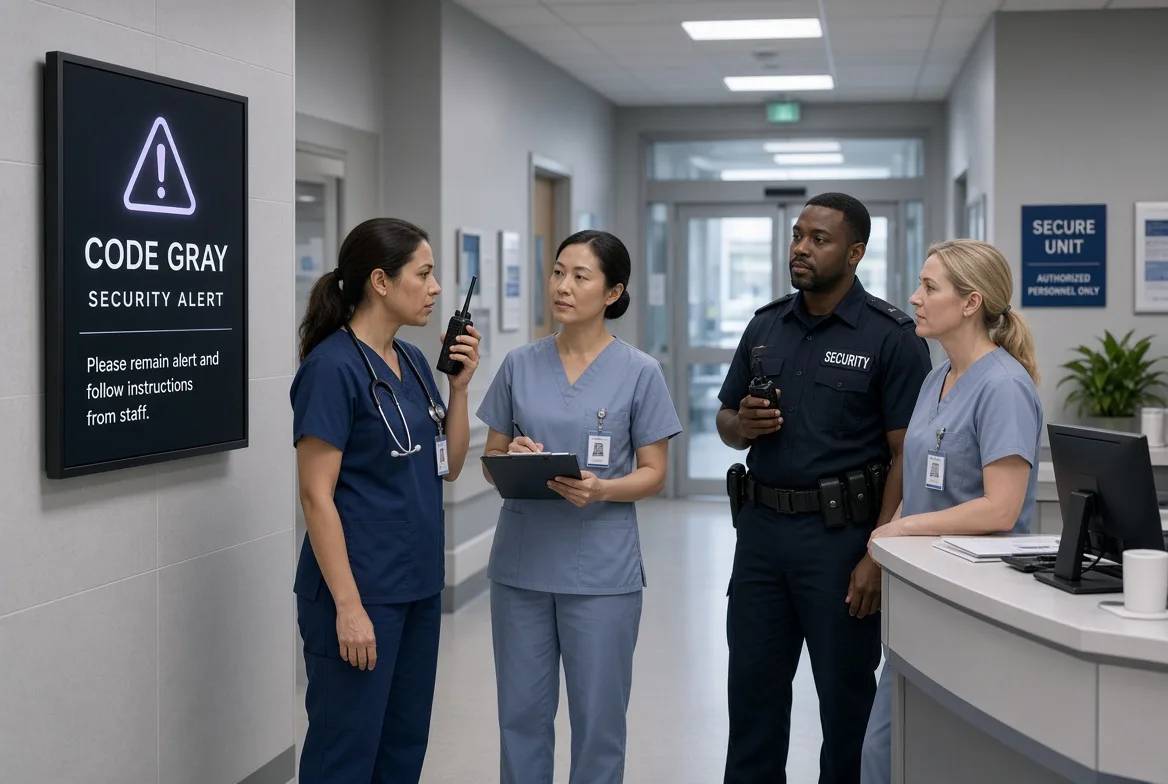
You're sitting in a hospital waiting room when the intercom crackles: "Code Gray, third floor, east wing." Nobody around you flinches, but you're left wondering what just happened — and whether you should be worried. Hospitals run on coded language precisely so the public doesn't panic, but that leaves patients and visitors in the dark about what's actually unfolding a few doors down.

Code Gray in a hospital is one of the most common — and most misunderstood — alerts in American healthcare facilities. It signals a combative or aggressive person, not a fire, a missing child, or an active shooter. Understanding what does Code Gray mean in a hospital, and how staff are trained to respond, can help you stay calm, stay safe, and know when to get out of the way.
This guide breaks down the Code Gray meaning, how the response unfolds, how it differs from similar-sounding codes, and what to do if you hear one called near you.
Quick Overview: Code Gray at a Glance
- What it is: An internal alert for a combative, agitated, or aggressive person — patient, visitor, or staff member — who does not have a weapon.
- Key use cases: Escalating patient agitation, visitor altercations, confused or combative individuals in the ER, workplace violence incidents.
- Who it's for: Hospital security teams, behavioral response teams, nursing staff, and hospital administrators who build the response protocol.
- Current status: Used in the majority of U.S. hospitals, though the exact color and procedure vary by facility since there's no single national standard.
Notable players: Individual hospital systems (Kaiser Permanente, Dignity Health, and others) set their own protocols; guidance also comes from the Joint Commission and OSHA.
What Does Code Gray Mean in a Hospital?
At its core, a hospital Code Gray is a behavioral emergency call. It tells staff that someone on the premises — most often a patient, though sometimes a visitor or even a staff member — is showing aggressive, threatening, or combative behavior that has moved beyond what the person on the floor can manage alone.
The critical distinction is the absence of a weapon. If a person is armed or the threat involves a weapon, most facilities escalate straight to a different alert (commonly Code Silver) instead. That difference isn't cosmetic — it changes who responds and how. A Code Gray hospital alert relies heavily on internal resources: security officers, a designated behavioral response team, and clinical staff trained in de-escalation. A weapon-involved incident typically triggers lockdown procedures and immediate coordination with outside law enforcement.
Agitation serious enough to trigger a Code Gray can come from many places: pain, fear, confusion, dementia, a psychiatric crisis, alcohol or substance withdrawal, or a reaction to medication. That's part of why hospital staff are trained to treat the person in crisis as someone who needs help and containment, not simply a threat to be removed.
How the Code Gray Response Actually Works
Every facility writes its own Code Gray protocol, but the core sequence tends to follow the same pattern:
- Recognize and assess. A staff member identifies escalating or aggressive behavior and makes a quick judgment about immediate danger to themselves, the patient, or bystanders.
- Activate the code. Staff call a designated emergency line, hit a panic button, or ask a colleague to notify the operator — giving the location, a description of the person, and the nature of the danger.
- Announcement. The hospital operator pages the code over the intercom, typically naming only the location (e.g., "Code Gray, third floor, east wing") so the situation is communicated without alarming the general public.
- Team response. Security personnel and a trained behavioral response team — which can include nurses, physicians, and sometimes psychiatric staff — move to the location.
- De-escalation. The response team tries verbal de-escalation first: calm tone, clear boundaries, distance, and reassurance. Physical intervention is a last resort, used only when someone's immediate safety is at risk.
- Secure the area. Non-essential staff, patients, and visitors are moved away, and the area is cleared to reduce stimulation and give the response team room to work.
The goal throughout is the same: protect everyone nearby while getting the person in crisis the help they need, rather than treating the incident purely as a security matter.
Code Gray vs. Other Hospital Emergency Codes
Because color codes vary between hospitals, confusion between similarly named alerts has caused real harm in the past — in one widely cited California incident, a Code Gray call for a combative person accidentally drew staff toward an active shooter because the wrong code had been used. That history is part of why standardization efforts, like the guidance published by the Hospital Association of Southern California, exist at all.
CodeCommon MeaningCode GrayCombative or aggressive person, unarmedCode SilverPerson with a weapon or active shooterCode BlueAdult medical emergency / cardiac arrestCode RedFire or suspected fireCode PinkInfant abductionCode PurpleChild abductionCode OrangeHazardous material spill (varies by facility)If you take one thing from this table, let it be this: hospital codes are not universal. A hospital security alert labeled Code Gray in one city might mean something different two towns over. If you work across multiple facilities or volunteer in a hospital, always confirm the local key.
Why Code Gray Protocols Matter Right Now
Hospital security response isn't a theoretical concern — it reflects a documented, worsening problem in American healthcare. Bureau of Labor Statistics data shows healthcare workers are about five times more likely to experience workplace violence than workers in other industries, despite making up roughly a tenth of the overall workforce. Nearly one in five U.S. healthcare workers report having experienced physical abuse on the job, and recent nursing surveys have found that a majority of emergency physicians say they or a colleague have been victims of workplace violence.
That backdrop is pushing hospitals to invest more in formal Code Gray protocols, behavioral response teams, and de-escalation training — and it's why OSHA has spent years developing a potential federal workplace violence prevention standard for healthcare specifically. A well-designed Code Gray protocol response isn't just about handling one incident; it's a core piece of a hospital's broader patient safety and workplace violence prevention strategy.
The Bottom Line
A Code Gray hospital alert is a sign that a system is working the way it's designed to: identifying a behavioral crisis, containing it quickly, and protecting patients, staff, and visitors without broadcasting alarm across the building. Knowing the Code Gray meaning — and the calm, practical steps to take if you hear one — turns a confusing announcement into simply one more piece of hospital safety infrastructure doing its job.
For a deeper breakdown of how these alerts are structured and activated, see this Code Gray hospital alert guide.
What to Do If You Hear a Code Gray
- Stay where you are unless directed otherwise. Wandering toward the commotion out of curiosity puts you and the response team at risk.
- Follow staff instructions immediately. If someone asks you to move to another area, do it without arguing — they're clearing space for the response team to work.
- Don't attempt to intervene. Even with good intentions, an untrained bystander can make de-escalation harder or become a target themselves.
- Keep children and vulnerable family members close. Move calmly; you don't need to run or panic.
- Report anything alarming you notice. If you spot aggressive behavior before staff do, tell the nearest nurse or security officer right away.