Most businesses start with ready-made software because it's easy to buy and quick to set up. It works — for a while. Then the business grows, and the cracks start to show: employees re-enter the same data into three different tools, spreadsheets quietly fill the gaps the software can't handle, and different departments end up running on systems that don't talk to each other.
Ready-made software can be a smart choice for many businesses. But when a company has to change its entire workflow to fit the software, rather than the other way around, it may be time to consider a custom solution.
This article looks at the real decision most growing US businesses eventually face: stick with an off-the-shelf product, or invest in something built specifically for how the business actually operates. A custom software development company like fxVisuals can help evaluate that decision honestly — because building custom software isn't automatically the right answer, and neither is staying with a generic tool forever.
Thinking about replacing your current business software? Explore fxVisuals' custom software development services to discuss your requirements and find a solution that fits your business.
What Is Ready-Made Software?
Ready-made software is a product built for a broad range of businesses and sold as a finished solution. Common examples include accounting platforms, CRM tools, project management software, inventory systems, HR software, and e-commerce platforms.
Benefits of ready-made software:
- Quick to purchase and set up
- Often a lower upfront investment
- Existing features and vendor support
- Regular updates from the provider
- Familiar tools with common integrations already built in
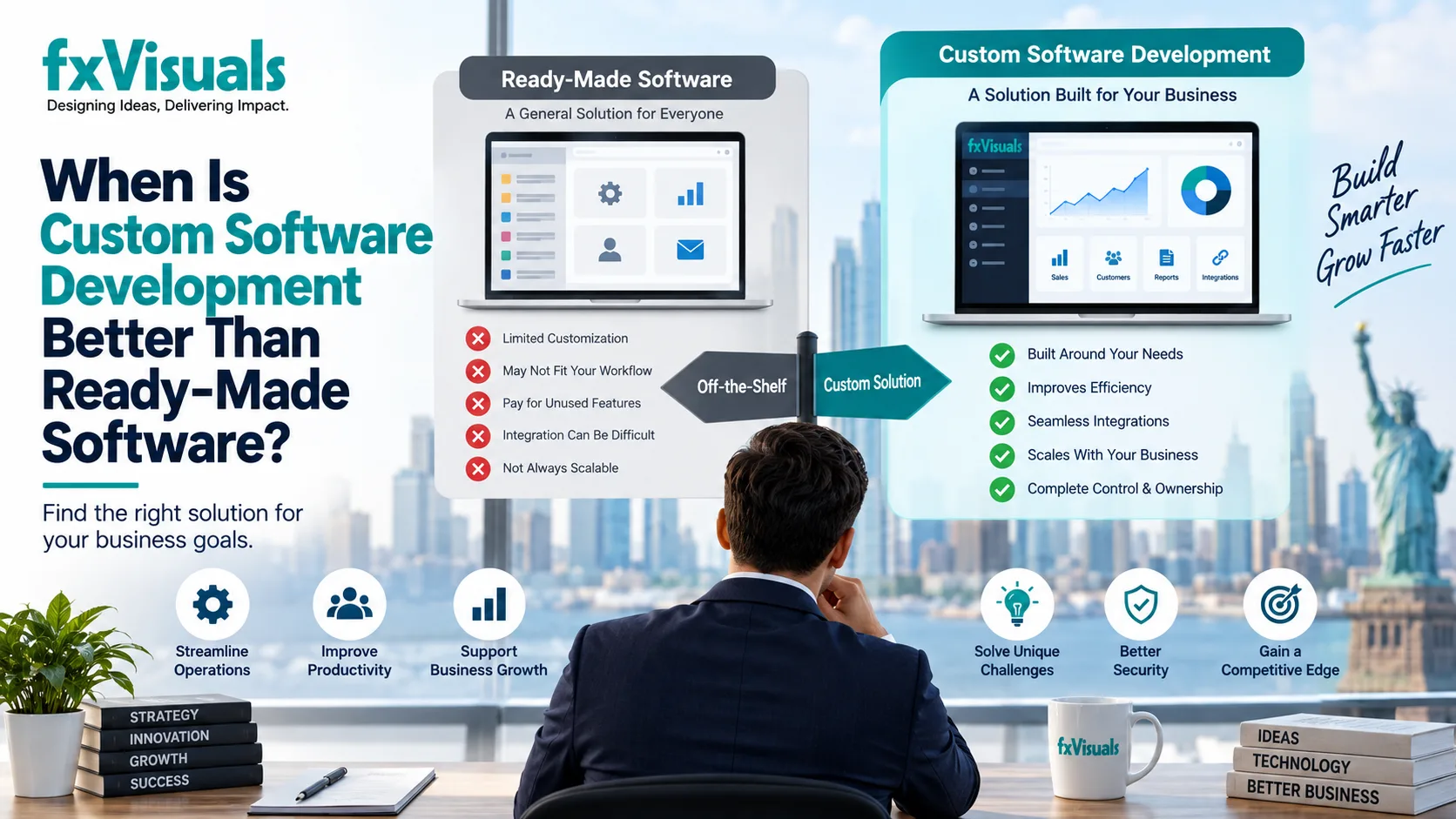
Limitations of ready-made software:
- May not match your exact workflow
- Customization is often limited
- You may end up paying for multiple subscriptions
- Advanced features can require expensive upgrades
- Data access and integrations may be restricted
- Your business may need to adapt its processes to fit the software, rather than the other way around
It's worth being clear here: ready-made software isn't bad software. For a huge number of businesses, it's genuinely the right choice.
What Is Custom Software Development?
Custom software is built around the specific needs, workflows, and goals of a single business, rather than a generic set of features meant to serve everyone.
A custom software development company can help build things like:
- Custom business management systems
- CRM platforms tailored to a specific sales process
- Web applications
- Customer or vendor portals
- Internal employee tools
- Inventory and order management systems
- Business automation solutions
- Software integrations between existing systems
- Industry-specific applications
The core idea is simple: custom software is designed to fit how a company actually works, instead of forcing employees to follow a process that was designed for someone else's business.
Custom Software vs. Ready-Made Software: Which Is Right for Your Business?
FactorReady-Made SoftwareCustom SoftwareSetupUsually quickerRequires planning and developmentInitial investmentOften lowerUsually higherCustomizationLimited to available optionsBuilt around business needsScalabilityDepends on the providerCan be designed for growthIntegrationsAvailable integrations varyCan be built around required systemsOwnershipUsually subscription or licenseDepends on the agreementMaintenanceProvider-managedRequires an agreed maintenance approachBest forCommon business needsUnique or complex workflowsKey takeaway: Choose ready-made software when it already solves your business problem. Consider custom software when the limitations of your existing tools are creating ongoing costs, inefficiencies, or barriers to growth. Custom isn't automatically better — it's better in specific situations, which the next section covers.
When Is Custom Software Development Better Than Ready-Made Software?
Example 1: Your Business Has Industry-Specific Workflows
Some businesses operate in ways standard software simply wasn't built to support — healthcare administration, logistics and transportation, manufacturing, professional services, real estate, and financial service operations are common examples. These industries often need specialized approval processes, unique customer or case records, or reporting systems that don't map neatly onto a generic tool.
When custom makes sense: When adapting a ready-made tool requires too many workarounds or manual steps to be worth the effort.
Example 2: Your Business Operates Across Multiple Locations
A growing US business with multiple branches, offices, or warehouses often needs centralized operations that most off-the-shelf tools weren't designed for — multi-location retail, restaurant groups, healthcare networks, logistics companies, and franchise operations are typical examples. Requirements here often include centralized reporting, location-specific access, shared customer records, branch-level permissions, inventory visibility, and standardized workflows across every site.
When custom makes sense: When existing tools can't coordinate the business's operations effectively across locations.
Example 3: Your Existing Software Doesn't Integrate Properly
Most businesses run several systems at once — CRM plus accounting software, e-commerce plus inventory management, ERP plus a customer portal, a payment system plus an internal dashboard, marketing automation plus sales software. When these systems don't talk to each other, the result is usually duplicate data entry, delays, and reporting problems that compound over time.
When custom makes sense: When a business needs tailored integrations, or a central platform to connect systems that were never designed to work together.
Example 4: Your Business Needs a Unique Customer or Employee Portal
Sometimes the limitation isn't a back-office process — it's the experience itself. Standard software often can't deliver the exact customer or employee experience a business wants, whether that's a customer self-service portal, an online booking system, a B2B ordering portal, an employee dashboard, a vendor management portal, or a subscription management platform.
When custom makes sense: When the required experience is a core part of the business model, not just a nice-to-have feature.
Example 5: Your Business Has Outgrown Its Current Software
Many businesses start with spreadsheets or a basic software package and eventually need more. Signs of outgrowing a system include increasing manual work, more employees relying on disconnected tools, data scattered across platforms, growing customer volume, reporting delays, and increasingly complex approval processes.
When custom makes sense: When the ongoing cost of staying with the existing system — in time, errors, and missed opportunities — starts to outweigh the investment in something better.
Signs Your Business May Need Custom Software
A business may benefit from custom software when:
- Your current software forces employees into inefficient workarounds
- You rely heavily on spreadsheets for important business processes
- Your systems don't communicate with one another
- You need features that existing software simply doesn't offer
- Your business has unique operational requirements
- You need a custom customer or employee portal
- Your business is expanding faster than your current software can scale
- You need more control over workflows, reporting, or user permissions
- You're spending too much time managing disconnected tools
One sign alone doesn't automatically mean custom development is necessary. It's worth weighing the cost, urgency, and realistic alternatives before deciding.
When Ready-Made Software Is the Better Choice
Your requirements are common. If a standard CRM, accounting platform, or project management tool already meets your needs, building from scratch usually isn't worth it.
Your budget is limited. Ready-made software typically requires a smaller upfront investment.
You need to start quickly. A ready-made product often lets your team begin working immediately, without waiting on a development timeline.
You don't need extensive customization. If your business can work comfortably within the available features, a standard product may be more than enough.
You want provider-managed updates. Many ready-made products include ongoing maintenance and updates handled entirely by the vendor.
The goal isn't to build custom software simply because it's possible. The goal is to choose whichever solution makes the most sense for the business.
How to Decide if Custom Software Is Worth the Investment
Compare the total cost of your existing software. Factor in monthly or annual subscriptions, additional paid features, integration costs, manual work, training time, data entry, reporting delays, and costs caused by errors.
Estimate the cost of custom development. This includes discovery and planning, design, development, testing, deployment, maintenance, and future improvements.
Evaluate the business impact. Will the software save employees time? Reduce manual work? Improve customer service? Support more locations? Improve data visibility? Help the business grow?
Consider the long-term value. A custom solution tends to be worth the investment when a business has recurring problems that ready-made software simply can't solve efficiently, no matter how it's configured.
How a Custom Software Development Company Builds a Solution
- Discovery and requirements — understanding the business, current challenges, users, and goals.
- Planning and solution design — defining key features, workflows, and overall structure.
- UI/UX design — creating an interface that matches how employees or customers will actually use it.
- Software development — building the required features, integrations, and functionality.
- Testing — checking usability, performance, functionality, and security.
- Deployment — launching the software and supporting the transition to the new system.
- Support and improvements — ongoing maintenance, updates, bug fixes, and future enhancements.
Not every custom software project needs to be a massive, year-long build. A well-planned project can start with the most important features and expand over time, rather than trying to solve everything at once.
How Much Does Custom Software Development Cost in the USA?
Costs vary significantly depending on scope, features, integrations, and complexity. As a general planning guide:
- Basic custom business application: approximately $15,000–$50,000
- Mid-level custom web application or CRM: approximately $50,000–$150,000
- Complex enterprise software or multi-system platform: $150,000+
These are broad illustrative estimates, not official fxVisuals pricing. Actual costs depend on the specific scope, team, technology, integrations, and complexity of the project.
What tends to drive cost up or down: the number of features, the number of users, design requirements, mobile app needs, CRM or ERP integrations, third-party APIs, security requirements, data migration, admin dashboards, testing depth, and ongoing maintenance needs.
How Long Does Custom Software Development Take?
As a general guide:
- Simple custom application: a few weeks to a few months
- Mid-sized business software: several months
- Complex enterprise platform: several months or longer
Timelines depend on scope, number of features, integrations, design changes, testing, client feedback turnaround, data migration, and team availability.
A custom software project doesn't have to launch with every possible feature included. Starting with a focused first version often helps businesses validate the solution before investing further, and plan future improvements based on real usage.
How to Choose the Best Custom Software Development Company
Relevant experience. Look for a track record building solutions similar to what your business needs.
A clear requirements process. The company should understand your problem before recommending any particular technology.
Transparent pricing. Ask for a clear scope, defined deliverables, and realistic cost estimates upfront.
Communication. A reliable partner should be able to explain progress in plain, business-friendly language — not just technical jargon.
Technology and integrations. Confirm the company can work with the platforms and systems your business already relies on.
Testing and support. Ask specifically how testing, deployment, maintenance, and future improvements will be handled after launch.
Business understanding. The best partner isn't necessarily the cheapest one — it's the one that understands how the software needs to help your business operate more effectively.
Why Choose fxVisuals for Custom Software Development?
Every business has different processes, challenges, and growth goals. fxVisuals helps businesses explore custom software solutions designed around their operational needs — whether that means a tailored web application, a CRM platform, a business automation solution, or a software integration connecting existing systems.
With a focus on practical digital solutions, fxVisuals can help businesses evaluate their requirements, plan the right functionality, and build software that supports long-term growth rather than adding another disconnected tool to the mix.
Explore fxVisuals' custom software development services to talk through your specific requirements.
Frequently Asked Questions
When is custom software development better than ready-made software?
Custom software is often the better choice when a business has unique workflows, complex integrations, specialized industry requirements, or limitations that ready-made software can't address efficiently.
What is the difference between custom software and off-the-shelf software?
Off-the-shelf software is a pre-built product designed for a broad range of businesses, while custom software is built specifically around one business's workflows, requirements, and goals.
How do I know if my business needs custom software?
Common signs include relying heavily on spreadsheets or workarounds, using disconnected systems that don't share data, needing features no existing software offers, or outgrowing the scale your current tools can support.
Is custom software development worth the cost for a small business?
It depends on the business. Small businesses with straightforward, common needs are often well served by ready-made software, while those with unique workflows or clear growth barriers may find custom development pays for itself over time.
How much does custom software development cost in the USA?
Costs vary widely based on scope and complexity — basic applications often start in the tens of thousands of dollars, while complex enterprise platforms can run well beyond $150,000. Actual pricing depends on the specific project.
How long does it take to build custom software?
Simple applications can take a few weeks to a few months, while mid-sized or enterprise platforms often take several months or longer, depending on features, integrations, and feedback cycles.
What should I look for in a custom software development company?
Relevant experience, a clear requirements process, transparent pricing, strong communication, compatibility with your existing technology, and a solid plan for testing and ongoing support.
Can custom software integrate with existing business tools?
In most cases, yes — though this depends on the specific tools involved, available APIs, and technical compatibility. It's worth discussing integration needs early in the planning process.
Can a custom software development company improve an existing application?
Yes. Many projects involve improving, extending, or modernizing an existing system rather than building something entirely from scratch.
Should a business build custom software or use a ready-made CRM?
It depends on how well a standard CRM fits your sales process. If it requires constant workarounds or can't support your reporting and workflow needs, a custom CRM may be a better long-term fit.
Final Thoughts
The real question isn't whether custom software is better than ready-made software in general — it's whether your business's specific workflows, integrations, and growth plans are being held back by a tool that wasn't built for them. Sometimes the answer is to switch software. Sometimes it's to build something that finally fits.
Ready to find the right software solution for your business? Talk to fxVisuals about your requirements and explore whether custom software development is the right fit for your business goals.