Hospital executives, clinical directors, and healthcare operations leaders are confronting an administrative crisis. For every hour a physician or nurse spends interacting with patients, they routinely spend two additional hours navigating clinical software, updating electronic charts, and managing insurance paperwork. This clerical burden drives severe clinical burnout, accelerates staff turnover, and inflates overhead expenses across health systems. When medical administrative personnel must manually copy demographic data between disparate software portals, verify coverage through fragmented payer clearinghouses, and track down missing prior authorization documents, revenue realization stalls and patient care is delayed.
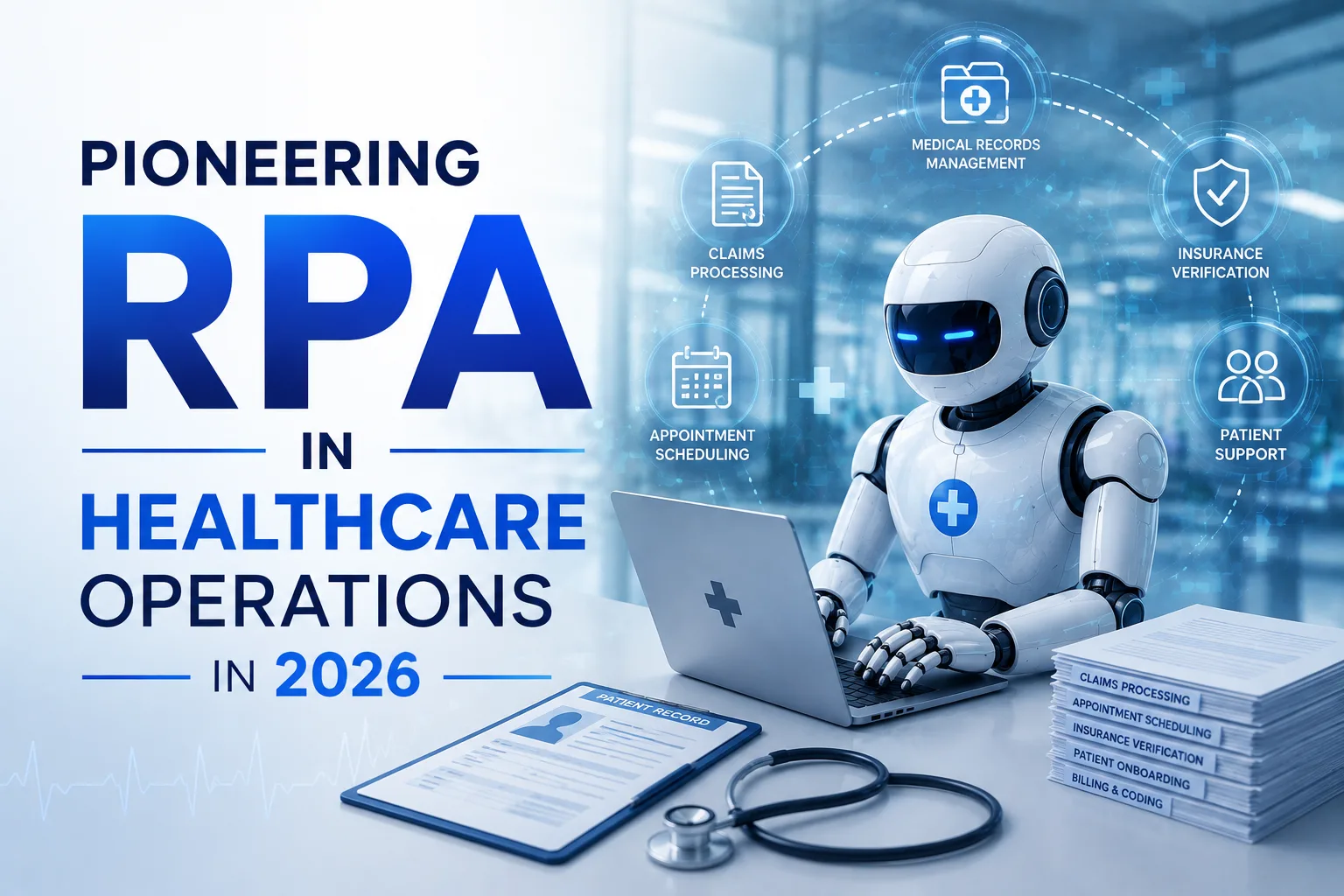
Health systems and ambulatory networks are resolving these operational friction points through rpa in healthcare. Robotic Process Automation deploys deterministic software robots that replicate human keystrokes, navigation paths, and data entry routines across digital systems. These digital workers log into disparate applications, bridge disconnected databases, and validate patient information without requiring health systems to replace their core legacy IT infrastructure. When combined with intelligent document capture and medical rule engines, automated bots execute high-volume clerical tasks continuously with zero transcription error, compressing claim settlement timelines from weeks to hours.
However, implementing robotic automation within medical environments requires specialized engineering that does not exist in standard commercial IT. Software bots must navigate fragile Electronic Health Record (EHR) interfaces without causing database locks, extract unstructured clinical narratives from scanned medical charts, and adhere strictly to HIPAA, HITECH, and patient privacy mandates. Selecting an unqualified technology vendor can result in brittle scripts that break whenever an EHR interface receives a routine software patch, creating administrative backlogs and exposing sensitive Protected Health Information (PHI) to unauthorized access.
This market report evaluates the top 10 software engineering companies and automation providers delivering robotic process automation for healthcare organizations, analyzing their technical competencies, clinical specializations, and regulatory standards.
What Criteria Define an Enterprise-Grade Healthcare Automation Partner?
Evaluating automation engineering firms for medical environments requires looking past standard robotic scripting capabilities. We evaluated candidate technology firms using five specialized criteria:
- EHR Safety and Interoperability: Demonstrated capability to interface with major Electronic Health Record platforms (such as Epic, Oracle Health, MEDITECH, and Athenahealth) through both safe user-interface automation and secure backend HL7 and FHIR data pipelines.
- Revenue Cycle Management (RCM) Optimization: Proven engineering track records in automating core financial workflows, including patient eligibility verification, dynamic medical coding audits, prior authorization submissions, and automated claim denial triage.
- Cognitive Document Extraction: The technical ability to combine rule-based task execution with optical character recognition (OCR) and clinical natural language processing (NLP) to parse scanned clinical charts, lab reports, and Explanation of Benefits (EOB) statements.
- Healthcare Regulatory and Privacy Compliance: Strict engineering adherence to HIPAA, HITECH, SOC 2 Type II, and HITRUST frameworks, featuring encrypted credential storage, automated session timeouts, and immutable transaction audit logs.
- Resilient Bot Governance and Exception Routing: Robust operational architectures that include centralized control dashboards, keystroke throttling to prevent database strain, and immediate human-in-the-loop exception routing when unhandled interface errors occur.
Top 10 RPA in Healthcare Companies in 2026
1. Idea Usher
Best suited for: Custom clinical workflow automation, multi-site EHR integration, and end-to-end revenue cycle engineering.
Idea Usher builds custom digital health software and automated clinical workflows, specializing in tailored robotic process automation for hospital networks, outpatient surgical centers, and digital health enterprises. The company approaches healthcare automation from an engineering perspective, developing custom unattended and attended bots that bridge modern web portals with legacy on-premises healthcare applications. Their development teams design automation suites that eliminate manual data transfers between practice management software, billing engines, and electronic health record databases.
The company excels at building resilient bots for complex revenue cycle management tasks. Idea Usher engineers automated pipelines that verify patient insurance coverage in real time via EDI 270/271 electronic transactions, extract diagnostic and procedural codes (ICD-10, CPT) from clinical encounter notes, and auto-populate insurance claims with zero manual data entry. Their bots interface directly with payer clearinghouses to track claim statuses and automatically resubmit rejected claims that fail due to simple clerical discrepancies. All automated workflows built by Idea Usher feature end-to-end HIPAA compliance, centralized credential encryption, and HL7/FHIR compatibility to ensure automated tasks do not compromise patient data integrity.
- Core Strengths: Custom healthcare bot development, automated insurance eligibility verification, FHIR-compliant data pipelines, and intelligent claims denial management.
2. Intellivon
Best suited for: Intelligent process automation (IPA), predictive denial triage, and clinical natural language parsing.
Intellivon operates at the intersection of enterprise artificial intelligence and specialized healthcare automation, developing cognitive process automation systems that handle non-deterministic clinical workflows. While standard RPA relies strictly on deterministic, rule-based logic, Intellivon builds hybrid software architectures combining software bots with specialized machine learning models and clinical natural language processing. This approach allows health systems to automate processes that involve unstructured medical narratives and variable document layouts.
Their engineering team builds predictive prior authorization and denial triage pipelines. Intellivon deploys software bots that ingest patient charts, analyze clinical documentation against specific payer coverage criteria, and auto-fill prior authorization requests before submitting them through payer APIs or web portals. Their predictive algorithms inspect claims packages prior to submission, flagging potential medical necessity mismatches or missing clinical documentation to stop denials before they occur. Furthermore, Intellivon provides automated compliance monitoring agents that audit bot transaction logs to ensure all automated data access adheres to institutional data governance standards.
- Core Strengths: Cognitive document processing, predictive claims denial analytics, automated prior authorization workflows, and AI-driven clinical text extraction.
3. Keragon
Best suited for: Cloud-native HIPAA-compliant clinical workflows, no-code and pro-code medical integrations, and practice management triggers.
Keragon is an automation platform built exclusively for healthcare, providing an API-first environment where medical practices and digital health startups can build HIPAA-compliant automations without writing extensive custom code. The platform provides pre-built connectors for major EHRs, billing platforms, and patient engagement tools, enabling automated triggers across clinical systems.
In outpatient clinics, Keragon automates patient onboarding, post-visit survey dispatch, and chronic care management check-ins. Their technical architecture ensures that all data processed through automated pipelines is encrypted in transit and at rest, maintaining Business Associate Agreements (BAAs) with all underlying service providers. The platform allows practice managers to design visual automation workflows that trigger whenever a patient schedules an appointment, changes insurance details, or completes a digital intake form.
- Core Strengths: Healthcare-exclusive workflow automation, pre-built EHR and billing connectors, native HIPAA compliance, and low-code clinical triggers.
4. UiPath
Best suited for: Large-scale health system orchestration, clinical process discovery, and enterprise bot governance.
UiPath delivers an enterprise-grade automation platform widely deployed across academic medical centers and multi-facility hospital conglomerates. The platform combines robotic task execution with process mining and cognitive document capture, allowing healthcare leaders to identify operational bottlenecks by analyzing digital workflows across departments.
UiPath enables hospital networks to deploy attended desktop robots that assist registration staff with patient check-in, cross-referencing insurance cards against payer clearinghouses in seconds. Its centralized control plane enforces strict role-based access control, detailed transaction audit logs, and automated bot scaling, making it well suited for high-volume institutional environments. Furthermore, UiPath provides pre-trained machine learning models designed specifically to extract structured data from medical invoices, physician order sheets, and insurance cards.
- Core Strengths: Enterprise process mining, pre-trained medical document understanding, attended front-desk automation, and centralized multi-site control planes.
5. Automation Anywhere
Best suited for: Cloud-hosted healthcare automation, generative AI process assistants, and prior authorization workflows.
Automation Anywhere delivers a cloud-native intelligent automation platform (Automation 360) widely utilized across health insurers, pharmaceutical logistics, and hospital networks. The platform is designed to scale across distributed clinical networks without requiring heavy local server footprints.
Their engineering focus centers on combining robotic task execution with generative AI models to parse complex payer documentation and medical policy updates. In clinical operations, Automation Anywhere automates prior authorization submissions, referral routing, and pharmacy inventory reconciliation. The platform maintains HITRUST CSF and SOC 2 Type II certifications, ensuring that data processed by cloud bots remains protected under institutional security frameworks.
- Core Strengths: Cloud-native automation architecture, generative AI process orchestration, referral tracking automation, and HITRUST-certified cloud security.
6. ScienceSoft
Best suited for: Custom healthcare IT integration, legacy EHR reconciliation, and ISO 13485-aligned engineering.
ScienceSoft brings more than 35 years of healthcare IT consulting and custom software development experience to healthcare automation. Operating under ISO 13485 medical device quality standards and ISO 27001 data security frameworks, the company specializes in engineering custom automation solutions that connect legacy hospital software with modern clinical platforms.
Their engineers build software bots that extract clinical findings from scanned paper intake forms and laboratory PDFs, standardizing terminology into SNOMED CT, LOINC, and RxNorm codes before auto-populating patient profiles in the EHR. ScienceSoft also develops automated billing bots that reconcile payments across internal financial software and external clearinghouses, reducing the administrative burden on revenue cycle teams.
- Core Strengths: ISO 13485-certified development processes, clinical terminology standardization, legacy EHR reconciliation, and medical practice management automation.
7. Innowise Group
Best suited for: Full-stack healthcare software engineering, cross-platform clinical automation, and medical IoT connectivity.
Innowise Group is an international software development company with extensive engineering capabilities across digital health, clinical systems, and enterprise automation. Their digital health practice builds integrated software platforms where automated bots serve as operational glue between patient mobile applications, connected medical devices, and hospital core systems.
When developing healthcare automation, Innowise engineers cross-platform solutions that automate vital sign ingestion from remote patient monitoring devices directly into physician EHR charts. Their developers build modular microservices backends that handle high-volume clinical transactions, ensuring data integrity across laboratory information systems, pharmacy databases, and clinical ledgers.
- Core Strengths: Full-stack digital health engineering, medical IoT data ingestion, cross-platform system connectivity, and API-first healthcare microservices.
8. CitiusTech
Best suited for: Payer-provider data interoperability, value-based care reporting, and clinical quality compliance.
CitiusTech is a specialized technology consulting and software engineering firm focused exclusively on healthcare and life sciences. The company develops domain-specific automation routines for health systems, medical technology companies, and health plans, helping them modernize manual operations while maintaining strict regulatory alignment.
Their engineering practice specializes in automating clinical quality reporting and value-based care metrics. CitiusTech builds bots that aggregate patient diagnostic data across disparate clinical databases, compile required quality measures (such as HEDIS and MIPS scores), and format electronic reports for submission to regulatory bodies. Their developers also build automated physician credentialing workflows that verify medical licenses against state licensing boards automatically.
- Core Strengths: Healthcare-exclusive domain expertise, automated HEDIS and MIPS quality reporting, provider credentialing automation, and payer-provider data exchange.
9. Appian
Best suited for: Low-code clinical case management, unified patient journey orchestration, and compliance auditing.
Appian delivers an enterprise low-code platform that combines robotic process automation with business process management and case management software. In healthcare, Appian is frequently deployed to orchestrate multi-department clinical workflows that involve both automated bot tasks and human decision points.
For example, in complex clinical discharge planning, Appian bots gather post-acute care options, verify insurance coverage for durable medical equipment, and populate discharge summaries, while presenting clinicians with a unified case dashboard for final approval. The platform features robust audit logging, native data fabric capabilities, and strict compliance with global healthcare privacy laws.
- Core Strengths: Low-code case management, unified clinical dashboard orchestration, end-to-end audit logging, and human-in-the-loop task routing.
10. Tungsten Automation (formerly Kofax)
Best suited for: High-volume medical document capture, intelligent optical character recognition, and financial clearinghouse integration.
Tungsten Automation, formerly known as Kofax, specializes in intelligent document processing and robotic process automation for document-intensive industries. In healthcare, the platform is widely used by hospital billing departments, clinical laboratories, and medical records archives to process incoming faxes, paper intake forms, and paper Explanation of Benefits statements.
Their cognitive capture technology utilizes advanced machine learning and optical character recognition to extract unstructured clinical data and convert it into structured electronic health records. Tungsten Automation provides automated workflows that route extracted medical data directly into billing clearinghouses and hospital information systems, drastically reducing manual data entry backlogs.
- Core Strengths: Cognitive document capture, automated medical fax processing, optical character recognition for paper charts, and clearinghouse data integration.
How Leading Healthcare Automation Providers Compare
CompanyBest Suited ForCore Technical SpecializationIdeal Clinical EnvironmentIdea UsherCustom Healthcare AutomationCustom bot scripts, FHIR pipelines, and RCM automationAmbulatory networks, hospital systems, and digital health clinicsIntellivonIntelligent Process AutomationPredictive claims denial triage, clinical NLP, and prior authorizationsSpecialty medical groups, health networks, and billing centersKeragonCloud Workflow AutomationHIPAA-compliant API pipelines and no-code clinical triggersPrivate medical practices, outpatient clinics, and telehealth firmsUiPathEnterprise Health SystemsProcess mining, pre-trained medical document AI, and control planesMulti-facility academic medical centers and regional hospital groupsAutomation AnywhereCloud-Native RPA & AICloud-native bot scaling, generative AI orchestration, and HITRUSTIntegrated delivery networks and pharmaceutical logisticsScienceSoftLegacy System IntegrationISO 13485 quality standards, terminology mapping, and EHR syncCommunity hospitals, healthcare IT vendors, and clinicsInnowise GroupFull-Stack Medical SoftwareMedical IoT ingestion, mobile app connectivity, and microservicesDigital therapeutics providers, hospital networks, and labsCitiusTechPayer-Provider InteroperabilityHEDIS and MIPS reporting, credentialing, and clinical data flowsManaged care organizations, health insurers, and health systemsAppianCase Management & Low-CodeUnified clinical case dashboards, human-in-the-loop, and BPMComplex inpatient surgical wards and care coordination hubsTungsten AutomationHigh-Volume Document CaptureOptical character recognition, fax extraction, and intake automationClinical laboratories, diagnostic archives, and billing officesWhere Does Robotic Process Automation Deliver the Highest ROI in Clinical Operations?
Robotic process automation delivers measurable financial and clinical returns when deployed across standardized, high-volume operational touchpoints. Five primary domains provide the most immediate return on investment:
1. Automated Prior Authorization Submissions
Prior authorization workflows represent one of the most resource-intensive bottlenecks in outpatient medicine. Clinical assistants typically spend hours manually transcribing patient diagnoses, past treatment histories, and physician recommendations into individual insurance company web portals. An automated software bot monitors the EHR scheduling calendar for upcoming procedures requiring authorization, collects relevant clinical notes and laboratory reports, logs into the appropriate payer portal, populates the request forms, and attaches supporting documentation. The bot periodically checks the portal for updates, writing approval codes or denial notices directly into the patient chart automatically.
2. Real-Time Eligibility and Benefits Verification
Patients frequently arrive for clinical appointments with changed insurance coverage, expired policies, or unmet deductible limits. When staff discover coverage lapses after appointments conclude, the health system absorbs uncompensated care expenses or incurs expensive billing follow-ups. Software bots run nightly batch reviews across all scheduled appointments for the following business day. The bots query commercial and government payer clearinghouses via electronic data interchange (EDI 270/271 transactions), verify active coverage status, check specific procedural copay amounts, and record verified financial responsibility figures directly into the practice management system prior to patient check-in.
3. Claims Processing and Denial Management
Clerical errors during claim creation account for a substantial percentage of initial insurance rejections. Software bots cross-reference clinical procedure codes (CPT) with diagnosis codes (ICD-10) before claim generation, checking for basic billing compliance and missing modifier codes. For claims that are denied due to simple demographic discrepancies, bots parse incoming remittance advice files (EDI 835), identify the specific denial reason code, extract the corrected data from the core medical record, and resubmit the corrected claim automatically without human intervention.
4. Patient Intake and Multi-System Record Reconciliation
When patients register through an online scheduling portal or are referred from external clinics, their medical records must be entered into the local EHR, laboratory management platform, and billing system. Unattended software bots extract demographic and insurance details from incoming digital intake forms, validate the entries against external databases, create unified patient charts, and map clinical terminology (such as medications, allergies, and past procedures) into standardized hospital formats without requiring staff to re-type the information.
5. Medical Staff Credentialing and License Verification
Onboarding physicians and allied health professionals requires extensive background verification. Credentialing personnel must verify educational degrees, board certifications, state medical licenses, and national practitioner databank records across multiple external government agencies. Software bots automate this manual verification process by querying state licensing boards and regulatory websites, downloading active license confirmations, checking for disciplinary actions, and updating the hospital credentialing database, reducing onboarding turnaround times from months to days.
How Do Health Systems Safeguard Patient Privacy and Maintain EHR Stability?
Deploying software robots inside clinical IT architectures requires strict adherence to security and systems engineering safeguards:
Centralized Credential Vaulting
Robots must never store database passwords, administrative keys, or payer portal logins in local scripts or configuration files. Enterprise healthcare RPA architectures utilize dedicated credential management vaults (such as CyberArk or Azure Key Vault) that inject encrypted session tokens dynamically at runtime. The bot authenticates securely, performs its designated workflow, and terminates the session immediately, leaving no credential traces in system memory.
Keystroke Throttling and System Resource Management
EHR platforms are mission-critical transactional databases. If an unattended bot submits thousands of rapid data requests simultaneously, it can lock database tables, slowing system response times for physicians and nurses caring for patients on hospital floors. Skilled automation engineers implement keystroke throttling, request queuing, and scheduled execution windows, configuring high-volume automated batches to run during off-peak night hours to protect clinical system stability.
Comprehensive Audit Logging for HIPAA Compliance
Under HIPAA and HITECH regulations, every access event involving Protected Health Information must be recorded and auditable. Healthcare automation platforms maintain immutable, time-stamped activity logs that record the specific bot identifier, the patient record accessed, the exact data modified, and the source workstation. These detailed logs allow hospital compliance officers to inspect bot actions during routine regulatory audits and verify that automated agents operate strictly within authorized data scopes.
Resilient Exception Handling and Human Escalation
Payer web portals and clinical applications frequently update their graphical user interfaces and data field layouts. When a software bot encounters an unexpected layout change, a missing form field, or conflicting clinical data, it must not attempt to force data entry or freeze active operations. The bot must safely abort the individual transaction, flag the specific patient encounter in a centralized management queue, notify administrative staff, and proceed to the next scheduled task without corrupting records.
Frequently Asked Questions About RPA in Healthcare
What is the difference between standard RPA and intelligent process automation in healthcare?
Standard RPA executes deterministic, rule-based tasks across structured data environments, such as copying patient demographic information from a registration form into an EHR. Intelligent Process Automation (IPA) incorporates machine learning, optical character recognition, and clinical natural language processing into the bot pipeline, allowing the software to read unstructured medical charts, interpret variable doctor handwriting, and make contextual decisions based on clinical guidelines.
How much does it cost to implement robotic process automation in a healthcare organization?
Implementing custom robotic process automation in a healthcare organization typically ranges from $50,000 to $250,000 or more, depending on project scope and integration requirements. A focused automation script addressing a single repetitive task, such as nightly insurance eligibility checks, sits at the lower end of the range. Enterprise-wide automation initiatives featuring cognitive document processing, multi-system EHR integration, automated prior authorization workflows, and centralized bot management require higher capital investment.
Can software bots access legacy healthcare software that does not support modern APIs?
Yes. A primary operational advantage of robotic process automation is its ability to interact with legacy software through the user interface layer. Bots emulate human interactions by logging into terminal screens, navigating menu trees, reading text fields, and entering data exactly like a human employee. This allows healthcare organizations to automate workflows across legacy systems without undertaking expensive core software migrations.
How does RPA reduce claim denial rates for medical practices?
RPA reduces claim denial rates by eliminating clerical transcription errors and enforcing pre-submission compliance checks. Software bots verify insurance active status and coverage limits prior to patient visits, validate that diagnostic codes align with procedure codes according to payer rules, and ensure required prior authorization numbers are attached to claims before submission to clearinghouses.
The Operational Future of Healthcare Automation
Robotic Process Automation has transitioned from basic back-office scripting into an essential architectural component of modern healthcare administration. By transferring high-volume, data-intensive tasks from clinical staff to secure digital workers, healthcare organizations can eliminate billing backlogs, lower operational expenses, and eradicate data transcription errors. Most importantly, freeing healthcare professionals from administrative paperwork allows hospitals and clinics to refocus valuable human time, attention, and empathy where it matters most: delivering direct, high-quality patient care.
Successfully deploying an enterprise healthcare automation program requires an engineering partner that combines technical software development skills with deep domain expertise in clinical workflows and healthcare privacy regulations. Whether automating prior authorization requests, modernizing revenue cycle operations, or synchronizing patient charts across fragmented systems, selecting an experienced development team ensures your software bots operate securely, scale reliably, and deliver lasting operational returns.