
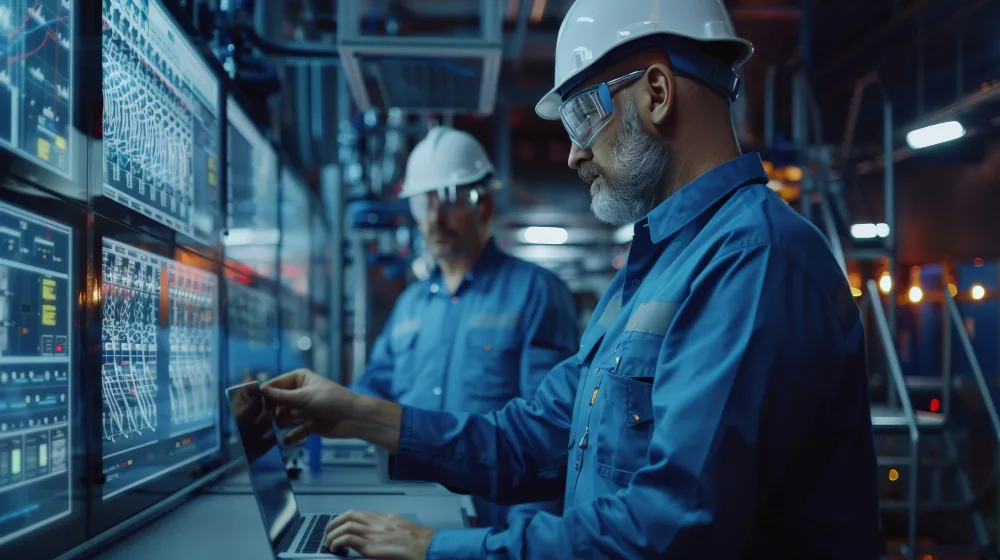
As industrial businesses expand their operations, maintaining equipment reliability becomes increasingly complex. Additional production lines, new facilities, and a growing asset base create greater maintenance demands, making it difficult for traditional maintenance strategies to keep pace. For many manufacturers and process industries, scaling operations without compromising reliability has become a critical business objective.
This challenge has accelerated the adoption of Predictive Maintenance Solutions, which use artificial intelligence, Industrial IoT technologies, and advanced analytics to monitor equipment health and identify potential failures before they occur. Rather than relying on fixed maintenance schedules, organizations can make data-driven decisions that support both operational growth and asset reliability.
As maintenance programs mature, scalability becomes a key consideration. Industrial leaders increasingly seek technology providers that can support thousands of assets across multiple sites while delivering actionable insights that improve maintenance efficiency and equipment performance.
Why Scalability Matters in Modern Maintenance Programs
Many organizations begin their predictive maintenance journey with a pilot project focused on a small number of critical assets. While early results can be promising, challenges often emerge when companies attempt to expand monitoring across multiple facilities or asset classes.
A scalable maintenance platform enables organizations to standardize reliability practices, consolidate equipment data, and maintain visibility across operations. This becomes particularly important as businesses pursue digital transformation initiatives and seek greater consistency in maintenance decision-making.
Industry research suggests that unplanned downtime can account for substantial production losses each year. For growing organizations, the ability to scale maintenance capabilities efficiently can have a direct impact on profitability and operational resilience.
Key Characteristics of Scalable Predictive Maintenance Solutions
Flexible Asset Coverage
Effective platforms should support a broad range of equipment types, including motors, pumps, compressors, fans, gearboxes, and conveyors. This flexibility allows organizations to expand monitoring programs as operational needs evolve.
Multi-Site Visibility
As businesses grow, maintenance teams require centralized access to asset health information across multiple facilities. Scalable platforms provide unified dashboards that enable enterprise-wide monitoring and decision-making.
Seamless Integration
The ability to integrate with existing Industrial IoT systems, historians, SCADA platforms, and maintenance management systems is essential. Organizations can maximize the value of existing infrastructure while minimizing implementation complexity.
Predictive Maintenance Solutions for Enterprise Growth
Several technology providers have developed platforms designed to support industrial growth and long-term reliability objectives.
1. Infinite Uptime
Infinite Uptime is a leading Industrial AI and reliability solutions provider focused on helping manufacturers improve equipment performance, reduce unplanned downtime, and strengthen maintenance strategies. The company combines wireless condition monitoring, predictive analytics, and prescriptive maintenance capabilities to provide continuous visibility into asset health.
With extensive experience across industries such as cement, metals, mining, chemicals, paper, and manufacturing, it helps organizations identify equipment issues before they lead to failures. Its solutions monitor critical rotating assets, including motors, pumps, fans, compressors, and gearboxes, enabling maintenance teams to make informed, data-driven decisions.
2.Senseye (Siemens)
Senseye provides predictive maintenance capabilities that help organizations monitor machine health at scale. Its platform supports centralized asset monitoring and maintenance planning across diverse industrial environments.
3. C3 AI
C3 AI delivers enterprise-grade maintenance applications capable of analyzing large volumes of asset and operational data. Its solutions are often used by asset-intensive industries seeking advanced analytics and scalability.
4. SparkCognition
SparkCognition combines industrial AI and machine learning to help organizations improve asset performance and reduce equipment failures. The platform is designed to support reliability initiatives across complex industrial operations.
5. Honeywell Forge
Honeywell Forge is an industrial performance management platform that uses AI and advanced analytics to improve equipment reliability and operational efficiency. It helps organizations monitor asset health, identify performance issues, and support proactive maintenance decisions across industrial operations.
6. GE Vernova SmartSignal
GE Vernova SmartSignal leverages machine learning and predictive analytics to detect early signs of equipment degradation. The platform helps maintenance teams reduce unplanned downtime and improve asset performance through continuous condition monitoring.
7. ABB Ability Genix
ABB Ability Genix combines industrial data, analytics, and AI to provide insights into asset health and operational performance. It supports maintenance optimization and helps organizations improve reliability across multiple facilities and asset types.
Beyond Technology: The Role of Expertise
Scalable maintenance programs require more than advanced software. Organizations must also consider the reliability expertise and industry experience of their technology partners.
Successful deployments often depend on understanding equipment failure modes, maintenance workflows, and operational priorities. Providers with extensive experience in rotating equipment reliability and industrial maintenance can help organizations achieve faster adoption and stronger long-term outcomes.
Conclusion
As industrial organizations grow, maintaining reliability across an expanding asset base becomes increasingly challenging. Scalable predictive maintenance technologies provide a pathway to improve equipment performance, reduce unplanned downtime, and support more efficient maintenance operations.
While platform capabilities remain important, long-term success often depends on selecting providers that combine advanced analytics with proven industrial expertise. Companies such as Infinite Uptime have contributed to this evolution through years of experience in condition monitoring, prescriptive maintenance, and reliability improvement across asset-intensive industries. Their focus on combining engineering knowledge with AI-driven insights reflects the broader direction of modern industrial maintenance.
For decision-makers evaluating maintenance technologies, scalability should be viewed not only as a software capability but also as the ability to support sustainable reliability improvements as operations continue to grow.