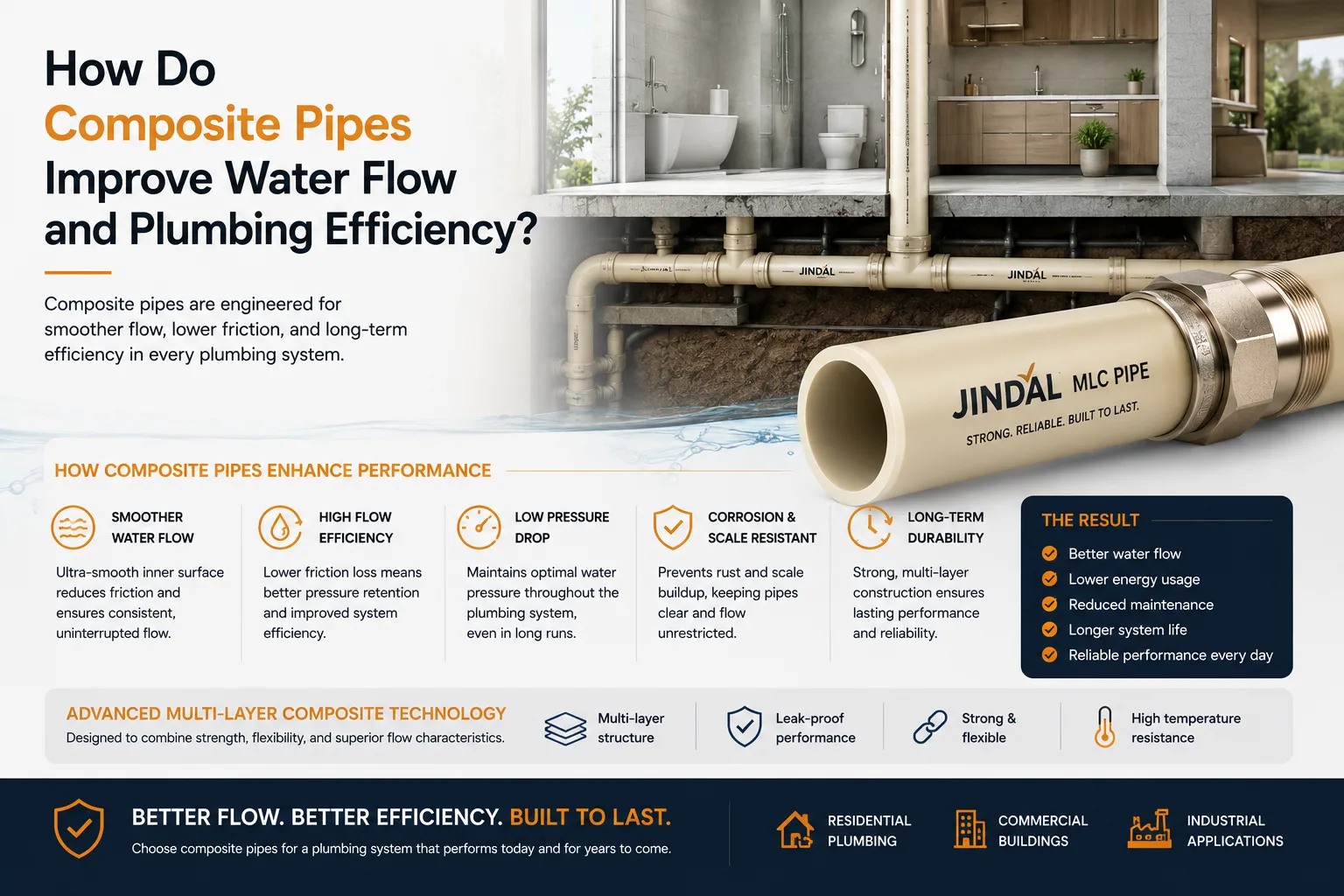
Composite pipes are increasingly viewed as the future of modern plumbing because they combine the strengths of both metal and plastic materials within a single system. Their resistance to corrosion, ability to handle pressure fluctuations, reduced thermal expansion, and long service life make them well-suited for the demands of today's residential, commercial, and industrial buildings.
How Plumbing Requirements Are Changing
Modern buildings place greater demands on plumbing infrastructure than ever before. Systems must support higher occupancy levels, changing water usage patterns, energy-efficient designs, and long-term operational reliability.
As a result, builders and consultants are looking beyond traditional piping materials and focusing on solutions that offer:
- Long service life
- Low maintenance requirements
- Reliable water delivery
- Improved installation efficiency
- Better lifecycle value
This shift has contributed to the growing adoption of composite piping systems worldwide.
What Are Composite Pipes?
Composite pipes are multilayer pipes that combine polyethylene and aluminium to create a stronger and more stable piping solution.
A typical multilayer composite pipe consists of:
- Inner polyethylene layer
- Adhesive bonding layer
- Aluminium core
- Adhesive bonding layer
- Outer polyethylene layer
This engineered construction allows the pipe to combine flexibility, strength, and durability in a single product.
Professionals looking to understand the technology behind these systems can explore How PE-AL-PE Multi-Layer Pipes Work to learn how each layer contributes to overall performance.
Corrosion Resistance Supports Long-Term Reliability
Corrosion has historically been one of the biggest causes of plumbing deterioration.
Traditional metal pipes can experience:
- Rust formation
- Internal scaling
- Reduced water flow
- Higher maintenance costs
- Premature replacement
Composite pipes eliminate many of these concerns because the inner polymer layer does not corrode when exposed to water.
The Plastic Pipe Institute (PPI) highlights the growing use of advanced plastic piping systems in water distribution applications due to their corrosion resistance and long-term performance characteristics.
Better Performance Under Modern Building Conditions
Today's plumbing systems operate under varying temperatures and pressure conditions.
Pipe materials must withstand:
- Daily pressure fluctuations
- Hot and cold water cycles
- Continuous usage
- Multi-storey distribution networks
The aluminium layer within composite pipes helps improve dimensional stability while maintaining flexibility, making them suitable for demanding environments.
Key advantages include:
- High pressure resistance
- Reduced deformation
- Improved structural stability
- Reliable long-term performance
Reduced Thermal Expansion Improves System Stability
Thermal expansion can affect the performance of many conventional piping materials.
As temperatures change, excessive expansion and contraction may place stress on:
- Pipe supports
- Fittings
- Connections
- Building structures
Composite pipes minimize these effects through their aluminium core.
Benefits include:
- Greater dimensional stability
- Better alignment retention
- Reduced stress on joints
- Lower maintenance requirements
These characteristics are particularly valuable in hot water distribution systems and radiant heating applications.
Installation Efficiency Is Driving Adoption
Construction projects increasingly prioritize faster installation without compromising quality.
Composite pipes offer several installation advantages:
- Lightweight construction
- Easier transportation
- Flexible routing
- Reduced installation time
- Fewer connection points
These benefits can help lower labour requirements while improving project efficiency.
Lower Maintenance Supports Lifecycle Value
The future of plumbing is increasingly focused on lifecycle performance rather than initial purchase price.
Infrastructure owners want systems that reduce:
- Maintenance costs
- Repair frequency
- Water damage risks
- Operational disruptions
According to the U.S. Environmental Protection Agency's asset management guidance, evaluating infrastructure based on long-term performance and lifecycle costs leads to better asset management decisions.
Composite pipes align with this approach because they are designed for durability and reduced maintenance over decades of operation.
Reliable Connections Improve System Performance
Even durable pipes require dependable connection systems.
Modern press-fit technologies help improve consistency while reducing installation errors and future leakage risks.
For multilayer plumbing systems, solutions such as EZ Press fittings are increasingly used to create secure and efficient pipe connections.
Reliable fittings play a significant role in overall system performance and longevity.
Why the Industry Is Moving Toward Composite Pipes
Several industry trends are accelerating the adoption of composite piping systems:
Growing focus on durability
- Longer infrastructure lifespan
- Lower replacement frequency
- Improved reliability
Greater emphasis on efficiency
- Faster installation
- Reduced maintenance
- Better lifecycle value
Demand for modern plumbing solutions
- High-rise buildings
- Commercial projects
- Mixed-use developments
- Energy-efficient construction
As these priorities continue to shape the construction sector, composite pipes are becoming a practical choice for future-ready plumbing infrastructure.
Composite Pipes vs Traditional Plumbing Materials
FeatureComposite PipesTraditional Plumbing MaterialsCorrosion ResistanceExcellentVariesThermal ExpansionLowModerate to HighPressure PerformanceHighModerateInstallation EfficiencyHighModerateMaintenance RequirementsLowHigherLifecycle ValueExcellentModerate
The Growing Role of Composite Pipes in Modern Construction
The plumbing industry is steadily moving toward materials that offer long-term reliability rather than short-term savings.
Manufacturers such as Jindal Tubes have contributed to this transition by supporting advanced composite pipe solutions that address many of the challenges associated with conventional plumbing systems.
As building owners, engineers, and consultants continue to prioritize durability, efficiency, and lifecycle performance, composite pipes are expected to play an increasingly important role in future plumbing infrastructure.
FAQs
Why are composite pipes considered the future of plumbing?
They combine corrosion resistance, pressure stability, reduced thermal expansion, and long service life within a single multilayer system.
Do composite pipes require less maintenance?
Yes. Their resistance to corrosion, scaling, and structural degradation helps reduce maintenance and repair requirements.
Are composite pipes suitable for residential and commercial buildings?
Yes. They are widely used across residential, commercial, institutional, and industrial projects.
Why are builders increasingly choosing composite pipes?
Builders are looking for solutions that offer long-term reliability, lower maintenance costs, installation efficiency, and better lifecycle value.
Final Insight
The future of plumbing is being shaped by materials that deliver long-term performance, lower maintenance requirements, and greater operational reliability. Composite pipes meet these demands through their engineered multilayer design, combining the advantages of metal and polymer technologies in a single system.
As construction continues to focus on lifecycle value, sustainability, and infrastructure durability, composite pipes are well-positioned to become a standard component of modern plumbing systems.