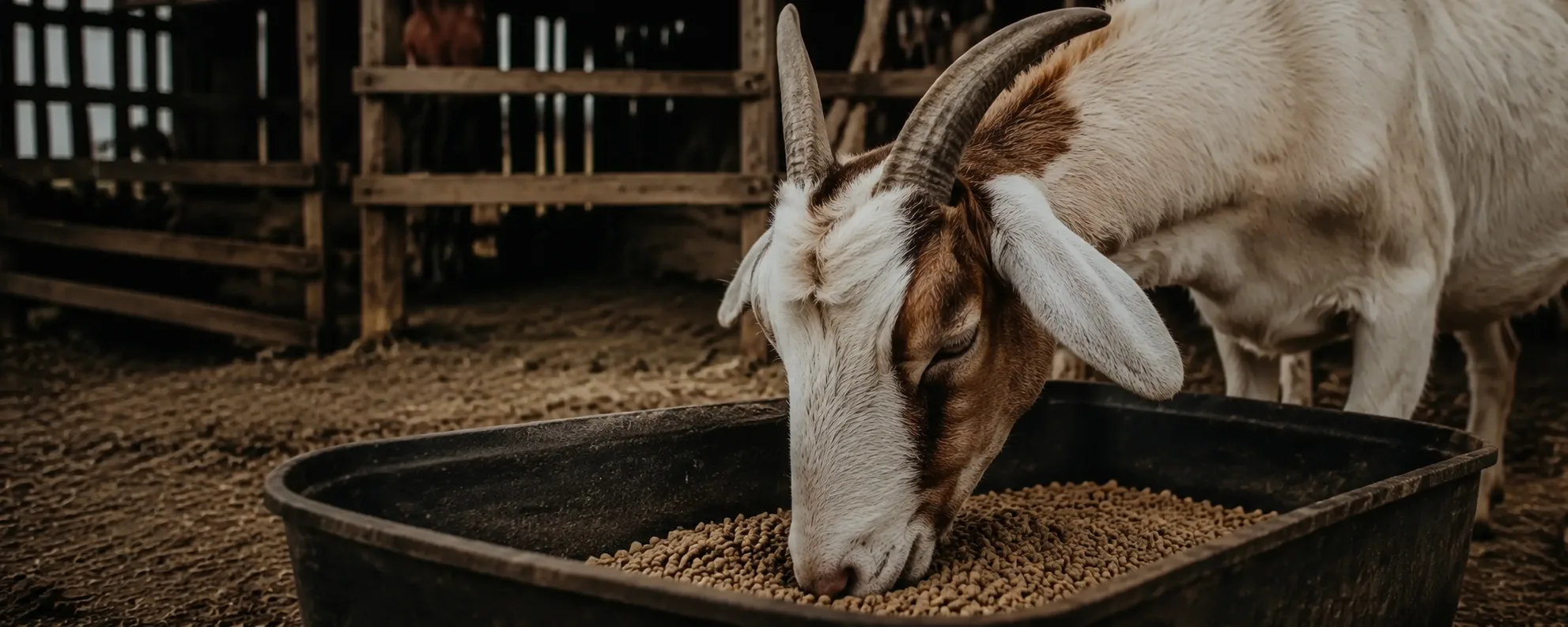
Goats are not messy eaters. They are precise. Watch one at a feed bunk and you'll see a level of selectivity that would impress a sommelier. They nuzzle through the mix, lips working, tongue flicking. The grain disappears. The mineral pellets? Often left behind. The fine particles? Blown aside. What looks like random waste is actually a deliberate sorting process, hardwired into an animal built to browse, not to eat a uniform pile of ground feed.
That instinct costs money. A goat can waste 10 to 15 percent of a loose ration. Over a winter, that's not a rounding error. It's a truckload of feed that never becomes milk, meat, or fiber. Worse, the nutrients left in the trough are often the ones the animal needs most: minerals, vitamins, amino acids. The goat fills up on the energy-dense bits and walks away nutritionally short. You see it in uneven body condition, poor kidding rates, and does that fade in late lactation.
Pellets change the equation. Compress a complete ration into a hard, uniform cylinder, and the goat can't sort. Every bite is the same. Waste drops. Intake becomes predictable. And because the pelleting process uses heat, moisture, and pressure to gelatinize starches and denature proteins, the feed is actually easier to digest. Feed conversion improves. The same amount of feed produces more growth or milk. It's one of the few management changes that pays for itself twice—once in reduced waste, once in better performance.
But making a good goat pellet is not the same as making a poultry or swine pellet. Goat rations tend to be high in fiber, often built around alfalfa, beet pulp, or other roughage. They may include copper, which is essential for goats but abrasive to machinery. The material can be sticky, dusty, and inconsistent. A machine designed for grain will clog, wear out dies, and produce pellets that crumble before they reach the feeder.
That's why the choice of equipment matters. A proper goat feed pellet making machine is built with wear-resistant dies, adjustable conditioning, and enough torque to push fibrous material through without stalling. It should allow you to control steam addition, die speed, and pellet size. It should be easy to maintain, with quick-change dies and accessible lubrication points. And it should be backed by a manufacturer who understands livestock feed, not just general biomass.
For small herds, a compact mill can produce a few hundred kilos per hour. That's enough for a few dozen animals and maybe a few neighbors. But as the operation grows, the calculus shifts. A commercial dairy or meat goat operation may need several tons per day. At that scale, automation and reliability become critical. You cannot afford downtime during peak feeding. You cannot afford inconsistent pellet quality that leads to sorting and waste. You need a system designed for continuous operation, with sensors and controls that keep the process stable even when ingredient quality varies.
This is where experience in the industry separates one supplier from another. Richi Pelletizer has built a reputation for durable, practical equipment that handles the tough stuff—high-fiber rations, abrasive minerals, and the daily grind of farm production. Their machines are not the cheapest on the market, but they are designed to last. The dies hold their shape. The gearboxes handle shock loads. The controls are intuitive enough that a busy farmer can learn them in an afternoon. And when something does need attention, the support network is there to keep production running.
The financial case is straightforward. Commercial goat feed carries a premium because it is a specialty product. Mills do not run it continuously, so the cost per bag stays high. When you produce your own, you capture that margin. You also gain control over the formula. You can adjust protein for growing kids, energy for late gestation, or mineral balance for a specific forage base. You can switch ingredients when prices change. You can store pellets for months without spoilage. And you can sell surplus to other producers, turning a cost center into a modest revenue stream.
None of this requires a massive facility. Many operations start with a single machine in an existing barn, then expand as they see the results. The learning curve is gentle. The technology is proven. The market for quality goat feed is growing. The only real question is whether you are ready to stop feeding the floor and start feeding the animal.
If you want to see how other producers have made the switch—what equipment they chose, what capacity they run, and what returns they achieved—click to investigate the specifications, case studies, and practical guides available. Your goats will not thank you. But your feed bill will.