Businesses across industries are increasingly adopting digital tools that help them manage customers, operations, finance, and internal processes in a more structured and efficient way. Traditional methods and disconnected software systems often create challenges such as data duplication, lack of visibility, and reduced productivity.
To solve these issues, many organizations are shifting toward integrated platforms that bring multiple business functions under one ecosystem. Among these platforms, Zoho has gained strong attention for offering a complete combination of Customer Relationship Management (CRM) and Enterprise Resource Planning (ERP) solutions.
The increasing shift toward Zoho is not random; it is driven by practical business needs such as automation, scalability, affordability, and centralized control of operations. This article explains in detail why businesses are making this transition and what makes Zoho a preferred choice for CRM and ERP solutions.
Understanding CRM and ERP in a Business Context
What CRM Means for Businesses
Customer Relationship Management (CRM) systems are designed to manage interactions between a business and its customers. A CRM system helps organize customer data, track communication, manage sales pipelines, and improve customer engagement.
Zoho CRM is one of the most widely used tools in this category. It allows businesses to track leads, manage follow-ups, automate sales activities, and maintain structured customer information in one place.
A strong CRM system ensures that businesses do not lose track of customer interactions and can respond more efficiently to opportunities.
What ERP Means for Businesses
Enterprise Resource Planning (ERP) systems are designed to manage core business operations such as finance, inventory, procurement, human resources, and reporting. Instead of using multiple tools for each department, ERP systems centralize these functions.
Zoho provides ERP-related capabilities through its interconnected applications that support business operations in a unified structure. This reduces operational complexity and ensures that all departments work with consistent and updated data.
The Growing Demand for Integrated Systems
Challenges of Separate Software Tools
Many businesses traditionally rely on different software tools for different departments. While this may seem manageable at first, it often leads to several problems:
- Data inconsistency across systems
- Lack of real-time visibility
- Difficulty in communication between departments
- Increased operational costs
- Time wasted switching between tools
These challenges make it harder for businesses to operate efficiently and make informed decisions.
Need for a Unified Ecosystem
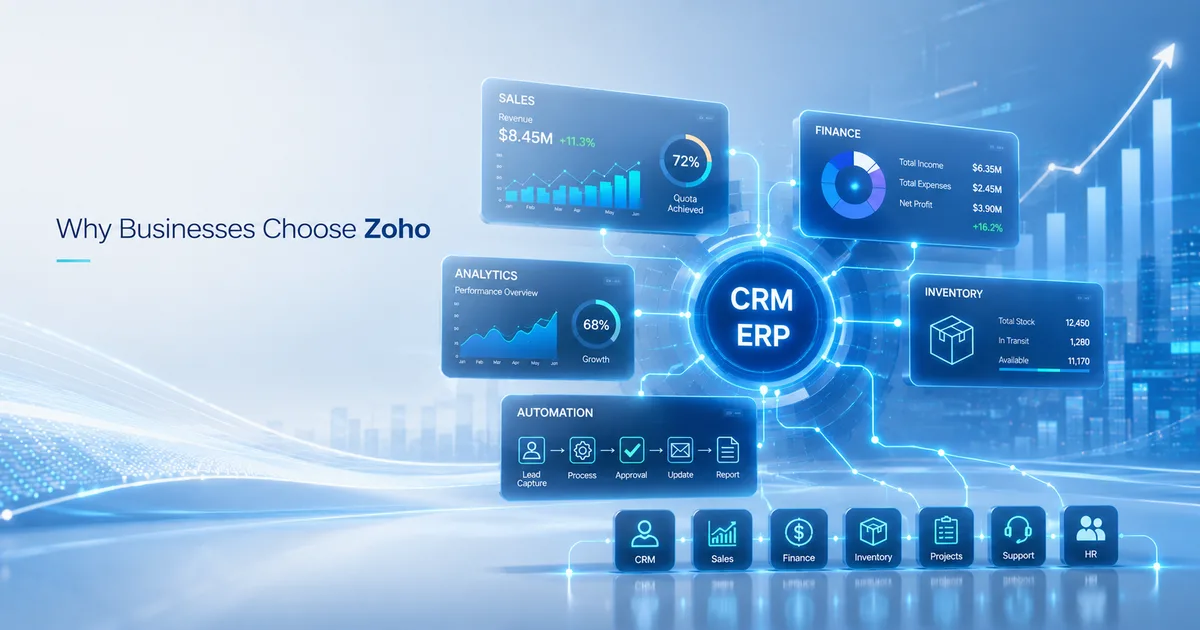
Because of these challenges, businesses are moving toward unified ecosystems that connect CRM, ERP, analytics, and communication tools into one platform. Zoho provides this kind of environment, where different applications work together seamlessly.
This integrated approach allows businesses to maintain a single source of truth for their data and operations.
Why Zoho is Becoming a Preferred Choice
1. All-in-One Business Platform
One of the biggest reasons businesses choose Zoho is its all-in-one structure. Instead of relying on separate vendors for CRM, ERP, and other tools, Zoho offers a complete ecosystem that includes everything in one platform.
This reduces complexity and helps organizations manage operations more efficiently without dealing with multiple integrations.
2. Strong CRM Capabilities
Zoho CRM plays a central role in helping businesses manage customer relationships effectively. It supports:
- Lead tracking
- Sales pipeline management
- Workflow automation
- Customer segmentation
- Performance tracking
By organizing customer data in a structured way, businesses can improve decision-making and streamline sales processes.
3. ERP-Level Operational Control
Zoho’s ERP-related capabilities help businesses manage internal operations such as finance, inventory, and order management.
Instead of using separate systems for each function, businesses can rely on connected modules that share data in real time. This reduces duplication and improves accuracy across departments.
4. High Flexibility and Customization
Every business operates differently, which is why flexibility is important. Zoho provides customization options that allow businesses to:
- Modify workflows
- Create automation rules
- Design custom dashboards
- Adjust reporting structures
This adaptability makes Zoho suitable for a wide range of operational needs.
5. Automation for Better Productivity
Automation is one of the strongest advantages of Zoho’s ecosystem. Businesses can automate repetitive tasks such as:
- Sending notifications
- Updating records
- Assigning tasks
- Generating reports
This reduces manual workload and allows employees to focus on more strategic activities.
6. Scalability for Growing Businesses
Zoho is designed to grow with businesses. Whether a company is small or expanding rapidly, the system can scale without requiring a complete change in infrastructure.
New features and modules can be added as business requirements evolve, making it a long-term solution.
Role of Zoho Consulting Support
While Zoho offers powerful tools, proper implementation is essential to unlock its full potential. Many businesses choose to work with a Zoho consulting partner to ensure smooth setup, configuration, and optimization of the system.
A consulting partner helps in:
- Understanding business requirements
- Setting up CRM and ERP modules correctly
- Creating optimized workflows
- Ensuring smooth migration from old systems
- Providing ongoing technical support
This professional guidance ensures that businesses get maximum value from the Zoho ecosystem.
Improved Collaboration Across Departments
One of the biggest advantages of Zoho is improved collaboration between departments. Since all data is stored in a connected system, teams can easily access and share information without delays.
Sales, finance, operations, and management teams can all work using the same platform, reducing communication gaps and improving efficiency.
Cost Efficiency and Resource Optimization
Another major reason for switching to Zoho is cost efficiency. Instead of investing in multiple software tools, businesses can use a single platform that offers multiple functions.
This reduces licensing costs, training efforts, and maintenance requirements. Over time, it also reduces the dependency on multiple vendors.
Enhanced Decision-Making with Analytics
Zoho provides built-in reporting and analytics features that help businesses understand performance trends. Decision-makers can access dashboards that show real-time data about sales, operations, and financial performance.
This helps in identifying opportunities and addressing issues quickly.
Conclusion
The shift toward Zoho for CRM and ERP solutions is driven by the need for integrated systems, improved efficiency, and better control over business operations. By combining customer management and enterprise resource planning into one ecosystem, Zoho helps businesses simplify processes and improve productivity.
With powerful tools like Zoho CRM and its ERP capabilities, organizations can centralize their operations, reduce complexity, and scale effectively.
The availability of customization, automation, and analytics further strengthens its value. Additionally, working with a Zoho consulting partner ensures that businesses can implement and optimize the system correctly for maximum benefit.