
In any industrial facility, valves operate quietly in the background. They regulate flow, isolate equipment, and support daily operations without attracting much attention. However, when a valve fails, leaks, or creates excessive pressure loss, its importance becomes immediately clear.
Whether the application involves water treatment, HVAC systems, cooling networks, or utility services, selecting the right valve can significantly influence operational efficiency and maintenance requirements.
This is one reason why the wafer type butterfly valve continues to be widely used across industrial installations. Its compact design, reliable performance, and ease of operation make it a practical solution for many flow control applications.
Why Industrial Facilities Prefer Compact Valve Designs
Modern industrial plants are becoming increasingly space-conscious. Mechanical rooms, pump stations, treatment facilities, and service corridors often contain large amounts of equipment within limited areas.
Every component must justify the space it occupies.
Large valves can increase installation complexity and create challenges during maintenance activities. Compact valve designs help overcome these limitations by fitting easily into confined spaces while still delivering dependable performance.
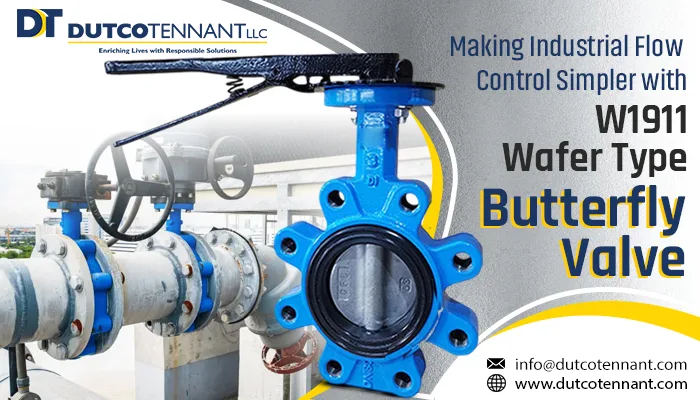
The W1911 butterfly valve is designed with this requirement in mind. Its wafer-style configuration allows installation between flanges without adding unnecessary bulk to the piping system.
Flow Control Is About Balance
Many people assume that valves simply open and close pipelines. In reality, efficient flow control requires balancing several factors at the same time.
The valve must allow sufficient flow when open, provide reliable shutoff when closed, minimize pressure losses, and remain easy to operate throughout its service life.
A well-designed industrial butterfly valve helps achieve this balance through a simple yet effective operating principle. The rotating disc controls flow efficiently while maintaining a compact overall profile.
This combination makes butterfly valves suitable for applications where both performance and practicality matter.
Installation Simplicity Matters More Than Many Realize
During project execution, installation time directly affects labour costs, commissioning schedules, and operational readiness.
Equipment that is difficult to position or requires extensive structural support can increase project complexity. Compact butterfly valves help reduce these challenges because they are generally lighter than many alternative valve types.
The wafer body design simplifies installation between flanges, making the process faster and more straightforward for contractors and maintenance teams.
For facilities planning future expansions or modifications, easier installation can also simplify upgrade projects.
A Valve Must Perform Consistently, Not Just Initially
The real value of a valve becomes evident after years of operation.
Industrial systems often operate continuously, exposing valves to pressure fluctuations, flow changes, and repeated operating cycles. Consistent performance over time is therefore just as important as initial functionality.
The W1911 wafer type butterfly valve is designed to provide dependable operation across a range of industrial applications. Properly selected and maintained, it can support long-term flow control requirements while helping reduce unnecessary maintenance interventions.
Where Butterfly Valves Are Commonly Used
Butterfly valves are versatile enough to serve many different industries.
They are frequently installed in:
· Water treatment facilities
· Cooling water systems
· HVAC networks
· Utility infrastructure
· Industrial service lines
· Pump stations
· Distribution networks
Their ability to handle large flow volumes while maintaining a compact footprint makes them particularly useful where space and efficiency are both priorities.
Across many projects in the UAE, engineers sourcing flow control equipment through Dutco Tennant LLC often consider the W1911 butterfly valve for applications that require reliable operation and efficient installation.
Maintenance Teams Appreciate Simplicity
Operational staff generally prefer equipment that is straightforward to inspect, service, and replace.
Complex valve arrangements may increase downtime during maintenance activities. Compact butterfly valves often simplify access and reduce handling requirements during servicing.
This practical advantage becomes especially important in facilities where operational interruptions must be kept to a minimum.
By reducing maintenance effort, facilities can improve overall system availability and operational efficiency.
Weight Can Influence More Than Transportation
The weight of industrial equipment affects much more than shipping logistics.
Heavy valves may require additional lifting equipment, stronger support structures, and more installation resources. A lighter valve can simplify handling throughout the entire project lifecycle.
Because of its compact design, the wafer type butterfly valve often provides a practical solution where weight reduction is beneficial without compromising performance.
Selecting a Valve Should Always Be Application-Based
No valve is universally suitable for every operating condition.
Engineers typically evaluate factors such as:
· Operating pressure
· Flow characteristics
· Fluid compatibility
· Temperature conditions
· Installation constraints
· Maintenance access
The best valve choice is the one that matches the actual operating environment rather than simply following a standard specification.
Understanding these requirements helps ensure reliable performance and long-term operational value.
A Practical Choice for Modern Industrial Systems
Industrial facilities continue to focus on efficiency, reliability, and ease of maintenance. Equipment that supports these objectives provides long-term value beyond its initial purchase cost.
The W1911 wafer type butterfly valve offers a combination of compact installation, dependable operation, and maintenance-friendly design that makes it suitable for many industrial flow control applications.
For water treatment plants, HVAC systems, utility services, and industrial process networks, choosing the right valve contributes to smoother operations, lower maintenance demands, and improved system reliability over time.