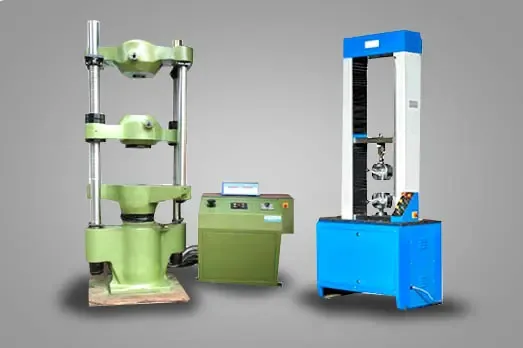
Accurate material testing helps manufacturers maintain product quality, reduce structural risks, improve consistency, and ensure compliance with industrial standards.
Manufacturing industries today operate under tighter tolerances and stricter quality expectations than ever before. Whether producing automotive components, steel products, industrial equipment, or structural materials, manufacturers rely heavily on precise testing results to maintain reliability and performance.
Even small inaccuracies during testing can create larger production issues later. Incorrect material evaluation may affect product durability, operational safety, and long-term structural integrity. That is why material testing accuracy has become one of the most important parts of modern industrial manufacturing.
How do testing machines support industrial quality control?
Testing machines help manufacturers verify whether materials meet required performance standards before production or distribution.
Different testing systems evaluate different mechanical properties.
For example:
- Universal Testing Machines evaluate tensile and compression behavior
- Hardness testing systems measure surface resistance
- Impact testing systems evaluate material toughness
- Spring and torsion testing machines measure rotational performance
Together, these systems help industries understand how materials behave under different working conditions.
Manufacturers working with advanced material testing systems often improve production consistency while reducing the chances of structural or mechanical failures.
Why does repeatability matter during material testing?
Repeatability ensures testing results remain consistent across multiple samples and production batches.
One accurate reading is valuable, but consistent readings across repeated tests are essential for industrial reliability.
Industries such as:
- Automotive manufacturing
- Aerospace engineering
- Defense laboratories
- Steel production
- Metallurgical research
depend heavily on repeatable testing because even small inconsistencies can affect safety standards and product performance.
Modern computerized systems reduce variability by standardizing testing conditions and minimizing manual interpretation.
How does digital testing improve manufacturing accuracy?
Traditional testing systems often depend heavily on manual calculations and operator observations. This increases the possibility of inconsistencies during analysis.
Digital testing systems improve precision through:
- Automated calculations
- Real-time monitoring
- Software-driven analysis
- Faster report generation
- Better data storage
Facilities using Impact Testing Machines frequently integrate digital reporting systems to improve toughness evaluation and testing efficiency.
Digital workflows also improve traceability, which is increasingly important during audits and compliance inspections.
Why are industries modernizing older testing systems?
Many organizations still operate older testing machines because their mechanical structures remain strong and reliable.
However, older systems often lack:
- Computerized controls
- Digital reporting
- Real-time graphical analysis
- Automated calculations
- Data storage capability
Instead of replacing entire systems, industries increasingly choose electronic modernization and software integration.
Facilities modernizing older Tensile Testing Machines often improve testing precision and reporting efficiency without the cost of replacing complete equipment setups.
Electronic upgradation also helps manufacturers extend machine lifespan while improving operational performance.
Why is testing software becoming more important?
Testing software has become a critical part of modern material testing environments.
Advanced software systems help operators:
- Generate automated reports
- Store historical test records
- Analyze stress-strain behavior
- Compare sample performance
- Evaluate proof stress values
Customized software is becoming increasingly common because industries often require specific reporting formats and testing procedures depending on production or research requirements.
Software-driven analysis also improves workflow efficiency while reducing manual calculation errors.
Which industries rely heavily on accurate testing?
Several industries require highly accurate testing because product reliability directly affects safety, performance, and compliance.
Industries include:
- Steel manufacturing
- Automotive engineering
- Aerospace production
- Defense research
- Educational engineering institutions
- Industrial R&D laboratories
Facilities involved in surface durability analysis frequently use Hardness Testing Machines to evaluate material resistance and maintain production consistency.
Research laboratories and industrial facilities also rely on Compression Testing Machines for evaluating load-bearing strength and structural behavior.
How do electronic extensometers improve testing precision?
Electronic extensometers improve measurement accuracy during tensile and deformation testing procedures.
They help evaluate:
- Yield strength
- Material elongation
- Proof stress
- Structural flexibility
Accurate elongation measurement is especially important when industries work with high-performance materials that require precise deformation analysis.
Electronic extensometers also improve confidence in final testing results by reducing operator-dependent variability.
Why does accurate testing improve long-term product reliability?
Material testing directly affects production decisions. If testing data is inaccurate, manufacturers may unknowingly approve materials that fail under actual operating conditions.
Accurate testing helps industries:
- Improve product reliability
- Reduce production defects
- Strengthen customer confidence
- Maintain manufacturing consistency
- Support compliance requirements
As industrial standards continue becoming stricter, reliable testing systems will remain essential for quality assurance and engineering reliability.
Why is data-driven testing becoming the future of manufacturing?
Manufacturing is becoming increasingly digital and data-focused.
Industries now expect:
- Automated reporting
- Faster analysis
- Better traceability
- Digital documentation
- Real-time testing insights
Modern quality-control environments increasingly integrate data from Other Testing Machines into centralized production analysis and reporting systems.
Testing technology is evolving beyond basic force measurement into fully integrated digital quality-control systems that support smarter manufacturing decisions.
Frequently Asked Questions
Why is material testing accuracy important?
It helps manufacturers maintain product reliability, production consistency, and safety standards.
How do testing machines support quality control?
They evaluate whether materials meet required mechanical and structural performance standards.
Why is repeatability important during testing?
Repeatability ensures testing results remain consistent across multiple samples and production batches.
Can older testing systems be upgraded?
Yes. Many older machines can be modernized with computerized controls and software integration.
Which industries rely heavily on accurate testing?
Steel, aerospace, automotive, defense, research, and manufacturing industries commonly depend on advanced testing systems.
Conclusion
Material testing accuracy has become more important than ever because modern industries depend on precision, repeatability, and reliable quality-control processes. Manufacturers today require more than simple testing procedures. They need accurate, traceable data that supports production consistency, engineering performance, and long-term product reliability.
As industrial standards continue evolving, advanced testing systems will remain essential across manufacturing, research, and engineering environments. Accurate material testing not only improves product quality but also helps industries reduce risks, strengthen compliance, and make better engineering decisions.