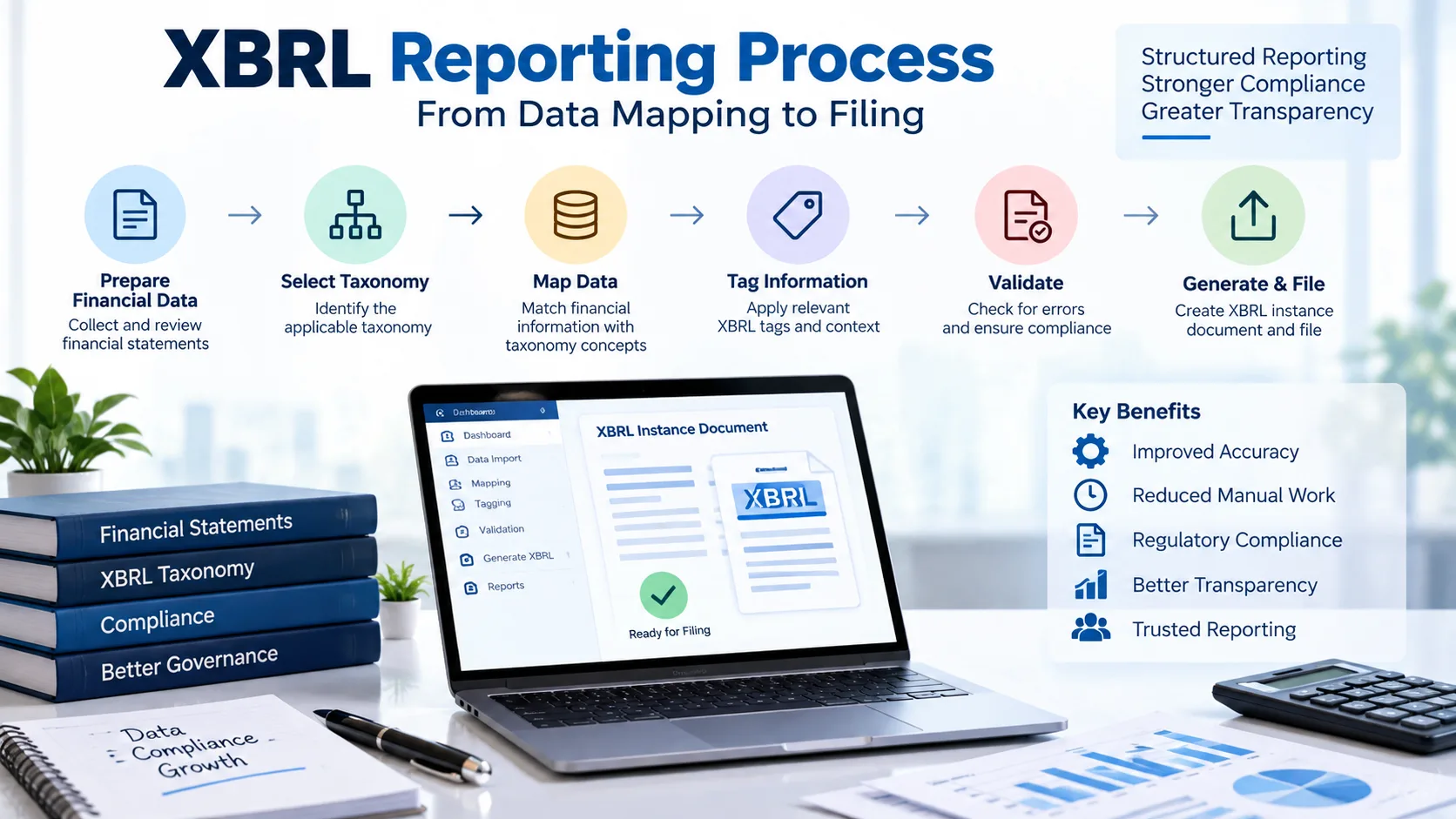
The XBRL Reporting Process involves more than converting financial statements into a digital file. It requires businesses to prepare source information, map financial facts to the appropriate taxonomy concepts, apply tags, create an XBRL instance document and validate the resulting data before filing.
For finance teams, Chartered Accountants and compliance professionals, understanding this workflow helps reduce avoidable errors and makes recurring reporting more systematic. Businesses can also use XBRL Filing Software to organize several stages of this process within a structured reporting workflow.
What Is the XBRL Reporting Process?
The XBRL reporting process is a structured method of converting applicable financial information into XBRL format for regulatory reporting.
The process connects information from financial statements with standardized XBRL taxonomy elements. Each relevant financial fact needs to be associated with an appropriate concept and contextual information before an instance document can be generated.
The Ministry of Corporate Affairs explains that mapping involves comparing concepts in financial statements with elements in the published taxonomy and assigning suitable taxonomy elements to the relevant financial information.
What Are the Main Steps in XBRL Reporting?
A typical XBRL workflow can be divided into several stages, with each stage contributing to the accuracy of the final report.
1. Prepare the Source Financial Statements
The process begins with the company's financial statements and supporting information.
Depending on the applicable reporting requirement, this can include:
- Balance sheet
- Statement of profit and loss
- Cash flow information
- Notes to accounts
- Other applicable disclosures
The source information should be reviewed before beginning the XBRL conversion process. Errors in the underlying financial information can affect the final XBRL document even when the technical conversion itself is completed correctly.
2. Identify the Applicable Taxonomy
The next step is to identify the taxonomy relevant to the reporting requirement.
An XBRL taxonomy provides standardized concepts that can be used to represent financial information. Selecting the appropriate taxonomy element is an important part of the reporting process because the selected concept needs to accurately represent the underlying financial fact.
3. Map Financial Data
Data mapping connects the information in the company's financial statements with corresponding taxonomy elements.
For example, an accounting head in a financial statement needs to be matched with the appropriate XBRL concept. The mapping process requires professional judgment in cases where multiple concepts may appear relevant.
MCA guidance notes that mapping should be reviewed before proceeding because subsequent reporting depends on the quality of the mapping.
4. Tag Financial Information
After mapping, the relevant financial facts are tagged using the selected XBRL concepts.
Tagging transforms financial information into structured data that can be interpreted by systems using the XBRL framework. Contextual information, units and reporting periods also need to be represented appropriately.
This makes tagging an important stage rather than simply a technical formatting exercise.
5. Generate the XBRL Instance Document
Once the required information has been mapped and tagged, an XBRL instance document can be generated.
An instance document contains business reporting information represented using tags from the relevant XBRL taxonomy. It forms the structured output that can subsequently be validated as part of the filing workflow.
Why Is XBRL Validation Important?
Validation is one of the most important quality-control stages in XBRL reporting.
An instance document may contain errors caused by incorrect mapping, missing information, inconsistent values or other rule-related issues. Identifying these problems before filing gives the finance or compliance team an opportunity to review and correct them.
The MCA filing manual describes a workflow that includes loading the instance document into the XBRL validation tool and validating it before proceeding with filing.
Common Validation Issues
Some issues that may require attention include:
- Incorrect taxonomy mapping
- Inconsistent financial values
- Missing required information
- Calculation inconsistencies
- Incorrect contextual information
- Errors in tagged disclosures
A systematic review process can make it easier to identify and resolve these issues.
How Can XBRL Software Support the Reporting Workflow?
XBRL software can bring several stages of the reporting process into a single workflow.
Depending on the solution, this may include data import, taxonomy mapping, tagging, validation, error identification and instance-document generation.
For organizations preparing recurring reports, software can also reduce repetitive data entry and make previous reporting information easier to manage. However, software should support professional review rather than replace it.
Cost-XBRL as a Specialized Reporting Requirement
XBRL reporting is not limited to standard financial statement reporting. Certain organizations may also need to deal with specialized reporting requirements related to cost audit and compliance information.
In this context, Cost-XBRL Filing Software refers to software designed for converting applicable cost audit and compliance reports into XBRL format. It is a specialized reporting workflow rather than a reference to the price of XBRL software. A solution such as Cost-XBRL Filing Software can support activities such as importing cost audit information, tagging reports, validating data and generating a cost instance document.
This distinction is useful for finance and compliance professionals because general XBRL reporting and Cost-XBRL reporting can involve different data structures and reporting requirements.
Common Mistakes in XBRL Reporting
A well-defined process can help prevent several avoidable problems.
Treating Mapping as a Simple Search Exercise
Selecting a taxonomy concept based only on a similar label can result in inappropriate tagging. The meaning and context of the financial information should be considered before finalizing the mapping.
Skipping Detailed Validation
Generating an instance document does not mean the document is ready for filing. Validation and review should be completed before submission.
Reusing Old Data Without Review
Previous-year information can save time, but it should not be carried forward without checking whether values, classifications and disclosures remain applicable.
Making Last-Minute Corrections
Late-stage corrections can create additional review work. Maintaining a structured process from source-data preparation through validation can reduce this risk.
How Can Businesses Make XBRL Reporting More Efficient?
Businesses can improve their reporting workflow by creating a defined responsibility matrix for data preparation, mapping, review and approval.
It is also useful to maintain organized source data and documentation for recurring reporting periods. Standardized internal review procedures can help identify inconsistencies before the final instance document is generated.
For organizations handling significant reporting volumes, appropriate XBRL software can further streamline repetitive activities while allowing finance professionals to retain control over important classification and compliance decisions.
Frequently Asked Questions
What is the XBRL reporting process?
The XBRL reporting process generally involves preparing source financial information, selecting the applicable taxonomy, mapping and tagging data, generating an instance document, validating it and completing the applicable filing process.
Why is data mapping important in XBRL?
Data mapping connects financial statement information with appropriate XBRL taxonomy concepts. Incorrect mapping can affect the meaning and accuracy of the resulting report.
What is an XBRL instance document?
An XBRL instance document is a structured file containing business reporting information represented through XBRL taxonomy tags.
Can XBRL software help with validation?
Yes. Depending on the solution, XBRL software can provide built-in validation features or integrate validation tools to help identify potential errors before filing.
Is Cost-XBRL the same as the cost of XBRL software?
No. Cost-XBRL refers to XBRL reporting associated with applicable cost audit and compliance reports. It is a specialized reporting area and should not be confused with software pricing.
Conclusion
A reliable XBRL reporting process connects financial data preparation, taxonomy selection, mapping, tagging, instance-document generation and validation into a structured workflow. Each stage has a role in producing accurate and reviewable XBRL information. For businesses and finance professionals, focusing on data quality and systematic validation is just as important as the software used for the conversion. A well-managed process can make recurring XBRL reporting more organized while reducing avoidable errors before filing.