In today's competitive manufacturing environment, businesses need reliable production methods that deliver quality, efficiency, and flexibility. Plastic components are used across industries, including automotive, healthcare, packaging, construction, electronics, and consumer goods. However, standard plastic products may not always meet the specific requirements of every business. This is where custom Plastic Manufacturing becomes a valuable solution.
Custom manufacturing allows businesses to develop plastic components according to their product specifications, design requirements, and operational needs. From creating prototypes to producing large quantities of finished components, it provides greater control over product development and manufacturing processes.
For businesses looking to improve product performance, reduce unnecessary production costs, and maintain consistent quality, choosing the right manufacturing approach can make a significant difference. Custom plastic solutions offer opportunities to improve product design, streamline operations, and develop products that stand out in the marketplace.
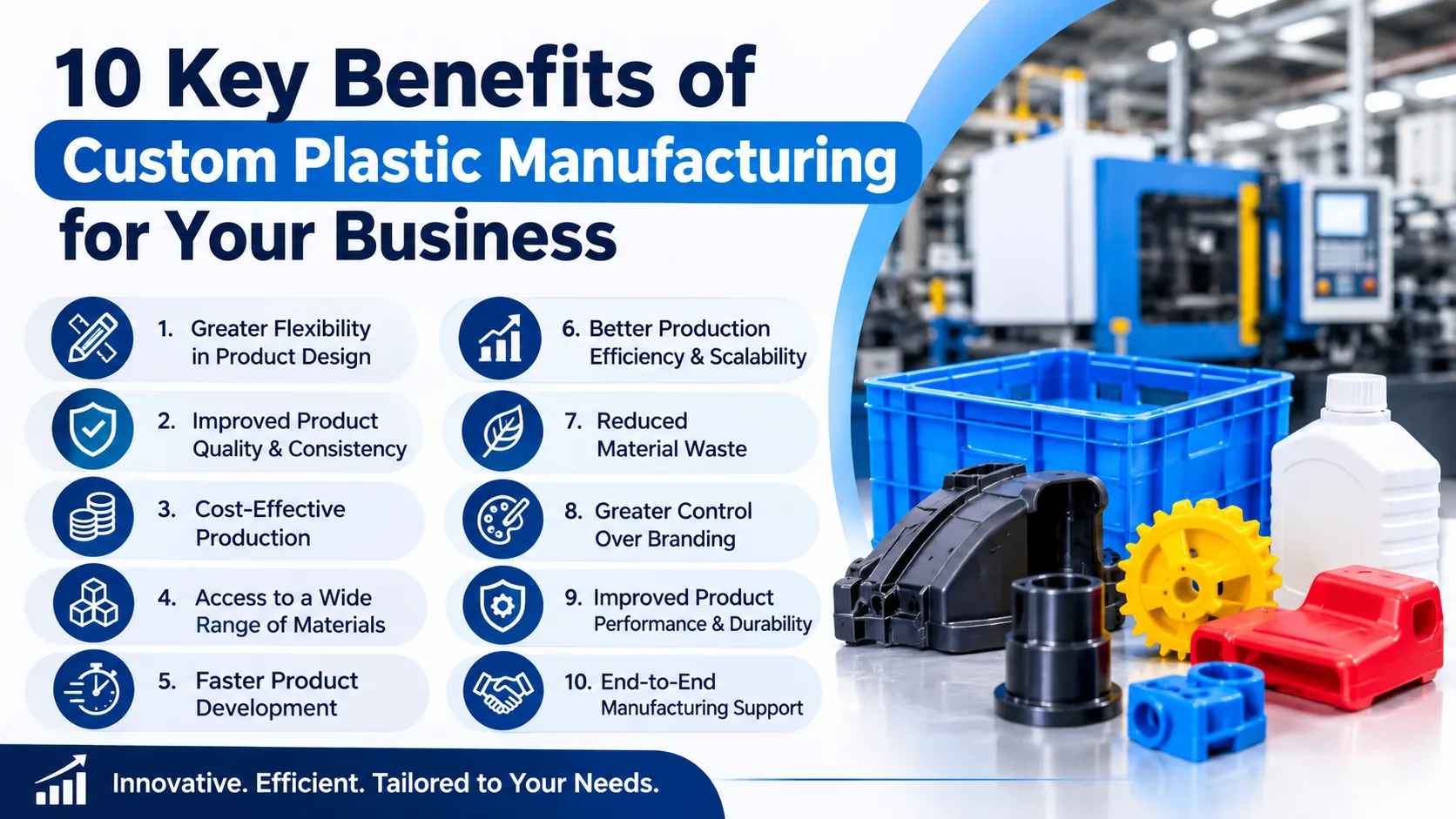
In this article, we explore ten key benefits of custom plastic manufacturing and explain how businesses can use these advantages to achieve their production goals.
1. Greater Flexibility in Product Design
One of the biggest advantages of custom plastic manufacturing is the flexibility it provides during product development. Businesses can create components according to their exact requirements rather than adjusting their designs to fit standard plastic products.
Custom designs allow manufacturers to consider important factors such as product dimensions, shape, wall thickness, surface finish, colour, and functional features. This flexibility is particularly valuable for businesses developing specialised products or components that must fit into existing assemblies.
For example, an automotive manufacturer may require a plastic component with precise dimensions and specific mounting points. A custom-designed solution can accommodate these requirements while supporting the overall performance of the product.
Manufacturers can also incorporate design improvements during development, helping businesses create products that are more practical, visually appealing, and suitable for their intended applications.
2. Improved Product Quality and Consistency
Product quality plays an important role in customer satisfaction and long-term business success. Inconsistent components can lead to assembly problems, product failures, increased waste, and unnecessary production delays.
Custom plastic manufacturing allows businesses to establish specific quality requirements for their products. Manufacturers can work with clients to define material specifications, dimensional tolerances, inspection procedures, and production standards.
Once the design and manufacturing process have been established, production can follow a consistent set of specifications. This helps reduce variations between components and supports reliable product performance.
Quality control can also be incorporated throughout the manufacturing process, from material selection and mould development to production and final inspection.
For businesses producing plastic components in large quantities, maintaining consistency is especially important. Reliable manufacturing processes help ensure that products meet customer expectations across multiple production runs.
3. Cost-Effective Production Over Time
Although developing a custom plastic product may involve initial expenses for design, prototyping, and tooling, it can provide significant cost advantages over time.
Custom manufacturing allows businesses to select materials and production methods that suit their product requirements. This helps avoid unnecessary material usage, excessive processing, and additional components that may increase production costs.
Injection moulding, for example, can be highly efficient for producing large quantities of identical plastic components. Once the mould has been developed and the production process established, manufacturers can produce repeatable components with reduced manual intervention.
Businesses may also benefit from fewer assembly issues, lower material waste, and reduced product rework.
The overall cost-effectiveness of a custom manufacturing project depends on factors such as production volume, component complexity, material selection, and tooling requirements. When these factors are considered carefully, businesses can develop a production strategy that supports long-term financial efficiency.
4. Access to a Wide Range of Materials
Different products require different material properties. Some applications need flexibility, while others require strength, durability, chemical resistance, or heat resistance.
Custom plastic manufacturing gives businesses the opportunity to select materials according to their intended application.
Common options include:
- Polypropylene (PP) for lightweight components and chemical resistance.
- Acrylonitrile Butadiene Styrene (ABS) for applications requiring strength and impact resistance.
- Polyethylene (PE) for products requiring flexibility and moisture resistance.
- Polycarbonate (PC) for applications where impact resistance and transparency are important.
- Nylon (PA) for components requiring strength and wear resistance.
Material selection should consider the operating environment, expected product lifespan, manufacturing method, and applicable industry requirements.
Working with experienced manufacturing professionals can help businesses identify suitable materials and avoid selecting plastics that may not perform effectively under actual operating conditions.
5. Faster Product Development and Prototyping
Getting a product to market efficiently can provide businesses with a competitive advantage. Custom plastic manufacturing supports product development by allowing companies to evaluate designs before committing to full-scale production.
Prototyping provides an opportunity to assess a product's dimensions, appearance, functionality, and compatibility with other components.
Businesses can identify design issues early, make improvements, and validate important product features before investing in production tooling.
Depending on the project, prototypes may be developed using 3D printing, machining, or other suitable manufacturing methods.
This process helps reduce uncertainty during product development and allows businesses to make informed decisions about the final design.
For companies introducing new products, prototyping can also support discussions with stakeholders, engineers, suppliers, and potential customers.
6. Better Production Efficiency and Scalability
As businesses grow, their production requirements often change. A manufacturing process that works for a small initial order may not be suitable when demand increases.
Custom plastic manufacturing allows production processes to be planned around current and future business requirements.
Manufacturers can evaluate production volumes, cycle times, equipment capabilities, and tooling requirements to develop an appropriate manufacturing strategy.
For businesses producing high volumes of plastic components, injection moulding can support efficient repeat production. Automated processes may also help reduce manual handling and improve production consistency.
As demand increases, businesses can assess opportunities to expand production capacity, improve tooling, or introduce additional manufacturing resources.
This flexibility helps companies respond to changing customer demand while maintaining greater control over production planning.
7. Reduced Material Waste
Material waste can increase manufacturing costs and create unnecessary environmental challenges. Custom plastic manufacturing provides opportunities to improve material efficiency through thoughtful product design and production planning.
During the design stage, engineers can evaluate component geometry, wall thickness, and material requirements to avoid unnecessary material usage.
Manufacturing processes can also be reviewed to identify opportunities to reduce rejected components, production defects, and excess material.
For injection moulded products, appropriate mould design and process optimisation can help improve material utilisation and reduce production waste.
Businesses may also consider recyclable materials or suitable recycled-content options where product requirements and applicable standards allow.
Reducing waste requires careful planning and ongoing process evaluation. However, even small improvements in material efficiency can contribute to lower costs and more responsible manufacturing practices over time.
8. Greater Control Over Branding and Product Appearance
A product's appearance can influence how customers perceive a business and its products.
Custom plastic manufacturing allows companies to incorporate specific visual features into their components, helping create a consistent and recognisable brand identity.
Businesses can specify colours, surface finishes, textures, shapes, and other design elements according to their branding requirements.
Depending on the product and manufacturing process, branding features may also be incorporated directly into the moulded component.
This can reduce the need for additional finishing or decoration processes and help maintain consistency across product ranges.
For consumer products, packaging, and promotional items, customised appearance can help businesses differentiate their offerings from competing products.
A carefully designed plastic component can therefore support both functional requirements and the overall customer experience.
9. Improved Product Performance and Durability
Plastic components must often withstand demanding conditions, including repeated use, temperature changes, moisture, impact, and exposure to chemicals.
Custom manufacturing allows businesses to consider these operating conditions during product development.
By selecting suitable materials and refining component designs, manufacturers can develop products that meet specific performance requirements.
For example, a component used in an industrial environment may require greater resistance to chemicals and mechanical stress. A consumer product may instead prioritise lightweight construction, flexibility, or ease of handling.
Design features such as reinforced sections, appropriate wall thickness, and carefully positioned mounting points can also contribute to product performance.
Testing and validation are important to confirm that the finished component meets its intended requirements.
When material selection, product design, and manufacturing processes are properly aligned, businesses can develop plastic components that support reliable performance throughout their expected service life.
10. Access to End-to-End Manufacturing Support
Managing multiple suppliers for product design, prototyping, tooling, manufacturing, and packaging can create additional complexity for businesses.
Working with a manufacturing partner that offers several of these services can simplify the production process.
An integrated manufacturing approach allows businesses to coordinate important stages of product development and production through a more streamlined workflow.
For example, a manufacturing partner may assist with initial design discussions, prototype development, mould creation, injection moulding, quality checks, packaging, and distribution.
This can improve communication between different production stages and help identify potential issues earlier.
Businesses may also benefit from having a central point of contact for project updates, production planning, and technical discussions.
For companies seeking to develop new products or improve existing manufacturing processes, end-to-end support can make project management more straightforward and efficient.
How to Choose the Right Manufacturing Partner
Selecting the right manufacturing partner is an important decision that can influence product quality, production costs, and long-term business performance.
Before starting a project, businesses should evaluate several factors.
First, review the manufacturer's experience with similar products and materials. A supplier with relevant technical knowledge may be better equipped to identify design challenges and recommend appropriate production methods.
Second, understand the manufacturer's capabilities. Consider whether they offer the services required for your project, such as design assistance, prototyping, tooling, injection moulding, quality control, and distribution.
Third, discuss production requirements in detail. Clear communication about specifications, quantities, deadlines, and quality expectations helps establish realistic project goals.
Finally, consider the manufacturer's approach to customer service and ongoing support. A reliable manufacturing relationship should provide opportunities for communication, continuous improvement, and future product development.
The right partner should understand your business objectives and work with you to develop practical manufacturing solutions.
Conclusion: Turn Your Manufacturing Requirements into Business Opportunities
Custom plastic manufacturing offers businesses a practical way to develop specialised products, improve production efficiency, and maintain greater control over quality and design.
From material selection and prototyping to scalable production and integrated manufacturing support, the benefits extend across multiple stages of the product lifecycle.
For businesses planning new products or looking to improve existing production processes, custom Plastic Manufacturing can help turn product requirements into reliable manufacturing solutions.
The key is to work with a manufacturing partner that understands your technical requirements, production goals, and long-term business objectives.
Clear Call to Action
Ready to develop a new plastic product or improve your existing manufacturing process? Partner with SDI Plastics, an experienced plastic moulding company established in 1993. Our team provides end-to-end support across product design, prototyping, toolmaking, injection moulding, packaging, and distribution. Contact SDI Plastics today to discuss your project requirements and discover how our manufacturing expertise can help bring your ideas to life.
Frequently Asked Questions
1. What is custom plastic manufacturing?
Custom plastic manufacturing is the process of designing and producing plastic components according to specific product requirements. It can include product design, prototyping, tooling, material selection, injection moulding, and finishing.
2. Which industries use custom plastic manufacturing?
Industries such as automotive, healthcare, packaging, construction, electronics, agriculture, and consumer goods use custom plastic manufacturing to produce specialised components and products.
3. Is custom plastic manufacturing suitable for small businesses?
Yes. It can be suitable for small businesses developing new products or requiring specialised components. However, tooling costs, production quantities, material requirements, and project complexity should be considered before selecting a manufacturing approach.
4. How long does a custom plastic manufacturing project take?
Project timelines vary depending on design complexity, material selection, tooling requirements, prototyping, and production volume. A simple project may take less time than a complex product requiring specialised moulds and extensive testing.
5. What should I consider before starting a custom plastic manufacturing project?
Consider your product design, intended application, material requirements, production quantity, budget, quality standards, and delivery expectations. Discussing these factors with an experienced manufacturing partner can help establish a suitable production plan.